Engineers' Day 2025: Celebrating India’s First Women Engineers and Their Legacy
Synopsis
On Engineers Day 2025, learn about India's first three women engineers who graduated in the same year, paving the way for women in the field. Discover their stories, the college they attended, and the branches they chose.
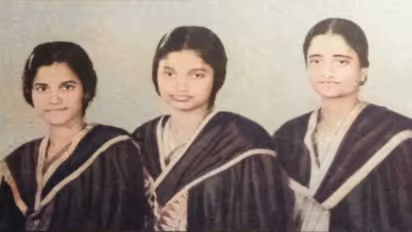
Engineers' Day 2025: Back in the early 1900s, opportunities for girls to pursue higher education were extremely limited. College seemed like an unreachable dream, and societal expectations pushed many into early marriages instead. Against this backdrop, the thought of women entering a tough, male-dominated field like engineering was almost unheard of. Yet, three pioneering women—A Lalitha, PK Thresia, and Leelamma George—defied the odds. In 1940, they became the first women admitted to an engineering college in India, graduating in 1944 and forever changing the course of history.
Where did India's first women engineers study? How did they get the opportunity?
The story begins at Guindy College of Engineering in Chennai (then Madras), Asia's oldest technical institute. The principal, Dr. KC Chacko, and the electrical engineering professor, A Subbarao (Lalitha's father), played key roles in securing their admission. Lalitha was admitted first in 1940, followed by Thresia and Leelamma a few months later.
Which engineering branches did India's first women engineers choose?
At the time, there were only three branches: civil, mechanical, and electrical. The course was four years long, but due to World War II, it was shortened to three and a half years. Thresia and Leelamma chose civil engineering, while Lalitha opted for electrical engineering. Since the college lacked a women's hostel, Thresia and Leelamma had to commute daily, while Lalitha lived on campus with her father, making her studies somewhat easier. In 1944, all three graduated. Interestingly, the Vice-Chancellor had to manually strike out 'He' and write 'She' on their degree certificates.
PK Thresia: Cochin's first woman engineer
PK Thresia came from an affluent family in Cochin State. After graduating, she joined the Public Works Department (PWD) and led several major projects, including the construction of Thrissur Medical College and several important bridges and roads. After the formation of Kerala State in 1956, Thresia received promotions, reaching the position of Chief Engineer in 1971—a significant achievement for a woman at that time. Thresia remained unmarried, dedicating her life to her profession. She passed away in 1980, but her work lives on.
Leelamma George: Town planning expert
Leelamma George was born in Trivandrum. She initially attempted to study medicine but abandoned the course after being frightened by dissection. Her father persevered and secured her admission to engineering. After graduating, Leelamma started working in the Travancore PWD. Later, she pursued higher education in England, specializing in town planning. Upon returning, she worked on numerous projects, including the planning of modern settlements like Jawahar Nagar Colony in Thiruvananthapuram. However, due to cadre integration, she lost her seniority and retired as Deputy Chief Engineer. She passed away in 1988.
Also read: Top 50 Engineering Colleges in India for 2025: Your Guide to a Bright Future
A Lalitha: India's first woman engineer
Lalitha's story is also inspiring. After an early marriage and the subsequent death of her husband, her father gave her the opportunity to study engineering. Lalitha earned a degree in electrical engineering. She then worked as an apprentice at the Jamalpur Railway Workshop in Bihar and later as an engineering assistant at the Central Standard Organisation of India in Shimla. She also passed the graduate exam from the Institution of Engineers in London. A Lalitha worked on several major projects, most notably the Bhakra Nangal Dam generator project, which brought her national recognition. In 1964, she represented India at the first International Conference of Women Engineers and Scientists. Lalitha is still remembered as India's first woman engineer.
PK Thresia, Leelamma George, and A Lalitha—these three women transformed societal perceptions by pursuing engineering in that era. Today, millions of girls study engineering, but it was these pioneers who paved the way.
Stay updated with the Breaking News Today and Latest News from across India and around the world. Get real-time updates, in-depth analysis, and comprehensive coverage of India News, World News, Indian Defence News, Kerala News, and Karnataka News. From politics to current affairs, follow every major story as it unfolds. IMD cities weather forecastsRain Cyclone Asianet News Official App