DRDO, IAF successfully test RudraM-II missile from Su-30 MKI fighter
Synopsis
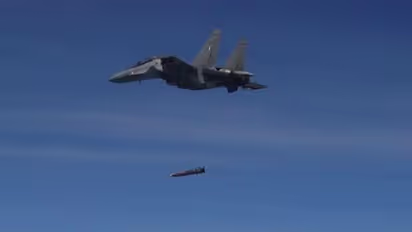
DRDO and the IAF successfully flight-tested the indigenous RudraM-II air-to-surface missile from a Su-30 MKI jet. The missile, launched under extreme conditions, successfully struck its predefined target with pinpoint accuracy.
Successful RudraM-II Flight Test
The Defence Research and Development Organisation (DRDO) and the Indian Air Force (IAF) on Tuesday successfully conducted flight tests of the RudraM-II air-to-surface missile from an SU-30 MKI fighter jet. The tests were carried out under extreme release conditions and along a critical trajectory, demonstrating the capability of all the Anti-Radiation Missile's subsystems. According to the Ministry of Defence, the missile successfully guided itself to a predefined target after launch and struck it with pinpoint accuracy. All trial objectives were achieved, as confirmed by flight data collected through various range instruments deployed by the Integrated Test Range (ITR) at Chandipur, Odisha.
About the RudraM-II Missile
RudraM-II is an indigenously developed, solid-propellant air-launched missile designed for air-to-surface missions. The weapon is intended to neutralise a wide range of enemy assets and incorporates several advanced indigenous technologies developed by various DRDO laboratories. The missile has been developed by Research Centre Imarat (RCI), Hyderabad, the nodal DRDO laboratory for the project, in collaboration with other DRDO facilities including the Defence Research and Development Laboratory (DRDL), High Energy Materials Research Laboratory (HEMRL), Armament Research and Development Establishment (ARDE), and ITR. Several Development-cum-Production Partners (DcPPs), along with agencies such as Hindustan Aeronautics Limited (HAL), the Regional Centre for Military Airworthiness (RCMA), the Missile System Quality Assurance Agency (MSQAA), and other industry partners, also contributed to the programme.
A Milestone for 'Aatmanirbharta'
Defence Minister Rajnath Singh lauded the efforts of DRDO, the IAF, defence public sector undertakings, industry partners and other stakeholders involved in the project, the MoD statement added. He stated that the tests have demonstrated the growing maturity of indigenous defence technologies, contributing significantly to Aatmanirbharta in advanced weapon systems. Secretary, Department of Defence R&D and Chairman DRDO also congratulated all teams associated with the programme for the successful achievement.
Previous Missile Trials
The latest tests mark another milestone in India's efforts to strengthen its indigenous missile capabilities.
May 2024 RudraM-II Test
In May 2024, DRDO had successfully flight-tested the RudraM-II missile from a Sukhoi Su-30MKI fighter aircraft off the coast of Odisha. The trial met all objectives and validated the missile's propulsion system as well as its control and guidance algorithms. The missile's performance during the 2024 trial was assessed through data collected by electro-optical systems, radar and telemetry stations deployed by ITR Chandipur at multiple locations, including an onboard ship.
RudraM-I (NGARM) Test
Earlier, on May 2, 2024, DRDO had successfully flight-tested India's first indigenously developed New Generation Anti-Radiation Missile (NGARM), also known as RudraM-I, at the Chandan Range in Rajasthan. The missile achieved its intended range and struck the target with a miss distance of just five metres. The test successfully demonstrated the operation of the missile's warhead during the terminal phase of flight. Launched from a Sukhoi-30MKI aircraft of the IAF, the missile accurately navigated towards its target before the warhead detonated and destroyed it. The trial validated several key technologies, including safe weapon separation from the aircraft, the dual-pulse solid propulsion system, guidance and control algorithms, electro-mechanical actuation systems, the end-game processor based on laser altimeter measurements, and the safe-arm mechanism used for warhead detonation. RudraM-I has been designed primarily for Suppression of Enemy Air Defences (SEAD) missions. Developed by DRDL, Hyderabad, as the nodal laboratory, the project received support from several DRDO laboratories including RCI, Advanced Systems Laboratory (ASL), Defence Electronics Research Laboratory (DLRL), ARDE, HEMRL, Instruments Research and Development Establishment (IRDE), ITR, and Terminal Ballistics Research Laboratory (TBRL), along with multiple industry partners. (ANI)
Stay updated with the Breaking News Today and Latest News from across India and around the world. Get real-time updates, in-depth analysis, and comprehensive coverage of India News, World News, Indian Defence News, Kerala News, and Karnataka News. From politics to current affairs, follow every major story as it unfolds. IMD cities weather forecastsRain Cyclone Asianet News Official App