Dharmendra Pradhan witnesses Snana Yatra at Puri's Jagannath Temple
Synopsis
Union Education Minister Dharmendra Pradhan offered prayers at Puri's Jagannath Temple during the 'Snana Yatra'. The festival involves the ceremonial bathing of the deities with 108 pots of water before the annual Rath Yatra.
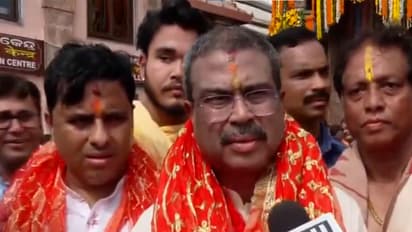
Union Education Minister Dharmendra Pradhan on Monday offered prayers at the Jagannath Temple in Puri and witnessed the sacred 'Snana Yatra' of Lord Jagannath, Lord Balabhadra and Devi Subhadra on the occasion of Deva Snana Purnima, one of the major rituals preceding the annual Rath Yatra.
Speaking after offering prayers, Pradhan expressed gratitude for getting an opportunity to have darshan of Lord Jagannath and seek his blessings. "I feel extremely fortunate to have had the opportunity to get a darshan of Mahaprabhu on the auspicious occasion of Snana Purnima. I am deeply grateful. In these times of global crisis, may the blessings of Mahaprabhu Jagannath remain upon human civilization, upon our India, and upon our state of Odisha; only then can prosperity and happiness come into all our lives. The Lord's blessings should serve as the guiding light for our lives," Pradhan told ANI.
The Sacred Snana Yatra Ritual
Deva Snana Purnima marks the ceremonial bathing of the sibling deities with 108 pots of sanctified water. Following the ritual, the deities are believed to fall ill and remain out of public view during the 'Anasara' period before reappearing for the annual Rath Yatra.
Thousands of worshippers gathered to witness the sacred bathing ceremony of Lord Jagannath, Balabhadra, and Subhadra, marking a centuries-old tradition.
The festival marks the ceremonial bathing of Lord Jagannath, Lord Balabhadra, and Goddess Subhadra in 108 pots of water in a sacred ritual. Devotees from across the country travelled to be part of the event.
Snana Yatra is celebrated on the full moon day of the Hindu month of Jyeshtha, which usually falls in June. This festival holds immense religious significance, as it is believed to be the birthday of Lord Jagannath.
The deities are taken out in a grand procession from the sanctum sanctorum of the Jagannath Temple to the Snana Mandap, an elevated platform where the bathing ritual takes place.
Lord Jagannath, along with his siblings Balabhadra and Subhadra, are brought out from the sanctum sanctorum to the Snana Mandap, a special bathing platform.
On this day, the deities undergo a ceremonial bath with 108 pitchers of sacred water.
After the bath, the deities are adorned in Gajanan Besa, which means they are dressed to resemble Ganesha, the elephant-headed deity. This unique attire, also known as Hati Besa, has deep symbolic meaning.
On this day, the deities undergo a grand ritual bathing with 108 pitchers of sacred water, a practice believed to purify and honour them. This is one of the rare occasions when the deities are publicly visible, giving devotees a close view before the famous Rath Yatra.
'Anasara': The Period of Seclusion
Following this bath, it is believed that the deities become unwell and are moved into a period of seclusion known as "Anavasara," where they are kept away from public view for about 15 days. This period is considered a time of recuperation, as the deities are believed to suffer from fever due to the extensive bathing ritual.
During Anavasara, the deities are offered special medicinal preparations known as 'Phuluri Tela' to aid in their recovery. (ANI)
(Except for the headline, this story has not been edited by Asianet Newsable English staff and is published from a syndicated feed.)
Stay updated with the Breaking News Today and Latest News from across India and around the world. Get real-time updates, in-depth analysis, and comprehensive coverage of India News, World News, Indian Defence News, Kerala News, and Karnataka News. From politics to current affairs, follow every major story as it unfolds. IMD cities weather forecastsRain Cyclone Asianet News Official App