Who is Amir Rashid Ali Arrested for Helping Delhi Bomber Dr Umar Un Nabi in Red Fort Blast
Synopsis
Security agencies probing the Red Fort blast have found three bullet cartridges near the explosion site, raising new questions. Investigators are recreating full route of accused Umar Nabi and examining suspected hawala trail of nearly Rs 20 lakh.
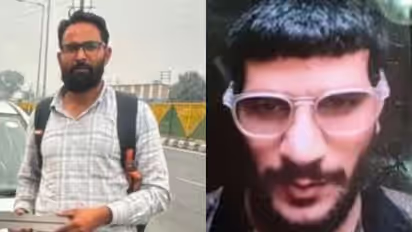
The investigation into the Red Fort car blast has taken a major turn with the arrest of a Kashmiri man accused of helping Dr Umar Un Nabi carry out the deadly attack. The National Investigation Agency (NIA) has arrested Amir Rashid Ali, a resident of Samboora in Pampore, from Delhi. According to officials, the car that exploded near the Red Fort was registered in Amir's name and he had travelled to Delhi to help Umar arrange the vehicle. Investigators believe this car was later turned into a vehicle-borne improvised explosive device (VBIED).
Who is Amir Rashid Ali
The National Investigation Agency released a statement saying it has made a major breakthrough in the probe into the Red Fort area car bomb blast. The agency arrested Kashmir's Amir Rashid Ali who is accused of conspiring with the suicide bomber to carry out the attack that killed 10 people and injured 32.
Amir Rashid Ali is a resident of Samboora, Pampore in Jammu and Kashmir. He was arrested in Delhi, the NIA said. Investigators found that the car used in the attack had been registered in Amir's name.
Officials say Amir had come to Delhi to help the alleged suicide bomber Umar Un Nabi secure the vehicle that was later turned into a vehicle-borne improvised explosive device (VBIED). NIA investigators have forensically established the identity of the deceased driver of the VBIED as Umar Un Nabi. Umar was a resident of Pulwama district and served as an assistant professor in the Department of General Medicine at Al-Falah University in Faridabad, the agency said.
Amir's arrest follows a large search operation launched by the NIA after it took over the case from Delhi Police.
Another vehicle seized and examined
The NIA has also seized another vehicle belonging to Umar Nabi. This second vehicle is now being examined for evidence as part of the wider probe. The agency has so far examined 73 witnesses, including several people who were injured in the blast. These witness statements are being used to build the timeline and identify others who may have helped plan or carry out the attack.
Co-ordination with multiple police forces and agencies
The NIA is working closely with Delhi Police, Jammu & Kashmir Police, Haryana Police, Uttar Pradesh Police, and various central sister agencies. The agency said it is continuing its investigation across states and following multiple leads to uncover the larger conspiracy behind the bombing. The agency has registered the matter as case RC-21/2025/NIA/DLI. Investigators said the enquiry will continue and more arrests are possible as they trace the conspiracy and identify others involved.
The agency gave no further personal details about the arrested man in its statement. It said forensic work, witness statements and searches remain key parts of the ongoing investigation.
New clues emerge from Red Fort blast site
Security agencies investigating the November 10 blast near Delhi's Red Fort have found new clues that may help explain how the deadly explosion was carried out. Thirteen people were killed and more than two dozen were injured when a Hyundai i20 car suddenly exploded near the historic monument.
Now, during careful examination of the debris, investigators have found three bullet cartridges, including two live rounds and one empty shell, close to the burnt car. A source involved in the probe said these bullets were not of a type normally allowed for civilian use, which has raised new questions about how they reached the spot.
Bullets of restricted calibre found near blast car
According to the source, the bullets are 9mm rounds, which are usually given only to specialised security units or to people who have special permission.
"The staff deployed in the area were told to check their own issued ammunition. None of them were missing any bullets," the source said. "The cartridges were there, but there was no weapon found that could fire them. We are trying to understand how these bullets reached the spot and whether they are linked to the blast."
These findings have added another mystery for investigators, who are still working to understand whether the bullets were brought by the accused, were dropped by someone else, or were unrelated but coincidentally present at the site.
Investigators to re-create entire route of accused Umar Nabi
Security agencies are also preparing a full reconstruction of the movements of the accused, Umar Nabi, who is believed to have driven the car that exploded.
Officials will trace his route from the time he left Faridabad, then visited Nuh in Haryana, and later had tea in Delhi, before the sequence of events that led to the explosion.
To do this, teams are collecting call records, mobile tower locations, and CCTV footage from more than 50 cameras placed along his route.
“The reconstruction will cover every check-post crossed, every parking entry, and every stop he made,” a source said. “We want to see if anyone met him, followed him, or helped him at any point. Even the smallest detail could help us understand what happened in the hours before the blast.”
Possible hawala funding under scrutiny
The investigation is not limited to explosives and route tracing. Security agencies are now looking into a suspected hawala money trail, which may have been used to send funds to the accused and the two arrested doctors, Muzammil and Shaheen.
Initial checks have found transactions worth nearly Rs 20 lakh, which are suspected to have come from foreign-based handlers. Investigators believe the money may have been used to buy chemicals and other material needed for making the bomb.
So far, around ₹3 lakh appears to have been spent on fertiliser purchases, and officers are checking records to match these payments with the items recovered from the blast site.
Blast may have used highly unstable TATP
Experts believe that the bomb may have been made using Triacetone Triperoxide (TATP), a dangerous explosive also known as “Mother of Satan” because it is extremely unstable and can explode due to even slight heat, friction, or pressure.
TATP has been used in several major terror attacks worldwide, and its presence signals careful planning and specialised handling.
Along with TATP, investigators also found traces of ammonium nitrate, which can significantly increase the strength of an explosive. All chemicals used in the blast are now being examined by experts to understand how the device was made and whether more people were involved.
Focus on Al-Falah University grows stronger
A major part of the investigation is now centred around Al-Falah University in Faridabad, Haryana. Several people linked to the university were in touch with the accused or the arrested doctors.
Security teams have been visiting the university daily to check attendance logs, staff records, and entry-exit details of people who may have met Umar, Muzammil, or Shaheen.
A female doctor associated with the institution has already been detained for questioning. Officials said that some people who were known to meet the accused have not been present on campus since the blast, which has increased suspicion.
Full scan of vehicles parked near Umar’s car
Investigators are also studying the parking area near Sunehri Masjid, where Umar's car had been parked before it exploded. A detailed log has been prepared of every vehicle that entered the parking space in the three hours before the blast. The log includes:
- Registration numbers
- Entry and exit timings
- Driver details
- Vehicle ownership records
All drivers and owners are being questioned to check whether they saw Umar, met him, or noticed anyone else near his car.
“Umar’s photograph is being shown to all of them,” the source said. “Even a small detail, like someone walking around the car, could help us understand whether another person planted or adjusted the explosive.”
A bomb detection team is still deployed at the parking lot as a precaution.
New FIRs filed against Al-Falah University
Meanwhile, Delhi Police have filed two new FIRs against Al-Falah University after red flags were raised by the University Grants Commission (UGC) and the National Assessment and Accreditation Council (NAAC).
These FIRs relate to alleged cheating and forgery in accreditation claims made by the university. Earlier, another FIR relating to criminal conspiracy had already been lodged to examine the wider network connected to the blast.
Raids continue across three states
Security agencies are carrying out raids in Delhi, Haryana, and Uttar Pradesh to gather more information about:
- Chemical purchases
- Financial transactions
- Hideouts
- People who may have assisted the accused
- Movement of suspects in the days before the blast
Officials say that the investigation is expanding every day as new clues emerge.
(With inputs from agencies)
Stay updated with the Breaking News Today and Latest News from across India and around the world. Get real-time updates, in-depth analysis, and comprehensive coverage of India News, World News, Indian Defence News, Kerala News, and Karnataka News. From politics to current affairs, follow every major story as it unfolds. IMD cities weather forecastsRain Cyclone Asianet News Official App