Delhi HC rejects Naresh Balyan's bail plea, notes syndicate nexus
Synopsis
Delhi High Court denied bail to ex-AAP MLA Naresh Balyan in a MCOCA case, citing a 'discernible nexus' with gangster Kapil Sangwan's crime syndicate. The court found prima facie evidence of 'continuing unlawful activity' for pecuniary gain.
HC Denies Bail, Cites Syndicate Nexus
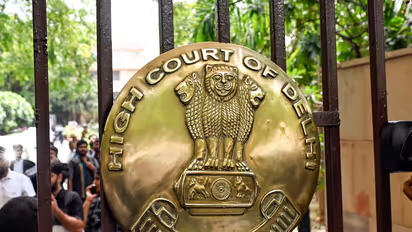
The Delhi High Court on Monday refused to grant bail to former Aam Aadmi Party (AAP) MLA Naresh Balyan in a case under the Maharashtra Control of Organised Crime Act (MCOCA), observing that the material collected during the investigation prima facie disclosed a "discernible nexus" between him and the organised crime syndicate allegedly headed by absconding gangster Kapil Sangwan alias Nandu, and that the invocation of MCOCA could not be termed unjustified.
Justice Manoj Jain held that a broad assessment of the evidence collected by the investigating agency indicated the presence of "continuing unlawful activity" carried out through threats and intimidation for pecuniary gain. The Court observed that, at the stage of deciding bail, it was not required to conduct a detailed examination of the evidence but only ascertain whether the statutory requirements for invoking MCOCA were prima facie satisfied.
Court's Rationale for MCOCA Application
The Court said that the stringent conditions under Section 21(4) of MCOCA applied and noted that a person accused under the Act can be released on bail only if the Court is satisfied that there are reasonable grounds to believe that he is not guilty and is not likely to commit any offence while on bail. It held that those conditions were not met in Balyan's case.
Rejecting Balyan's argument that MCOCA had been wrongly invoked because there was no fresh unlawful activity attributable to him, the High Court held that the requirement of multiple charge sheets under the Act is "syndicate-centric" and not "individual-centric." It observed that the previous charge sheets need not necessarily be against the individual accused but should relate to the continuing unlawful activities of the organised crime syndicate. The Court added that even a person acting as a facilitator or abettor of the syndicate could attract the provisions of MCOCA.
The High Court also rejected the contention that registration of a separate MCOCA FIR amounted to double jeopardy. It observed that the investigating agency is legally entitled either to invoke MCOCA in an existing FIR or register a fresh FIR after obtaining the necessary approval, and merely choosing the latter course does not violate the constitutional protection against double jeopardy.
Evidence and Witness Statements
Referring to the investigation, the Court noted that the prosecution relied on confessional statements of co-accused, statements of protected witnesses, the alleged audio conversation between Balyan and Kapil Sangwan, forensic analysis of voice samples, technical evidence including internet protocol records, and allegations relating to facilitating extortion and property disputes. At the bail stage, the Court said such material could not be discarded outright and would have to be tested during trial.
The Court further observed that although Balyan had earlier complained to the police alleging threats from Kapil Sangwan and had even received security protection, those complaints by themselves did not negate the incriminating material collected during the investigation. It said whether those complaints were genuine, a tactical exercise, or whether the relationship between the two had subsequently changed were matters that could only be examined during trial.
Speedy Trial Argument Rejected
On Balyan's plea that his prolonged incarceration and delay in framing charges violated his right to a speedy trial, the High Court acknowledged the importance of Article 21 but held that in cases involving organised crime under MCOCA, long custody alone could not become the decisive ground for grant of bail. The Court noted that the investigation was extensive, the alleged syndicate head remained absconding, and the trial court was already hearing arguments on the charge. It expressed hope that the trial court would proceed expeditiously.
Case Background and Final Order
Finding no illegality in the trial court's order refusing bail, the High Court dismissed Balyan's appeal and declined to interfere. It clarified that all observations made in the judgment were tentative and would not influence the trial court during the stage of framing of charges or the trial.
Balyan was arrested by the Delhi Police Crime Branch on December 4, 2024, in the MCOCA case. The prosecution alleges that he was associated with the organised crime syndicate allegedly run by Kapil Sangwan and facilitated extortion and illegal property transactions. He had challenged the trial court's order dated May 27, 2025, refusing him bail. (ANI)
(Except for the headline, this story has not been edited by Asianet Newsable English staff and is published from a syndicated feed.)
Stay updated with the Breaking News Today and Latest News from across India and around the world. Get real-time updates, in-depth analysis, and comprehensive coverage of India News, World News, Indian Defence News, Kerala News, and Karnataka News. From politics to current affairs, follow every major story as it unfolds. IMD cities weather forecastsRain Cyclone Asianet News Official App