Delhi HC: 'First come, first served' not sole basis for ground allotting
Synopsis
Delhi HC rules that the “first come, first served” policy is not the sole basis for allotting public grounds for events like Ramleela. It directs DUSIB to create new, transparent guidelines to ensure fairness and prevent unequal opportunities.
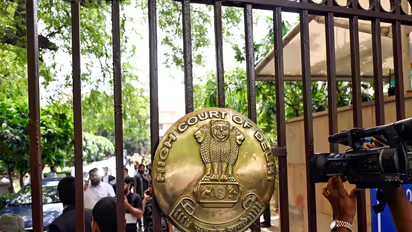
The Delhi High Court has held that a “first come, first served” policy cannot be the sole basis for allotting public grounds for Ramleela and other cultural or religious events, observing that the approach may create unequal opportunities for applicants and does not automatically meet the requirements of constitutional fairness.
Court's Rationale and Observations
Justice Amit Mahajan observed that the earliest applicant does not necessarily have the strongest claim to a public facility and directed the Delhi Urban Shelter Improvement Board (DUSIB) to review its existing instructions and frame comprehensive annual guidelines for allotment of grounds.
“The determinacy of a criterion and its inherent rationality are two distinct questions,” the court observed, noting that a policy cannot be justified merely because the date and time of receipt of applications can be objectively established.
The court said the first-come-first-served approach could create an “unequal race for information”, favouring applicants with privileged access to administrative information about the availability of public grounds.
New Transparent Allotment Process Mandated
The observations came while hearing a petition filed by Rays of New Beginning Foundation, which challenged the rejection of its application for allotment of Chunk-C Ground at Shivaji Place in Raja Garden, West Delhi, for its annual Ramleela Dussehra Mahotsav. While the court declined to cancel the existing allotment or transfer the ground to the petitioner for the 2026 festivities, it directed the authorities to introduce a transparent and structured process for future allotments.
Under the directions, an annual site-allocation notice identifying available grounds, booking dates, eligibility requirements, evaluation criteria, applicable charges and the procedure for filing objections must be published at least 90 days before the first scheduled event. Applications for the same site and booking period should ordinarily be invited within a common, predetermined window.
Where multiple eligible applicants seek the same ground, their claims must be assessed through a predetermined and published scoring matrix or other transparent criteria. The guidelines must also provide for a grievance-redressal mechanism and ensure that allotments and ordinary grievance proceedings are completed sufficiently before the events begin.
Checks Against De Facto Monopoly
The court cautioned against creating a de facto monopoly by repeatedly allotting the same ground to organisations that had organised festivities there in previous years. It observed that continuity and experience could be relevant considerations, but should not determine the outcome irrespective of competing claims.
An organisation with a satisfactory compliance record may receive limited preference, the court said, but such preference cannot create an automatic right to allotment.
Where other eligible applicants compete for the same site, preference to a previous organiser should not extend beyond two consecutive years, and the competing claims must be assessed on merit.
The court further said the authorities could require applicants to submit detailed operational plans covering crowd capacity, entry and exit arrangements, emergency response, fire and electrical safety, sanitation, traffic and parking management, accessibility, waste removal and restoration of the ground.
Background of the Petition
The foundation had organised its Ramleela Dussehra Mahotsav at the ground in 2023 and 2024 after obtaining allotment from the authorities. It applied on May 26, 2026, seeking permission to use the site from September 25 to November 8. After its representations went unanswered, the foundation approached the High Court.
On September 22, the court directed the authorities to take a decision on its application. The application was rejected on September 28, with the authorities citing the High Level Coordination Committee guidelines and stating that allotments were made on a first-come-first-served basis. They said another applicant had applied on April 10, earlier than the foundation's application, which was received on May 27.
The foundation argued that the Delhi Development Authority's standard operating procedure, issued on September 1, provided preference to societies that had organised festivities at the same site in preceding years, subject to proof of booking for two years out of the previous three. It contended that the authorities had departed from the prescribed procedure by relying on the first-come-first-served principle.
The High Court noted that no public notice had specified the application window or informed applicants that allotment would be determined on a first-come-first-served basis. It also flagged the lack of clarity arising from applications received in April and May, months before the DDA issued its standard operating procedure in September.
The court said the relationship between the earlier applications, the applicable committee guidelines and the subsequently notified procedure required an objective explanation. Observing that uncertainty over when the booking process opens could give some applicants an advantage even without actual favouritism, the court warned that a race to apply early could also encourage organisations to submit applications months before an event without preparing complete proposals addressing crowd management, emergency arrangements and safety requirements.
Ruling to Operate Prospectively
The court clarified that its directions to revise the allotment policy would operate prospectively. They would neither retrospectively alter the rules applicable to the 2026 season nor predetermine the rights of applicants under the existing policy. (ANI)
(Except for the headline, this story has not been edited by Asianet Newsable English staff and is published from a syndicated feed.)Stay updated with the Breaking News Today and Latest News from across India and around the world. Get real-time updates, in-depth analysis, and comprehensive coverage of India News, World News, Indian Defence News, Kerala News, and Karnataka News. From politics to current affairs, follow every major story as it unfolds. IMD cities weather forecastsRain Cyclone Asianet News Official App