Delhi doctors save Uzbek baby with rare disorder via liver transplant
Synopsis
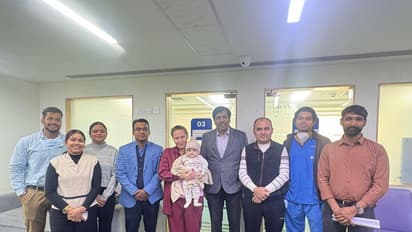
A one-year-old Uzbek baby with a rare genetic liver disorder, Alagille Syndrome, was saved by a living donor liver transplant in Delhi. The child's father was the donor, providing a life-saving intervention after a previous misdiagnosis.
A Life-Saving Intervention
Doctors at a private hospital in Delhi have successfully treated a one-year-old baby boy from Uzbekistan suffering from a rare genetic liver disorder (Alagille Syndrome) by performing a living donor liver transplant, with the child's father donating a part of his liver. The timely intervention helped save the baby's life after months of worsening illness.
According to the hospital, the baby had developed jaundice soon after birth and required neonatal intensive care. At two months of age, he was misdiagnosed with biliary atresia, a condition that blocks the normal flow of bile from the liver, and underwent a Kasai procedure- a surgery performed in infancy to help restore bile flow from the liver.
Initial Misdiagnosis and Deterioration
However, over the following months, his condition continued to worsen. He suffered from persistent jaundice, severe itching, poor weight gain, delayed growth, and pale stools, all indicating progressive liver failure.
Correct Diagnosis and Urgent Transplant
The family sought specialised liver care in India after the child's condition started deteriorating. At Max Super Speciality Hospital, Patparganj, doctors undertook a detailed assessment of the child and detected a serious heart ailment, suggesting that the illness was not limited to the liver alone. Detailed investigations confirmed Alagille syndrome, a rare inherited condition that can affect multiple organs, including the liver and heart.
Further assessment revealed an associated heart condition, significantly increasing the risks involved in major surgery. Given the child's deteriorating liver function and added cardiac risk, the case was reviewed by a multidisciplinary team of doctors. It was identified that a liver transplant was the only viable option and that it needed to be performed urgently.
According to the Max Super Speciality Hospital, with no time to lose, the child's father stepped forward to donate a portion of his own liver. After extensive evaluation to ensure the safety of both donor and child, the living donor liver transplant was successfully performed by a specialised liver transplant team led by Dr. Ajitabh Srivastava, Director - HPB Surgery and Liver Transplant, Max Super Speciality Hospital, Patparganj.
Expert Insight on the Case
Commenting on the case, Dr. Ajitabh Srivastava said, "Infants with prolonged jaundice are commonly evaluated for biliary atresia, for which the Kasai procedure is an early surgical treatment aimed at restoring bile flow and delaying the need for liver transplantation. However, rare genetic conditions such as Alagille syndrome can closely mimic biliary atresia in early infancy. In such cases, the Kasai procedure may not provide lasting benefit because the underlying problem is genetic rather than structural, and, in fact, the wrong procedure (Kasai) worsens the child's condition. As the liver disease progressed despite early surgery, a timely living donor liver transplant became the only life-saving option".
A Path to Recovery
The hospital said, "The child is on a steady path to recovery- a reminder that early diagnosis, coordinated medical care, and a parent's decision at a critical moment can together change the outcome of even the most challenging childhood illnesses". (ANI)
Stay updated with the Breaking News Today and Latest News from across India and around the world. Get real-time updates, in-depth analysis, and comprehensive coverage of India News, World News, Indian Defence News, Kerala News, and Karnataka News. From politics to current affairs, follow every major story as it unfolds. IMD cities weather forecastsRain Cyclone Asianet News Official App