CM Dhami outlines roadmap for 'Viksit Bharat' at Chintan Shivir
Synopsis
Uttarakhand CM Pushkar Singh Dhami addressed the 'Chintan Shivir' on Vision 2047, calling for a concrete, time-bound roadmap for a 'Viksit Bharat'. He urged officers to work as 'Team Uttarakhand' for people-centric, sustainable development.
Forging a Roadmap for 'Viksit Bharat 2047'
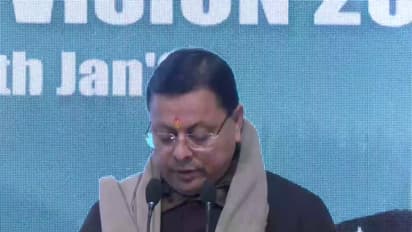
Uttarakhand Chief Minister Pushkar Singh Dhami on Friday addressed senior administrative officers of the State at the Chintan Shivir and "Dialogue on Vision 2047" held at the Civil Services Institute Addressing the two-day conclave, CM Dhami said that in line with Prime Minister Narendra Modi's resolve, a concrete, practical and time-bound strategy would be prepared through this exercise to make India a developed nation by 2047.
He said in-depth deliberations would be held on all major sectors related to the overall development of Uttarakhand, so that a clear, practical and time-bound roadmap for the state's future could be defined.
The Chief Minister said the resolve to make India a fully developed nation by 2047 can be realised only when every state in the country develops at an equal pace. For this, Uttarakhand must chart a clear and long-term development path in accordance with its resources, capabilities and unique strengths.
The Crucial Role of Proactive Administration
He said the Prime Minister's vision of "Viksit Bharat" is not limited to a single government, a single tenure or a single scheme, but represents a broad and long-term national vision to establish India as an economically, socially, technologically, strategically and culturally strong, self-reliant and globally leading nation. He added that the most important feature of this vision is that development is not confined to numbers alone, but is human-centric, inclusive and sustainable. A developed India, he said, means an India where every citizen gets equal opportunities and governance is transparent, sensitive and people-centric.
Chief Minister Dhami said that from policy formulation to implementation and final success, the effectiveness of administration depends on its proactiveness, sensitivity and efficiency. Therefore, the role of the administrative machinery is extremely crucial in realising this vision.
He said the administration must work not only with speed and transparency, but also implement every policy, decision and scheme with a goal-oriented and people-centric approach. He urged officers to go beyond issuing orders or holding meetings, and to complete every responsibility within their domain with innovation, transparency, timeliness and a result-oriented approach, along with accountability.
Focus on Citizen-Centric Outcomes
The Chief Minister said that today the state is preparing a roadmap to realise the vision of "Developed India through Developed Uttarakhand". This, he said, should not remain limited to drafting policies or setting targets alone, but must focus on the actual impact of these policies on the lives of common citizens. He stressed the need to focus on benchmarks such as increasing farmers' income, generating employment for youth and ensuring equal opportunities for women, adding that the achievement of these goals will be the true test of a developed Uttarakhand and a developed India.
Uttarakhand's Unique Path: Balancing Ecology and Economy
Highlighting the challenges and opportunities of being a hill state, the Chief Minister said that if policies and schemes are aligned with the state's geographical conditions, local needs and future requirements, Uttarakhand can strike a balance between economy and ecology and provide a new direction to development in the country.
He said it must be clearly defined where the state should stand by 2047 in sectors such as education, health, industry, tourism, agriculture, energy, technology and good governance. He also stressed the need for inter-departmental coordination and preparation of a clear action plan for the next 25 years, rising above departmental boundaries. He urged officers to move beyond a "solo player" mindset and work collectively as "Team Uttarakhand". He also asked officers to pay special attention to the development of the areas where they began their service, and to note public grievances raised during the "Jan Jan Ki Sarkar, Jan Jan Ke Dwar" programme and ensure their timely resolution.
The Three Pillars of a Developed State
In his address, the Chief Minister said that the foundation of a developed Uttarakhand rests on three pillars--good governance, technology and innovation, and people-centric, sustainable and balanced development.
Good Governance, Technology, and Innovation
He explained that good governance is not merely about following rules and procedures, but about ensuring timely decisions, transparent schemes and accountability at every level. He stressed the use of modern technologies such as e-governance, artificial intelligence and data analytics to make governance more effective, faster and more transparent, while ensuring that technology reaches remote and border villages as well.
Sustainable Development and Public Trust
He said public welfare must remain at the core of all policies and schemes, adding that public trust is the administration's greatest asset and must be preserved at all costs. He also emphasised the importance of maintaining a balance between development and environmental conservation in an ecologically sensitive state like Uttarakhand, and said disaster management must be an integral part of development planning.
The Chief Minister said that every scheme must have clearly defined outputs and outcomes, and that mere expenditure of funds cannot be the measure of success.
A Call to Action for Nation-Building
Motivating the officers, he said that every administrative decision not only impacts the present but also shapes the future. He added that the positive changes brought about in people's lives through administrative decisions and actions will define an officer's true legacy. He urged officers to view their responsibilities not just as administrative duties, but as opportunities for public service and nation-building.
He noted that issues such as public grievances being ignored or delays caused by red tape weaken public trust in the administration. He said that although the journey towards a developed India and a developed Uttarakhand is long, success is assured if the direction is right, policies are clear, intentions are honest, and the resolve remains firm.
Even after the inaugural session, Chief Minister Pushkar Singh Dhami remained present at the Chintan Shivir and Dialogue on Vision 2047 for a considerable time. After delivering his address in the first session, he took a seat in the front row of the hall, below the stage, and continued to listen attentively to the discussions and deliberations on various subjects, while also noting key points and suggestions.
On the occasion, SETU Commission CEO Shatrughan Singh, Principal Secretary R. K. Sudhanshu, Dr. R. Meenakshi Sundaram, NITI Aayog Programme Director Dr. Neelam Patel, IAS officers and experts from various fields were present. (ANI)
(Except for the headline, this story has not been edited by Asianet Newsable English staff and is published from a syndicated feed.)
Stay updated with the Breaking News Today and Latest News from across India and around the world. Get real-time updates, in-depth analysis, and comprehensive coverage of India News, World News, Indian Defence News, Kerala News, and Karnataka News. From politics to current affairs, follow every major story as it unfolds. IMD cities weather forecastsRain Cyclone Asianet News Official App