CDS Raises Alarm on Drone Warfare Post Op Sindoor, Urges Atmanirbhar Push in UAV Tech (WATCH)
Synopsis
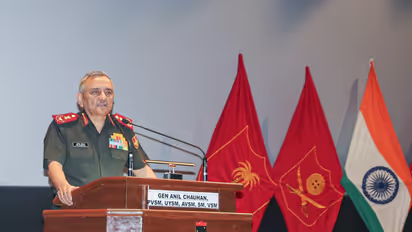
CDS General Anil Chauhan emphasised the urgent need for indigenous drone and anti-drone systems, citing lessons from Operation Sindoor and evolving global warfare.
India’s top military officer on Wednesday made a strong pitch for indigenisation in drone warfare technology, stressing that conflicts around the world have shown how Unmanned Aerial Vehicles (UAVs) can shift the tactical balance on the battlefield.
Addressing a high-level workshop at New Delhi’s Manekshaw Centre, Chief of Defence Staff (CDS) General Anil Chauhan said the lessons from Operation Sindoor shed light on why India must develop its own drone and anti-drone systems, built specifically for its terrain and operational needs.
“Are drones evolutionary or revolutionary?”
With a mix of insight and urgency, General Chauhan posed a question to the packed audience: “When we talk about drones, what do you think these are — are they bringing an evolutionary change or a revolutionary change in warfare?”
He answered with clarity. “I think their development is evolutionary and their employment has been very revolutionary in warfare. As the realisation of their deployment and scope increased, the Army started using drones in a revolutionary manner, you have seen this in a number of wars fought by us."
The CDS’ words reflected a broader transformation happening within the Indian Armed Forces — one that acknowledges how emerging technologies are redefining the rules of war.
Lessons from the battlefield: Operation Sindoor
Drawing from the recent military action against Pakistan, General Chauhan said the drone threat is not hypothetical — it’s already here.
“During Operation Sindoor, on 10th May, Pakistan used unarmed drones and loitering munitions. None of them inflicted any damage to the Indian military or civil infrastructure. Most were neutralised through a combination of kinetic and non-kinetic means, and some were even recovered in almost intact condition,” he stated.
His account painted a picture of a well-prepared Indian defence response, but also served as a warning. The next time may not be as forgiving — unless India builds what it needs at home.
“We must invest and build to safeguard ourselves”
Operation Sindoor wasn’t just a military engagement — it was a wake-up call. “Operation Sindoor has shown us why indigenously developed counter-UAS systems built for our terrain are crucial. We must invest and build to safeguard ourselves,” General Chauhan urged.
The CDS was clear-eyed about the strategic risks of foreign dependence. “We cannot rely on imported niche technologies that are crucial for our offensive and defensive missions,” he said, adding, “Dependence on foreign technologies weakens our preparedness, limits our ability to scale up production, results in a shortfall of critical spares for sustenance and round-the-clock availability.”
His call wasn’t merely for procurement reform, but a cultural shift — one that places long-term strategic autonomy over short-term convenience.
Drones and the changing nature of war
According to the CDS, drones are punching far above their weight in modern warfare.
“Drones are proof of reality, and their widespread utility in recent conflicts demonstrates how drones can shift tactical balance disproportionately to their size or price,” he said.
Highlighting the threat posed by low-cost, high-impact aerial platforms, he added: “Asymmetric drone warfare is making large platforms vulnerable and driving militaries to rethink the conceptual aspects of air doctrines, development of C-UAS and adaptive moves of engagement.”
The day-long workshop, hosted by the Headquarters, Integrated Defence Staff (HQ-IDS) in collaboration with the Centre for Joint Warfare Studies, focused on the indigenisation of critical UAV and C-UAS components currently being imported.
The timing couldn’t have been more relevant, given the backdrop of Operation Sindoor and growing tensions across India’s borders.
Stay updated with the Breaking News Today and Latest News from across India and around the world. Get real-time updates, in-depth analysis, and comprehensive coverage of India News, World News, Indian Defence News, Kerala News, and Karnataka News. From politics to current affairs, follow every major story as it unfolds. IMD cities weather forecastsRain Cyclone Asianet News Official App