British-era coins, dinosaur-era fossils found off Visakhapatnam coast
Synopsis
A trove of British-era coins and prehistoric fossils has been recovered from the seabed off Visakhapatnam, Andhra Pradesh. The discovery offers a rare look into the region's colonial history and the ancient geological past of the Bay of Bengal.
In a discovery that has sent ripples through the scientific and archaeological communities, a trove of British-era coins and prehistoric fossils has been recovered from the seabed off the coast of Visakhapatnam. The find, made during recent underwater explorations, offers a rare, layered look into both the colonial history and the ancient geological past of the Bay of Bengal.
Exhibition Bridges Past and Present
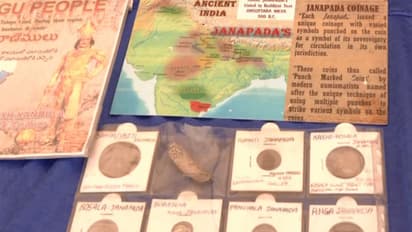
An exhibition in Visakhapatnam, featuring rocks and coins dating back to the era of dinosaurs, is leaving everyone astonished. Archaeology scholars in Visakhapatnam have organised this exhibition to showcase fossils thousands of years old, rocks with unique wood-like textures, and remnants recovered from the depths of oceans and lakes.
Shaswati Jagatpatnaik, a research scholar from Andhra University, describes the exhibition as a "living testimony" and a historical bridge that spans the dawn of humanity to modern independence, showcasing a vast collection of fossils, regional heritage, and ancient coinage from dynasties such as the Satavahanas and Mauryas. "We are witnessing here today what you can say is a bridge of the past mixed with that of the present itself. And this exhibition is the living testimony of it. Not only it features a private collection of the not only coins and fossils starting from the dawn of humanity up until the modern day British times but also it features all the pictures as well as visual representations of the heritage sites popular around Andhra Pradesh and Telangana, along with a brief history of Andhra University, the display of which can be seen in the front here," said Jagatpatnaik.
"Basically, the coin collection presented here starts from the early age of the Mahajanapadas and goes on up until 1947, the Indian independence movement. And the prominent dynasties whose coins are featured here include Satavahanas, Ikshvakus, Vishnukundinas, Mauryas, and Guptas, alongside some foreign variety coins," Jagatpatnaik added..
Historical Context of Railways
Speaking to ANI, Research scholar from the Department of History and Archaeology, Andhra University, Sneha Kalampudi said that, "The Britishers started the construction of railways in India during the 1850s, but when it comes to Andhra, it started between 1862. The first railway line was from Renigunta during the 1860s, and when it comes to Vishakhapatnam, the very first railway station is Waltair, constructed in 1896. Later, after post-independence India, the railways got nationalised. We had a zone called South Central Zone, which was in combined Andhra Pradesh, but after the 2014 bifurcation, it's our bad, actually, it's the zone headquarters that belonged to Telangana." (ANI)
Stay updated with the Breaking News Today and Latest News from across India and around the world. Get real-time updates, in-depth analysis, and comprehensive coverage of India News, World News, Indian Defence News, Kerala News, and Karnataka News. From politics to current affairs, follow every major story as it unfolds. IMD cities weather forecastsRain Cyclone Asianet News Official App