Bright Side Stories: IAS Officer's 20-Minute Idea Transformed 250 Telangana Schools, Ending Tobacco Use, Absenteeism
Synopsis
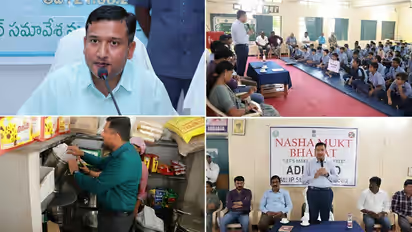
IAS officer Rajarshi Shah's simple idea of 20-minute daily health lessons has transformed more than 250 Telangana schools. The attendance has risen to 70%, tobacco use has fallen and the students learned hygiene, mental health and leadership skills.
A small but powerful change in school routines is creating big results in Telangana's Adilabad district. IAS officer Rajarshi Shah introduced a 20-minute daily health lesson called 'Aarogya Pathshala' that teaches students about hygiene, nutrition, mental health and anti-drug awareness. This idea has helped over 250 schools improve attendance, reduce tobacco use and empower students with confidence and life skills.
Shocking discoveries that led to change
When District Collector Rajarshi Shah visited schools in Adilabad, what he saw shocked him. Children as young as 11 were chewing tobacco, completely unaware of the health risks. Many girls were missing school every month during their periods due to a lack of awareness and basic hygiene facilities. Students did not understand simple concepts like stress, hygiene or healthy nutrition.
Adilabad is one of India's most socio-economically backward districts. Nearly 45% of its population belongs to Scheduled Castes and Tribes. Poverty, malnutrition, and lack of health services are daily challenges. “Health awareness among children and even their parents was alarmingly low,” Shah told The Better Indian. Many children suffered from exam stress and used local substances like jarda (chewing tobacco).
Reimagining the morning assembly
Shah decided to turn the neglected school morning assembly into something powerful. Instead of just prayers, it became 'Aarogya Pathshala' a 20-minute daily session focused on health education. Every day had a special theme:
Monday: Personal hygiene
Tuesday: Health and nutrition
Wednesday: Stress management and mental health
Thursday: Anti-drug education
Friday: Disease prevention
Saturday: Confidence and leadership
During these sessions, students learned through discussions, skits, drawings and activities. They were encouraged to participate actively instead of just listening passively.
Immediate positive results
The effects of this simple change were quick and powerful. School attendance rose from 50% to nearly 70%. Children who used to stay home started coming to school regularly. The initiative also focused strongly on girls’ health, providing sanitary pad vending machines, private rooms with hot water bags, pain relief balms, and first-aid kits. This reduced absenteeism related to menstruation.
Lunde Ramu, Principal of Telangana Model School in Jainad Mandal, saidas mentioned in The Better India report, “Earlier, students walked 2-3 km from the main road just to catch a bus. Girls faced the biggest challenge during their periods. Now, they feel confident and come to school regularly.”
Stories of change
Akshara, a Class 10 student, shared how the sessions helped her. “I didn’t know about nutrition or hygiene before. Now I eat healthy food and keep my surroundings clean. I also practice yoga and meditation. I even convinced a relative to give up alcohol,” she said proudly. Her confidence has grown. “I used to be scared of public speaking. Now, I speak in school competitions regularly,” Akshara added.
Six pillars of health
Aarogya Pathshala covers six important areas:
- Hygiene
- Nutrition
- Stress management
- Anti-drug education
- Disease prevention
- Personality development
Shah ensured the program was not just limited to the education department. He involved multiple government departments such as health, women and child welfare, AYUSH and rural development. Each department had a role in supporting the programme. Shah explained, “Responsibilities were clearly divided. Every department played a vital role in making the programme successful.”
Overcoming challenges
Implementing Aarogya Pathshala in over 250 schools was not easy. Teachers initially thought it would be an extra burden. But after workshops and easy-to-follow lesson plans, they began asking for the programme to be expanded. ASHAs (Accredited Social Health Activists) helped by uploading photos and data during school visits. This simple system made it easy to track attendance and activities.
The programme's success reached beyond schools. Teachers reported that students were now spreading health knowledge at home and in their villages. Ramu said, “Students are not just learning for themselves but also teaching their families. It creates a ripple effect that helps the whole community.”
Sustainable and replicable model
Aarogya Pathshala won the prestigious SKOCH Award for excellence in governance. This recognition proved the model’s success. What makes it special is its sustainability. The programme is managed by a district-level committee led by the Collector. It follows Standard Operating Procedures (SOPs) and uses a toolkit containing lesson plans, activity charts, audio-visual material, and simple monitoring formats.
“All materials are freely available online,” Shah shared, giving other districts the option to easily replicate the programme.
The State Government’s Adolescent Safety Empowerment Programme also follows similar themes, showing that this simple model fits well into existing efforts.
A small change with big impact
For Rajarshi Shah, Aarogya Pathshala is not just another project. “We don’t do this for awards. The real success is in the students’ confidence, better attendance, and their willingness to lead healthier lives,” he told The Better India.
“Even in remote villages, children now understand the importance of hygiene, nutrition and mental health. They are no longer passive learners but active role models,” Shah added.
Today, Aarogya Pathshala is showing that small, thoughtful changes in school routines can create lasting impacts. It empowers students to face life’s challenges with knowledge, confidence and hope.
Stay updated with the Breaking News Today and Latest News from across India and around the world. Get real-time updates, in-depth analysis, and comprehensive coverage of India News, World News, Indian Defence News, Kerala News, and Karnataka News. From politics to current affairs, follow every major story as it unfolds. IMD cities weather forecastsRain Cyclone Asianet News Official App