Bright Side Stories: How Uttar Pradesh Farmers are Bringing Back World's Tallest Flying Bird Sarus Crane
Synopsis
UP's farmers are helping revive the sarus crane, the world's tallest flying bird, by protecting its nests and wetlands. Once seen as a pest, the bird is now valued for supporting healthy farms. Villages across 10 districts are restoring habitats.
Every year on December 23, India marks National Farmers' Day, also known as Kisan Divas, to honour the country's farmers. The day marks the birth anniversary of Chaudhary Charan Singh, India's fifth Prime Minister and a strong voice for rural communities. This year, the day carries a deeper meaning in eastern Uttar Pradesh. Here, farmers are not just growing food. They are quietly bringing back a bird that was once close to disappearing from the landscape, the sarus crane, the tallest flying bird in the world.
Once seen as a troublemaker in fields, the sarus crane is now being protected by farmers themselves. Across 10 districts, villagers are saving its nests, guarding wetlands, and changing how people see nature.
A farmer and the birds that know his voice
In Pragpur village in Maharajganj district, farmer Rampreet walks carefully through a wetland near his fields. As he hums a soft tune, a pair of sarus cranes stand nearby, tall and calm, according to a study feature in The Better India.
For years, Rampreet has watched over these birds. He keeps an eye on their nests, eggs, and chicks. He makes sure no one disturbs them. It is hard to believe that Rampreet comes from a farming community that once called the sarus crane a 'pest'.
Back then, many farmers believed the birds damaged wheat and paddy crops. They tried to drive them away. Today, Rampreet sees things very differently.
Why the sarus crane entered farm fields
The sarus crane did not choose farmland by accident. Over the years, wetlands across Uttar Pradesh have been drained or reclaimed for farming, roads, and buildings. With their natural homes shrinking, sarus cranes were forced to move into flooded crop fields that looked like wetlands.
This change made farmers and birds share the same space, often leading to conflict.
In fact, more than 95 percent of wetlands in Uttar Pradesh lie outside protected areas. Except for a few, most are not even officially notified under the Wetland (Conservation and Management) Rules, 2017.
Still, the sarus crane adapted. It searched for places where water, food, and safety existed, even if that place was a farmer’s field.
Easy to spot, hard to forget
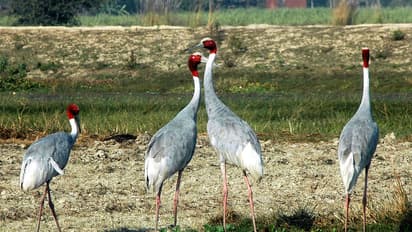
Once seen up close, the sarus crane is impossible to miss. The bird has soft grey feathers, long pink legs, and a bright red head and upper neck. Against green wetlands, it stands out clearly.
The sarus crane is the world’s tallest flying bird, growing up to 152 to 156 centimetres tall. It is also India’s only resident breeding crane and the state bird of Uttar Pradesh.
Yet, despite its size and beauty, its numbers were falling fast.
Alarm bells over falling numbers
The sarus crane population in India is estimated at 15,000 to 20,000 mature birds. A steady decline raised serious concern among conservationists. The bird was later classified as ‘Vulnerable’ by the International Union for Conservation of Nature (IUCN). This decline pushed the Wildlife Trust of India (WTI) to step in.
Professor BC Choudhury, senior advisor at WTI and principal investigator of the Sarus Habitat Securement Project, explains the problem clearly in the documentary Where the Sarus Sings.
“If you declare a bird as a state bird, you need to do something for it,” he tells The Better India.
"The fact that the sarus crane lives outside protected areas, in agricultural landscapes, means we must find a new way to protect it."
Vanishing wetlands and changing crops
One major reason behind the bird’s decline was the destruction of wetlands. Another was changing farming patterns. Professor Choudhury explains that the Terai belt, once rich in grasslands and many species, has changed sharply.
“The best population of sarus crane was in the Terai belt,” he says. “But it has turned into a single-crop landscape dominated by sugarcane.”
This shift removed the natural grass and shallow water areas that sarus cranes need to survive.
To respond to this crisis, the Sarus Habitat Securement Project was launched in 2013. It is led by the Wildlife Trust of India in partnership with the Uttar Pradesh Forest Department, with support from Tata Trusts and the World Land Trust.
Instead of fencing off land, the project focused on working with farmers.
Today, around 100 water bodies across 10 districts in eastern Uttar Pradesh have been identified as sarus crane habitats.
This is a major change for a region where seeing the bird had once become rare.
Listening to farmers before teaching them
Arshad Hussain, who has led the project since its start, says trust came before conservation.
“For the first two years, I only observed,” he says. "I studied the land and the birds. I listened to farmers."
“They asked us why they should protect a bird that damages their crops,” Arshad recalls.
So the team explained the hidden benefits. Slowly, farmers learned that the sarus crane is not an enemy.
While walking through fields, the bird loosens the soil, improving air flow. It eats harmful insects that damage crops. It also protects flowering plants that help in pollination.
Arshad often used a simple example.
“When you choose land for your home, you pick a place with good resources,” he told farmers. “If a sarus chooses your field, it means your land is healthy.”
This idea changed everything.
Counting birds and protecting nests
The Wildlife Trust of India conducts a biannual sarus census across the project districts. The latest count shows 2,878 sarus cranes in these areas. During the current breeding season alone, the project has protected 237 sarus crane nests. Farmers now inform teams when eggs hatch or chicks appear.
When children take the message home
The Better India mentions Bidauli village, where young Mukesh Chauhan returns from school excited. "The sarus bhaiyya came today,” he tells his mother. "They said we must not harm the bird or its eggs."
His mother shares this with her friends. The message spreads. This is how awareness grows.
Sarus protection committees at work
There are now 12 Sarus Protection Committees in Uttar Pradesh. Members carry binoculars, digital cameras, and a bird guide by Salim Ali. They track nests, record sightings, and guard wetlands.
Ravindra Tripathi, a committee secretary, says mindsets have changed. "School programmes and village meetings made people understand the bird," he says. "Now people recognise it with pride."
Members are called sarus mitras, friends of the sarus crane.
Protecting wetlands for all life
Before 2019, the project focused mainly on protecting cranes in fields. After 2019, the focus expanded to securing wetlands themselves. These wetlands support not just sarus cranes, but fish, frogs, insects, birds, and local water needs.
The work is done in collaboration with the Uttar Pradesh State Wetland Authority.
Today, sarus sightings bring joy.
“Farmers now call us happily,” Arshad says. “They update us about nests and chicks.” The bird once chased away is now welcomed.
In eastern Uttar Pradesh, farmers no longer see the sarus crane as a problem. They see it as a sign of a healthy land and a shared future.
Stay updated with the Breaking News Today and Latest News from across India and around the world. Get real-time updates, in-depth analysis, and comprehensive coverage of India News, World News, Indian Defence News, Kerala News, and Karnataka News. From politics to current affairs, follow every major story as it unfolds. IMD cities weather forecastsRain Cyclone Asianet News Official App