BHU partners with Australian centre for human origins research
Synopsis
Australia's Griffith University is leading an international centre to research human origins, focusing on South Asia to counter Eurocentric views. Banaras Hindu University is a key Indian partner in the seven-year, $85 million initiative.
Global Centre to Put South Asia at Heart of Human Origins Research
To address the long-standing imbalances in global research on human origins, an international centre led by Australia’s Griffith University has set out to place South Asia at the heart of the narrative. Banaras Hindu University (BHU) is a key Indian partner in this initiative, with Professor Gyaneshwer Chaubey of the Department of Zoology involved as a partner investigator.
In December 2025, the Australian Research Council designated the "ARC Centre of Excellence for Transforming Human Origins Research" as one of the country's eight Centres of Excellence. The centre is directed by Professor Michael Petraglia. It has received a federal grant of 35 million Australian dollars; when contributions from partner universities and organisations are included, the total funding is estimated at approximately 85 million Australian dollars. The project is set to run for seven years.
Dismantling Colonial Narratives and Promoting Inclusivity
The centre’s core question is why Homo sapiens became the only surviving human species on Earth. Research focuses on regions across Africa, Asia, and Australia (collectively termed the "Southern Arc") where modern humans engaged in long-term migration, adaptation, and innovation, yet which Eurocentric narratives have frequently marginalised According to Petraglia, research into human origins has long been hampered by three weaknesses: geographical bias, the neglect of indigenous and traditional knowledge, and colonial narratives. The centre aims to dismantle these barriers.
Half of the opportunities for over 40 research fellows, approximately 70 PhD/Master’s students, and more than 100 honours students are prioritised for researchers from indigenous communities or the Global South. International partners include institutions from Kenya, South Africa, Saudi Arabia, China, Indonesia, Sri Lanka, and India. From India, BHU and Anna University (Chennai) are included in the list.
BHU Professor's Contributions and Proposals
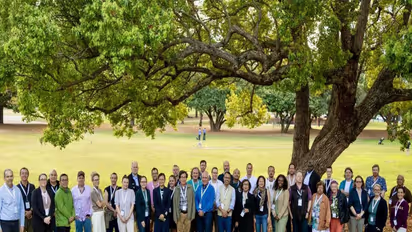
A workshop for the centre was held in Brisbane in late August 2026. According to Petraglia, participants came from South Africa, Kenya, Saudi Arabia, India, China, Indonesia, and Australia. Professor Gyaneshwar Chaubey participated in two panel discussions.
During the meeting, Petraglia remarked that Chaubey’s involvement has further strengthened the centre's focus on South Asia, a region where early humans spent a significant amount of time. During the brainstorming session, Professor Chaubey put forward two proposals that garnered consensus.
First, he noted that textbooks in many countries still teach misconceptions from the colonial era, including theories regarding race. Modern DNA research demonstrates that human diversity exists on a continuum; rigid racial categories do not hold up to scrutiny. Second, he proposed a systematic study of language isolates. Such languages found in South Asia and neighbouring regions could offer clues regarding migration, isolation, and ancient contact. Their story can only be fully understood by integrating genetics, archaeology, and linguistics.
Professor Gyaneshwar Chaubey explained that the core objective of this project is to write the story of human origins in collaboration with the scientists and regions that lie at the heart of this history. There had long been dissatisfaction over a dynamic where samples originated in the South, yet interpretations were formulated exclusively in the North; this centre aims to address that imbalance.
Stay updated with the Breaking News Today and Latest News from across India and around the world. Get real-time updates, in-depth analysis, and comprehensive coverage of India News, World News, Indian Defence News, Kerala News, and Karnataka News. From politics to current affairs, follow every major story as it unfolds. IMD cities weather forecastsRain Cyclone Asianet News Official App