Ambani's Sky: India's Satellite Internet Battle
Synopsis
Reliance Jio plans a massive satellite internet network to ensure Indian control. Meanwhile, Elon Musk accuses Mukesh Ambani of blocking Starlink to prevent competition. However, the Indian government denies any bias, stating that Starlink, Jio, and OneWeb are all equally awaiting mandatory national security clearances.
Far above the towers and cables that made Mukesh Ambani India's telecom titan, a new dream is taking shape. His company, Reliance Jio, is thinking of building its own family of satellites, around 1,600 to 1,650 of them. They would work as a team. As one satellite moves away, the next takes over, like runners passing a baton. The bill could reach $10 billion to $15 billion, roughly ₹89,000 crore to ₹1.34 lakh crore. The goal is a network India runs and controls, without leaning entirely on foreign companies.
These satellites would fly in low Earth orbit, fairly close to the ground. Talking to a friend across a room is quick. Shouting across a wide valley is slow. Older satellite internet mostly depends on a single satellite parked nearly 36,000 kilometres up. Every click must travel there and back. That waiting time is called latency. Starlink's satellites fly at only about 550 kilometres, so the wait almost disappears. It lasts 25 to 50 milliseconds, far less than a blink. Video calls and games then feel smooth.
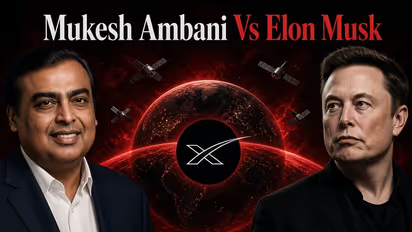
Ambani's towering presence has drawn the anger of Elon Musk, whose company Starlink is still waiting to launch in India. On X, Musk first said that Ambani is the "real boss of India". A day later, he mockingly called him "Prime Minister Ambani" and offered a sarcastic apology for not knowing it earlier. He alleged that Ambani wants to keep control of India's telecom market and earn from Indian customers without competition. Would Starlink at least be allowed to compete, he asked. Earlier in the week, he had blamed wealthy and powerful businesspeople for keeping Starlink out, calling it a "crime against the people of India".
His words touch something real. Many places in India, as in other countries, still have no internet. Children there miss online lessons. Small businesses cannot sell to buyers around the world. Musk also said Starlink has saved lives abroad during natural disasters, when phone networks and internet lines stopped working. It could do the same for men, women and children in India, he argued.
The Government tells a different story. On Thursday, the Ministry of Communications said its rules are fair and the same for every company. This includes satellite communication, which simply means sending calls and internet from space instead of only through cables and towers. Three companies hold the government's satellite service licence and other legal approvals. They are Starlink, Eutelsat OneWeb, backed by India's Bharti Group, and Jio Satellite Communications Ltd, fully owned by Jio Platforms. Amazon Leo, from Jeff Bezos's Amazon, is trying for one. All three are at almost the same stage, awaiting security clearance from the Union Home Ministry. Claims of unfair treatment, the Centre said, are completely false and baseless.
What is this clearance? Each company must prove its service is safe and that users' personal information is protected. The biggest concern is the ground station, also called a gateway. This is where signals from space join the normal internet. Think of it as a toll plaza. When all traffic passes through plazas on Indian soil, authorities can check that laws are followed. If a foreign company's traffic skipped them, India could neither monitor it nor enforce its laws. Next comes permission to use spectrum, the radio frequencies that carry signals between satellite and dish, like reserved lanes in the air. Starlink's final permission is reportedly held up over these national security concerns.
Starlink's wait has been long. The Department of Telecommunications, which regulates phone and internet services, gave it an operator licence three years after it applied. Last July, India's space authorisation agency allowed it to use its family of satellites here. Some industry experts called that the final approval needed. Sunil Bharti Mittal, Chairman of Bharti Airtel, has rejected Musk's charge. OneWeb, he pointed out, is also still waiting.
Yet rivals are also partners. Starlink has tied up with Reliance Jio and Bharti Airtel to take satellite broadband to India's remotest corners. That is where it fits best. In a city, homes stand close together, so one fibre cable serves thousands cheaply. Inside it, data travels as light that stays trapped in the cable and moves extremely fast. Plans start at about Rs 400 a month. Speeds begin at 40 Mbps, and the fastest cross 1 Gbps. That small delay drops to barely one to five milliseconds.
But laying cable across mountains and forests for a few scattered homes is costly and impractical. There, a dish facing the sky makes sense. Starlink promises speeds of 25 to 220 Mbps. It may cost Rs 5,000 to Rs 7,000 a month, plus Rs 25,000 or more for equipment. Exact Indian prices are not yet announced.
Mobile data remains the easiest option. It costs as little as Rs 20 per GB, with unlimited plans from Rs 199. A phone's hotspot can share it with a laptop. But that small delay grows to about 20 milliseconds on 5G and over 50 on 4G. Crowded areas also slow it down.
Behind the taunts lies a weightier question: who will connect the last unconnected Indian home, and on whose terms.
(Girish Linganna is an award-winning science communicator and a Defence, Aerospace & Geopolitical Analyst. He is the Managing Director of ADD Engineering Components India Pvt. Ltd., a subsidiary of ADD Engineering GmbH, Germany.)
Stay updated with the Breaking News Today and Latest News from across India and around the world. Get real-time updates, in-depth analysis, and comprehensive coverage of India News, World News, Indian Defence News, Kerala News, and Karnataka News. From politics to current affairs, follow every major story as it unfolds. IMD cities weather forecastsRain Cyclone Asianet News Official App