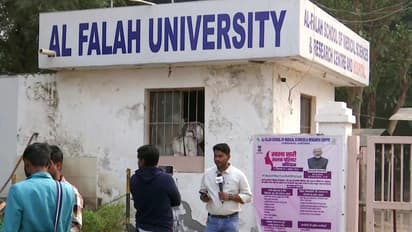
Al Falah University Under Fire: Fake NAAC ‘A Grade’, Terror Links Spark Shutdown Demands
Synopsis
After the Delhi blast probe linked it to a terror module, Al Falah University now faces NAAC’s wrath over fake accreditation claims. As outrage grows, calls mount to shut down the Faridabad-based institution once hailed as a minority education hub.
Once hailed as a promising institution for students from minority communities, Al Falah University in Faridabad now finds itself mired in one of the most alarming controversies to hit India’s higher education sector. Established in 2014 across a sprawling 76-acre campus in Haryana’s Dhauj village, the university once prided itself on offering accessible, quality education. Today, however, it stands accused of fake accreditation, alleged terror links, and deepening public outrage in the aftermath of Monday’s Red Fort blast in New Delhi.
The National Assessment and Accreditation Council (NAAC) has issued a show cause notice to the university for “misleading the public” with false claims of accreditation — a development that has sent shockwaves through India’s academic circles.
NAAC’s Notice: A Damning Indictment
The NAAC’s statement is unambiguous. It says that Al Falah University is "neither accredited nor applied for accreditation by NAAC".
Yet, on its website, the university proudly claimed:
"Al-Falah University is an endeavour of Al-Falah Charitable Trust, which has been running three colleges on the campus, namely Al Falah School of Engineering and Technology (since 1997, Graded A by NAAC), Brown Hill College of Engineering and Technology (since 2008), and Al-Falah School of Education and Training (since 2006, Graded A by NAAC)."

NAAC has called this paragraph “absolutely wrong and misleading the public, especially the parents, students and stakeholders.”
“Both of the above colleges’ accreditation status has expired. Both of the above colleges have not yet volunteered for the Cycle-2 Assessment and Accreditation (A&A) process of NAAC,” it added.
Seven-Day Ultimatum To Comply Or Face Action
In a strongly worded communication, NAAC questioned why legal or institutional action should not be taken against the university. It asked Al Falah to explain within seven days why it should not face disqualification from future accreditation processes and why its recognition should not be withdrawn by various national regulatory bodies including:
- The University Grants Commission (UGC) under Sections 2(f) and 12B.
- The National Medical Commission (NMC) for medical programmes.
- The National Council for Teacher Education (NCTE) for teacher training courses.
- The All India Council for Technical Education (AICTE) for technical programmes.
- The Government of Haryana, for administrative action at the state level.
The council also directed the varsity to immediately remove all false accreditation details from its website and other official materials.
Troubled University Under Scanner After Delhi Blast
This latest controversy comes as Al Falah University remains under the national spotlight following the Red Fort blast that killed 13 people earlier this week. Investigators are probing possible links between the university and a “white-collar terror module” allegedly connected to Jaish-e-Mohammed and Ansar Ghazwat-ul-Hind.
Two of the university’s doctors — Dr Muzammil Ganaie and Dr Shaheen Sayeed — were arrested in connection with the module. Another academic, Dr Umar Nabi, who was driving the car that exploded near Delhi’s Red Fort, was also associated with the institution.
Police later recovered 2,900 kg of explosives from rented premises in Faridabad allegedly used by Dr Ganaie and Dr Nabi.
A preacher from Haryana, Maulvi Ishtiyaq, who conducted religious sermons on the Al Falah campus, was also detained.
Al Falah University Distances Itself From Arrested Faculty
Under intense scrutiny, the university has publicly distanced itself from the arrested doctors.
In a statement, Vice Chancellor Prof (Dr.) Bhupinder Kaur Anand said:
“We are deeply saddened and anguished by the unfortunate developments that took place and condemn the same. Our thoughts and prayers are with all the innocent people affected by these distressing events.”
She clarified that the university’s association with the two doctors was purely professional:
“We wish to make it clear that the University has no connection with the said persons apart from them being working in their official capacities with the University.”
The statement added that the university was fully cooperating with investigating authorities.
“We also want to make it loud and clear that as a responsible institution, we stand in solidarity with the nation and reaffirm our unwavering commitment to the unity, peace, and security of our country.”
‘Baseless, Misleading Stories’ Says Varsity
The university also criticised “certain online platforms” for circulating “baseless and misleading stories with the clear intent of maligning the reputation and goodwill of the University.”
“It is hereby clarified that no such chemical or material, as is being alleged by certain platforms, is being used, stored, or handled within the University premises. The University laboratories are used solely and exclusively for the academic and training requirements of MBBS students and other authorised courses,” the statement read.
From Minority Education Hub To National Controversy
Once seen as a promising educational hub for minority students, Al Falah University has found itself mired in controversy.
Located in the Muslim-dominated Dhauj village of Haryana’s Faridabad district, the university began as an engineering college in 1997 and became a private university in 2014 under the Haryana Private Universities Act, 2006.
Run by the Al Falah Charitable Trust, headed by Chancellor Jawad Ahmad Siddiqui, the institution runs several colleges on its 76-acre campus — including the Al Falah School of Engineering and Technology, Brown Hill College of Engineering and Technology, and Al Falah School of Education and Training.
The university’s School of Medical Sciences & Research Centre, which started its first MBBS batch in 2019, charges Rs 16.37 lakh per year for the first four years and Rs 9 lakh in the final year.
Public Anger Mounts, Calls For Shutdown Grow
As details of the NAAC’s show cause notice emerge alongside the ongoing terror probe, public outrage has grown. Social media users and education activists are demanding the immediate closure of Al Falah University, calling it a “threat to national integrity and academic credibility.”
Students and parents who once saw it as an affordable private option now say they feel betrayed and deceived by the false accreditation claims.
“First terror links, now fake accreditation — how can such an institution be allowed to operate?” a former student posted on X.
Stay updated with the Breaking News Today and Latest News from across India and around the world. Get real-time updates, in-depth analysis, and comprehensive coverage of India News, World News, Indian Defence News, Kerala News, and Karnataka News. From politics to current affairs, follow every major story as it unfolds. IMD cities weather forecastsRain Cyclone Asianet News Official App