Ajit Pawar Death: Will NCP's 'Clock' Tick Towards a Sharad Pawar Reunion?
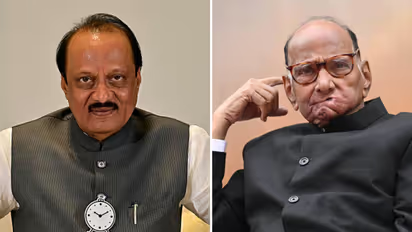
Synopsis
Ajit Pawar’s sudden death has plunged the NCP into uncertainty, sparking leadership questions, merger buzz with Sharad Pawar’s faction, and fresh tensions within Maharashtra’s ruling Mahayuti.
The sudden and tragic death of Maharashtra Deputy Chief Minister Ajit Pawar in a plane crash on Wednesday has sent shockwaves through the state’s political establishment, leaving behind not just grief, but a deep political vacuum—most acutely within the Nationalist Congress Party (NCP).
For a leader who had come to dominate the party’s organisational and electoral machinery, Ajit Pawar’s absence raises uncomfortable questions about succession, survival, and the future trajectory of the fractured NCP.
A Party Without a Clear Heir
Political observers say the NCP now faces an immediate leadership crisis, with no undisputed second-in-command capable of filling the void left by Ajit Pawar.
As the party’s iconic ‘clock’ symbol lost its most assertive standard-bearer, doubts surfaced over whether the NCP can hold together in its current form—especially as its relationship with founder Sharad Pawar remains unresolved.
Sharad Pawar’s Rajya Sabha term ends in April this year, adding another layer of uncertainty to an already fluid situation.
Will the Pawars Reunite?
Speculation has resurfaced over a possible reunion between Ajit Pawar’s NCP and the Sharad Pawar-led NCP (SP), particularly as relations between the two factions had visibly softened in recent months.
With Ajit Pawar no longer in the picture, political analysts believe Chief Minister Devendra Fadnavis faces the immediate task of ensuring that the 41 MLAs aligned with Ajit Pawar do not drift back towards Sharad Pawar’s camp.
The concern is not merely numerical but symbolic—control over the ‘clock’ symbol and the party’s identity could once again become contentious.
Sunetra Pawar and the Question of Legacy
Ajit Pawar’s wife, Sunetra Pawar, is currently a Rajya Sabha member and has been politically active. However, insiders point out that she lacks administrative experience, raising questions over whether she can play a larger leadership role at this critical juncture.
At the national level, the NCP currently has one Lok Sabha MP—Sunil Tatkare—and two Rajya Sabha MPs—Praful Patel and Sunetra Pawar.
The Contrast with Sharad Pawar’s Camp
During the recently held local body and civic elections, Sharad Pawar largely stayed away from the public spotlight. Instead, his daughter and NCP (SP) working president Supriya Sule led the campaign.
Yet, on the ground, the contrast was stark. While Sule campaigned extensively, political observers noted that she was no match for Ajit Pawar’s statewide presence and organisational grip.
Before his death, state politics was rife with speculation about a possible merger of NCP (SP) with the NCP under Ajit Pawar’s leadership. His untimely demise has now cast a long shadow over that possibility.
A Thin Leadership Bench
Beyond Ajit Pawar, the party’s senior leadership bench appears thin.
Apart from state NCP president Sunil Tatkare and national working president Praful Patel, there is no senior leader widely seen as capable of stepping into Pawar’s role. The only other mass-based leader, Chhagan Bhujbal—recently acquitted in a money laundering case—is currently unwell.
While Patel and Tatkare have been key organisational pillars, party insiders concede that neither possesses the statewide grassroots connect that Ajit Pawar commanded over decades.
Mahayuti’s Numbers—and Its Nervousness
The uncertainty comes at a time when the ruling Mahayuti alliance is riding high after its massive mandate in the 2024 assembly elections. The BJP leads the coalition with 132 MLAs, followed by the Eknath Shinde-led Shiv Sena with 57 and Ajit Pawar’s NCP with 41.
Despite the numbers, the alliance remains wary of internal shifts, particularly if NCP legislators begin reconsidering their loyalties.
An ‘Unofficial Merger’ on the Ground?
Senior journalist Prakash Akolkar believes the lines between the two NCP factions are already blurring.
“The question is no longer about who merges with whom. With only two Opposition parties left—Congress and Shiv Sena (UBT)—it remains to be seen whether the Congress can revive itself,” Akolkar was quoted as saying in a PTI report.
He pointed out that both NCP factions are contesting the February 5 Zilla Parishad elections together on the ‘clock’ symbol, effectively signalling an unofficial merger.
Civic Polls Tell a Brutal Story
Recent civic election results underscore the imbalance between the two factions.
In the Maharashtra municipal corporation polls, the NCP, contesting separately from its Mahayuti allies, won 167 seats across 29 corporations. It suffered defeats at its traditional strongholds of Pune and Pimpri Chinchwad, where it had aligned with the Sharad Pawar-led NCP (SP).
The results were stark: NCP (SP) managed just 36 seats statewide.
In the 165-member Pune Municipal Corporation, the NCP won only 27 seats and NCP (SP) just three, while the BJP swept the contest with 119 seats. In the 102-member Pimpri Chinchwad civic body, Ajit Pawar’s NCP secured 37 seats, Sharad Pawar’s faction failed to open its account, and the BJP stormed ahead with 84 seats.
The trend continued in local body polls last month, where the NCP won 966 seats and NCP (SP) 256 out of a total 6,851 seats across 246 municipal councils and 42 nagar panchayats.
An Open-Ended Political Future
Ajit Pawar’s death has not just removed a powerful leader—it has reopened unresolved questions about identity, leadership and unity within the NCP.
Whether the party consolidates, fractures further, or formally reunites with Sharad Pawar’s faction will shape Maharashtra’s political landscape in the months ahead. For now, the ‘clock’ continues to tick—without the man who once kept it firmly in his grip.
Stay updated with the Breaking News Today and Latest News from across India and around the world. Get real-time updates, in-depth analysis, and comprehensive coverage of India News, World News, Indian Defence News, Kerala News, and Karnataka News. From politics to current affairs, follow every major story as it unfolds. IMD cities weather forecastsRain Cyclone Asianet News Official App