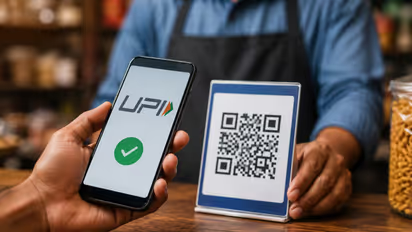
Will UPI payments become chargeable? Amid growing questions over transaction fees, the Payments Council has clarified the situation. Here’s what the latest update means for UPI users and digital payments in India.
Will you have to pay for UPI transactions now? The Payments Council of India (PCI) has put an end to all the speculation that started after a new bill was passed in Parliament. They have clearly stated, "UPI services will remain free for the general public." At the same time, small businesses won't have to pay any charges for accepting digital payments either.
211
PCI's clear message
PCI took to its X handle to clarify things. They posted, "The Merchant Service Charge, where it applies, is a business deal between a merchant and their payment service provider. It doesn't mean customers have to pay for digital payments." When asked about the platform's long-term viability, PCI highlighted that UPI, launched in 2016, has grown to become the world's biggest real-time payment system.
311
The reason for the costs
Running this massive national payment infrastructure requires constant investment. This includes money for technology, cybersecurity, following regulations, customer service, fraud prevention, and new innovations. Currently, banks and payment service providers bear these costs to ensure that regular users get a smooth and secure experience.
Clearing the air on costs, the council stressed that if any Merchant Service Charge is applied, it's a commercial deal between large businesses and payment service providers. This means regular customers won't have to shell out any money from their pockets for making digital payments.
511
Who is exempt from the charges?
Even small shopkeepers and your neighbourhood kirana stores will not have to pay any Merchant Discount Rate (MDR) for accepting UPI payments. This ensures that digital transactions remain accessible for India's small businesses. The discussion around this topic began right after the 'Taxation and Other Laws (Amendment) Bill, 2026' was passed in the Lok Sabha.
611
Bill passed in the Lok Sabha
Finance Minister Nirmala Sitharaman introduced this bill, and it was passed by a voice vote without any discussion. The bill proposes to amend the Payment and Settlement Systems Act, 2007, the Income-tax Act, 2025, and the Finance Act, 2026. This bill gives the government the power to impose a Merchant Discount Rate (MDR) on certain electronic payments. Under this, an MDR of 0.25% to 0.4% could be levied on business UPI transactions over ₹2,000. However, this will not affect person-to-person transactions.
711
PCI's message
The council has strongly stated that small shopkeepers and local vendors are protected from payment acceptance costs. "Small businesses will not have to pay any charge (MDR) for accepting UPI payments. UPI was designed to make digital payments accessible even to India's smallest businesses, and protecting them is central to the ecosystem's inclusive growth."
811
Reason for the discussion
The council also explained why this discussion about charges even began. They said, "UPI has grown from a new payment platform to the world's largest real-time payment system. As the ecosystem expands, there are discussions on how to build a sustainable model to keep billions of secure transactions running every month. However, protecting the interests of customers and small businesses remains our main goal."
911
Investment in UPI
Talking about the network's institutional support and operational costs, the industry body highlighted the investments made over the last decade. "For almost 10 years, banks, payment companies, fintechs, NPCI, and RBI have collectively invested in technology, cybersecurity, fraud prevention, innovation, and customer support to build one of the world's safest and most reliable payment systems." They added, "This investment continues daily to keep UPI secure, stable, and available 24x7."
1011
How does UPI run?
The council further explained how operational costs are managed within the system. "Running a national payment infrastructure involves continuous investment in technology, fraud prevention, cybersecurity, compliance, customer support, and innovation. These costs are currently borne by the ecosystem participants, including banks and payment service providers, who continue to invest so that customers can enjoy a safe, secure, and seamless payment experience."
1111
Who has to make the payment?
Regarding potential merchant-side service fees, the council reiterated, "The Merchant Service Charge, where applicable, is a commercial arrangement between the merchant and payment service providers. This does not mean that customers pay for using digital payments. Globally, merchant service charges are a standard feature of digital payment ecosystems, where customers enjoy a convenient and secure digital payment experience." They concluded, "UPI has now become a critical national digital infrastructure used daily by crores of Indians."