Why Do Indian Fans Have 3 Blades, but US Fans Have 4 or 5?

Published : Oct 21, 2026, 04:54 PM IST

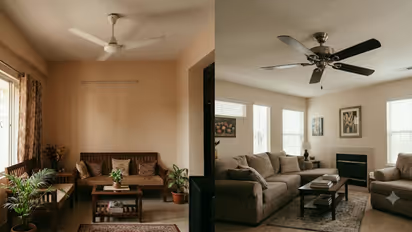
Fan Blades: Indian homes commonly use three blade ceiling fans, while American homes often have four- or five blade models. This difference comes down to climate, airflow needs, fan design and consumer preferences.
PREV
14
Why Are Three Blade Fans More Common in India?

India experiences hot weather for much of the year, with high humidity making conditions uncomfortable in several regions. In such climates, people often prefer ceiling fans that deliver a strong, direct flow of air. Three blade fans generally offer less aerodynamic resistance than some designs with more blades, allowing the motor to rotate them at higher speeds under comparable conditions. This can help certain models deliver stronger airflow, making them suitable for homes where a powerful breeze is a priority. However, the number of blades alone does not determine a fan's performance. Factors such as blade shape, length, pitch, motor efficiency and rotational speed also play a significant role. A well designed fan can deliver excellent airflow regardless of whether it has three, four or five blades.

24
Why Are Four and Five Blade Fans Popular in the US?

Many homes in the United States have heating, ventilation and air conditioning (HVAC) systems that help regulate indoor temperatures. In these homes, ceiling fans are often used alongside air conditioning to improve air circulation and make rooms feel more comfortable. Four and five blade fans are popular in the American market, partly because of their design and aesthetic appeal. Depending on the model, they can circulate air effectively at relatively low speeds, creating a gentle breeze that complements indoor climate control systems. However, it would be inaccurate to suggest that all American homes use four or five blade fans. Three-blade models are also available in the US. The choice ultimately depends on factors such as room size, climate, interior design, performance requirements and personal preference.

Does the Number of Blades Affect Airflow?

The number of blades influences a fan's performance, but more blades do not necessarily mean more airflow. Several factors determine how effectively a ceiling fan moves air, including:

* Blade design: The length, width, shape and pitch of the blades affect the amount of air a fan can move.

* Rotational speed: A fan spinning faster may deliver stronger airflow, depending on its design and operating conditions.

* Motor efficiency: The motor determines how effectively electrical energy is converted into rotational motion.

* Aerodynamic resistance: Additional blades can increase resistance and place a greater load on the motor, depending on the design.

Three blade fans often have lower aerodynamic resistance and can be designed to operate at higher speeds. Fans with more blades, meanwhile, can also deliver effective airflow when their blades and motors are engineered appropriately. Ultimately, a fan's actual air delivery is a more reliable indicator of performance than its blade count alone.

34
Is the Number of Blades Responsible for Fan Noise?

Fan noise depends on several factors, and the number of blades is only one of them. Some fans commonly used in India operate at relatively high speeds to provide stronger airflow. This can make the sound of moving air more noticeable. However, it does not mean that all three-blade fans are noisy. In the US, some ceiling fans are designed to operate at lower speeds, helping circulate air while maintaining relatively quiet operation. Nevertheless, a fans noise level depends on its motor quality, bearings, blade balance, installation and maintenance, as well as its operating speed. A properly designed and maintained fan can run quietly regardless of whether it has three, four or five blades.

44
Which Ceiling Fan Should You Buy?

When choosing a ceiling fan, it is better to consider its overall performance rather than focusing solely on the number of blades. Keep the following factors in mind:

* Air delivery: Check how effectively the fan circulates air and whether it meets your cooling needs.

* Room size: Choose a fan suited to the dimensions of your room.

* Power consumption: Compare the wattage of different models to understand their electricity requirements.

* Noise levels: Look for models designed for quiet operation, particularly for bedrooms and study rooms.

* Motor performance: Consider motor efficiency, reliability and the manufacturer's warranty.

If you prefer a strong breeze, a well designed three blade fan with high air delivery may be a suitable choice. If you prioritise quiet operation, a three, four or five-blade model may work well, provided it meets your requirements.

Read more
Read more Photos on

Recommended Stories