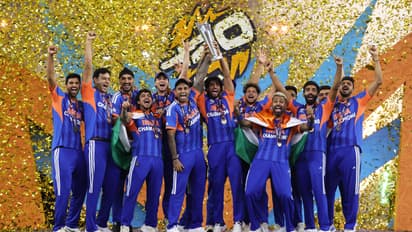
India’s historic third T20 World Cup triumph was powered by collective brilliance. From Sanju Samson’s redemption to Jasprit Bumrah’s lethal spells, every member of the playing XI played a decisive role.
India Create History With 3rd T20 World Cup Triumph
India’s march to a historic third T20 World Cup title was not defined by a single hero or one defining performance. Instead, it was a campaign built on collective brilliance — a true embodiment of team sport.
Across the month-long ICC tournament featuring 20 teams, India’s playing XI repeatedly produced match-winners capable of changing the course of a game in moments.
While the hosts entered the tournament as overwhelming favourites, the road to glory was not entirely smooth. There were early hiccups, moments of doubt and challenges along the way. But when the tournament reached its decisive phase, India delivered the dominance many had expected.
In the semifinal and final, India simply batted opponents out of the contest, showcasing the depth and firepower of a batting line-up that had matured over the past 18 months.
Here’s a look at the contributions from the players who powered India to their second T20 World Cup crown in less than two years.
213
1. Sanju Samson – Redemption on the Biggest Stage
After years of inconsistency and unfulfilled promise, Sanju Samson finally delivered the tournament that Indian fans had long waited for.
Having lost his place in the side earlier due to poor form, Samson was brought back during the Super 8 stage — and the stylish right-hander seized the opportunity with both hands.
He produced three unforgettable knocks in three must-win matches — 97, 89 and 89, including a match-defining innings in the final.
For a player whose technique had often been questioned, Samson silenced critics in emphatic fashion. His fearless strokeplay laid the foundation for crucial victories over West Indies, England and New Zealand in high-pressure knockout games.
313
2. Jasprit Bumrah – The Tournament’s Most Fearsome Bowler
If there was one constant throughout the tournament, it was Jasprit Bumrah’s brilliance.
Widely regarded as the best fast bowler in the world, Bumrah delivered a string of match-winning spells.
In both the semifinal and final, he struck with his very first ball — a testament to his uncanny ability to read the game and outthink batters.
He eventually finished with four for 15, the best figures ever recorded in a T20 World Cup final — a fitting performance for a once-in-a-generation fast bowler.
3. Abhishek Sharma – Faith Repaid at the Perfect Moment
Over the past 18 months, Abhishek Sharma has emerged as one of India’s most explosive match-winners.
However, the early stages of the tournament proved challenging. A stomach infection disrupted his rhythm and fitness, resulting in a prolonged lean patch.
Despite the struggles, the team management backed him throughout the campaign — a decision that paid off spectacularly.
In the final, Abhishek delivered when it mattered most, smashing a vital half-century and powering India to 92 without loss in the powerplay, effectively shutting half the door on New Zealand’s hopes.
513
4. Ishan Kishan – A Crucial Middle-Order Spark
Moved to number three to accommodate Samson at the top, Ishan Kishan adapted seamlessly to the new role.
The left-hander produced one of the most explosive knocks of the final — a blistering 25-ball 54.
But perhaps his most significant innings came earlier in the tournament. In the marquee clash against Pakistan in Colombo, Kishan hammered 77 off 40 balls on a difficult surface.
He also contributed a rapid 38 off 24 balls against Zimbabwe in the Super 8, proving his value in the middle order.
Not long ago, Kishan wasn’t even part of India’s immediate plans. Now, he has firmly cemented his place in the side.
613
5. Suryakumar Yadav – Leadership Under Pressure
Captain Suryakumar Yadav entered the tournament under immense pressure.
Runs had dried up following India’s T20 World Cup triumph in Barbados in 2024, raising questions about his form. However, three half-centuries in a bilateral series against New Zealand restored his confidence ahead of the home World Cup.
He made an immediate statement in the opening match against USA at Wankhede, scoring a brilliant 84 not out on a tricky two-paced surface.
Though he would have liked more runs during the Super 8 stage, his leadership remained calm and decisive throughout the tournament.
713
6. Shivam Dube – The Silent Game Changer
Shivam Dube’s transformation over the past six months has been remarkable.
Once known primarily for his ability against spin, Dube has significantly improved his game against pace as well.
His contributions came quietly but proved decisive. A fluent 66 against the Netherlands, a crucial 43 against England in the semifinal, and a rapid 26 not out off just 8 balls in the final all came at critical moments.
Those cameos often pushed India’s totals beyond the reach of the opposition.
813
7. Tilak Varma – Impact in a New Role
Tilak Varma had to adjust his role during the tournament after being shifted from number three to number five.
Coming off a groin surgery before the event, the young batter initially struggled during the league phase.
But once he found his rhythm, Tilak became a valuable aggressor in the middle order. His 16-ball 44 against Zimbabwe in the Super 8 provided a crucial breakthrough moment.
Later, his 21 off just seven balls in the semifinal helped accelerate India’s scoring on a high-scoring Wankhede pitch where no total felt safe.
913
8. Hardik Pandya – India’s Ultimate Utility Player
There is perhaps no cricketer in world cricket quite like Hardik Pandya.
Once again, he demonstrated his value as one of the game’s premier all-rounders. The captain trusted him in every phase of the innings — from the powerplay to the death overs.
With the bat, Pandya delivered two half-centuries during the tournament. His explosive 27 off 12 balls against England helped India push past the 250-run mark in the semifinal.
His all-round contributions were instrumental to India’s campaign.
1013
9. Axar Patel – Moments of Magic in the Field
Vice-captain Axar Patel endured a brief setback when he was dropped for two matches in Ahmedabad, including the Super 8 clash against South Africa that India lost.
However, he returned strongly when recalled for the must-win match against West Indies.
In the semifinal, Axar produced two sensational catches at different stages of the match that proved pivotal.
In the final, he struck early by dismissing the dangerous Finn Allen in the powerplay, immediately putting New Zealand under pressure.
1113
10. Varun Chakaravarthy – The X-Factor Spinner
Varun Chakaravarthy has been India’s mystery weapon over the past year and a half.
Though he lost some rhythm during the Super 8 stage and the knockout matches, his earlier performances played an important role in India’s campaign.
Even when runs flowed against him later in the tournament, the team management continued to back him.
He did manage to dismiss the explosive Tim Seifert in the final, and the belief remains that he is capable of turning games on his own.
1213
11. Arshdeep Singh – The Perfect Partner for Bumrah
Alongside Bumrah, Arshdeep Singh formed one of the most potent pace combinations in the tournament.
Like his senior partner, Arshdeep was trusted to bowl in all phases of the innings — the powerplay, middle overs and death.
His discipline, accuracy and ability to deliver under pressure ensured that India maintained control whenever the opposition threatened to build momentum.
1313
A True Team Triumph
India’s third T20 World Cup title was not merely about star performances or isolated brilliance.
It was about a team where every player contributed — sometimes loudly, sometimes quietly — but always when it mattered.
From Samson’s redemption arc to Bumrah’s relentless brilliance, the campaign showcased a squad filled with match-winners who thrived under pressure.
And together, they delivered another historic chapter in Indian cricket.