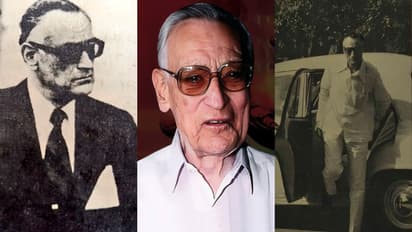
Rameshwar Nath Kao spent much of his life away from public attention, but his work helped shape India's modern intelligence system. Better known as RN Kao, he founded the Research and Analysis Wing, or R&AW, in 1968 and became the country’s first external intelligence chief.
Now, more than two decades after his death, the secretive spymaster's life is returning to the spotlight. Karan Johar's Dharma Productions and Leo Media Collective have announced a feature film based on Kao, with a theatrical release scheduled for August 11, 2028.
FILM ON R&AW FOUNDING CHIEF RN KAO ANNOUNCED – 11 AUG 2028 RELEASE... #DharmaProductions and #LeoMediaCollective unite for a big-screen feature on #RNKao, the founding chief of R&AW.
Based on Nitin Gokhale's book #GentlemanSpymaster, the large-scale espionage action drama is… pic.twitter.com/2Dgj6Bgjip— taran adarsh (@taran_adarsh) September 21, 2026
Rameshwar Nath Kao , Spymaster and The Man Who Founded Research & Analysis Wing (R&AW)
He Never Got Bharat Ratna Award But He Is Bharat Ratna In True Sense pic.twitter.com/7mTajvEqao— indianhistorypics (@IndiaHistorypic) March 22, 2026
The announcement was made on September 21, 2026, marking 58 years since R&AW was established. The film is based on national security expert Nitin Gokhale’s book R.N. Kao: Gentleman Spymaster and is expected to cover the years from 1955 to 1971.
But who exactly was RN Kao, and why does his name command such respect in India’s intelligence community?
Rameshwar Nath Kao was born in 1918 and entered the Indian Imperial Police in 1940. He later moved into intelligence work and joined the Intelligence Bureau around the time India became independent.
Over the years, Kao built a reputation for discretion, patience and an ability to operate away from the spotlight. Before R&AW was created, he worked on major intelligence and security assignments, including overseas cases.
One of his best-known early assignments came after the 1955 bombing of the Air India aircraft Kashmir Princess. Kao was involved in the investigation into the explosion, which occurred while the aircraft was travelling towards Indonesia for the Bandung Conference.
He was also sent to Ghana, where he helped the newly independent African nation build its intelligence and security organisation. These assignments helped establish Kao as one of India’s leading intelligence officers long before R&AW existed.
Until the 1960s, India's Intelligence Bureau handled both domestic and foreign intelligence.
However, the 1962 war with China and the 1965 war with Pakistan exposed shortcomings in India's ability to gather and analyse intelligence beyond its borders. The government subsequently decided that the country needed a dedicated external intelligence organisation.
In 1968, Prime Minister Indira Gandhi’s government created the Research and Analysis Wing, separating external intelligence responsibilities from the IB. Kao was chosen to lead the new agency.
He remained at the helm until 1977.
When R&AW began, Kao worked with a relatively small group of officers, many of whom had come from the Intelligence Bureau.
The early officers around him became informally known as the 'Kaoboys', a nickname that has since become part of Indian intelligence folklore. Reports about R&AW’s early history say Kao initially had around 250 handpicked personnel.
His job was not simply to run another government department. He had to build an organisation capable of gathering intelligence overseas, developing foreign sources and providing Indian policymakers with information about security threats.
Former intelligence officials have credited Kao with creating a distinct working culture within R&AW and bringing specialists into the organisation who were not always available through normal government recruitment channels.
The 1971 war became the defining chapter of Kao’s career. Political and military repression in East Pakistan had triggered a major crisis, sending millions of refugees into India and fuelling the Bangladesh liberation movement.
Kao and R&AW became deeply involved in gathering intelligence relating to Pakistan and developments in East Pakistan. Historical accounts also record Kao’s involvement in coordinating assistance connected to the Bangladesh freedom struggle.
Rameshwar Nath Kao , Spymaster and The Man Who Founded Research & Analysis Wing (R&AW)
In 1940 He Joined Imperial Police Service ( I.P.S ) Under British Govt pic.twitter.com/kPVVR6Yg3g— indianhistorypics (@IndiaHistorypic) September 21, 2023
One significant intelligence success came shortly before the war formally began.
According to an Indian Express account of R&AW’s early years, Kao’s team received advance information suggesting that Pakistan was preparing a pre-emptive air attack. The warning helped Indian forces prepare before Pakistan launched strikes on December 3, 1971.
The conflict ended with Pakistani forces surrendering in Dhaka on December 16, paving the way for the creation of Bangladesh.
Kao was part of a small group of senior officials who worked closely with Prime Minister Indira Gandhi during this period, alongside figures including PN Haksar and DP Dhar.
Kao is also closely associated with developments surrounding Sikkim, which became an Indian state in 1975.
Accounts of R&AW’s history have credited Kao and the organisation with playing an important intelligence role during the political developments that preceded Sikkim’s integration with India.
Because intelligence operations from that period remain partly classified or undocumented publicly, some dramatic versions of events surrounding Sikkim are difficult to independently verify. What is clear is that Kao was one of the senior intelligence figures involved during a crucial period in India’s relations with the Himalayan kingdom.
Unlike fictional spies, Kao rarely sought public recognition.
Former colleagues described him as exceptionally private and careful about discussing intelligence matters. Even after retirement, he did not publish a memoir revealing the secrets he had accumulated during decades of intelligence work.
That discretion became central to his reputation.
Former senior intelligence officer Vappala Balachandran, who worked with Kao, later described him as a man who created a new organisation and working culture while maintaining strong personal relationships with intelligence chiefs overseas.
Kao also developed ties with intelligence leaders in countries including France and Israel, helping India build channels that extended beyond conventional diplomacy.
Kao stepped down as R&AW chief in 1977.
He later returned to government service as a senior security adviser after Indira Gandhi came back to power. During this phase, Kao worked on strengthening coordination between different intelligence and security agencies.
He also helped develop an institutional mechanism for bringing together intelligence assessments before they reached policymakers, an approach later seen as an important step towards India’s modern national security architecture.
Kao died in 2002.
Despite spending his career in secrecy, his influence continues to be recognised within India’s intelligence establishment.
Former RBI Governor Raghuram Rajan's father, R Govindarajan, was an intelligence officer who became part of R&AW’s founding team.
Govindarajan had earlier served in the Intelligence Bureau and joined the newly created R&AW in 1968. He worked as a staff officer under RN Kao and was counted among the early officers informally known as the 'Kaoboys'.
The connection shows just how small and tightly knit the first generation of India’s external intelligence service was.
Dharma Productions and Leo Media Collective will now bring Kao’s life to the big screen.
The yet-untitled espionage film is scheduled for release on August 11, 2028, just ahead of Independence Day and in the year R&AW completes six decades.
The project is based on Nitin Gokhale’s Gentleman Spymaster and is expected to trace Kao’s journey between 1955 and 1971, including the circumstances that led to R&AW’s creation and its early operations around the 1971 India-Pakistan war.
Karan Johar said Leo Media Collective had spent two years researching and dramatising the story, adding that the team wanted to make a film based on real events while paying tribute to R&AW.
The cast and director have not yet been announced.
Interestingly, the project itself is not entirely new. Dharma Productions had first announced a film based on Kao and Gokhale’s book in January 2020. The September 2026 announcement has now confirmed its planned 2028 theatrical release.
For a man whose career depended on remaining unseen, RN Kao is now set to receive perhaps his most public retelling yet.
Stay updated with the Breaking News Today and Latest News from across India and around the world. Get real-time updates, in-depth analysis, and comprehensive coverage of India News, World News, Indian Defence News, Kerala News, and Karnataka News. From politics to current affairs, follow every major story as it unfolds. IMD cities weather forecastsRain Cyclone Asianet News Official App