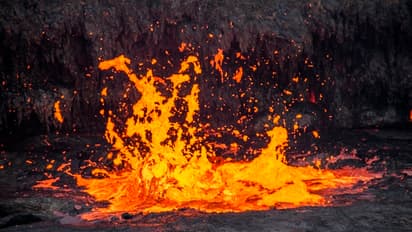
Ash from the recently erupted Hayli Gubbi volcano in Ethiopia travelled thousands of kilometres to India, creating a hazy, off-colour sky over several northwestern states.
People across parts of northwest India on Monday (November 24) evening looked up to find the sky a little dimmer, a little hazier, and strangely off-colour. What many didn't realise was that the cause was not local dust, not pollution, and not the weather but a volcanic ash cloud that had travelled thousands of kilometres from Ethiopia.
In an incredibly rare event, ash from the Hayli Gubbi volcano, a mountain that had slept for nearly 10,000 years, made its way to Indian airspace, drifting over Gujarat, Rajasthan, Maharashtra, Delhi-NCR, Haryana and Punjab.
Weather watchers at IndiaMetSky were the first to spot it entering Gujarat around 5:30 pm, calling the phenomenon "unusual" and "fascinating," even as authorities scrambled to assess its impact.
27
A volcano wakes up after millennia
Hayli Gubbi sits in Ethiopia's Afar region, a place where the Earth's crust is literally pulling apart. On Sunday morning, around 8:30 am GMT, the volcano erupted suddenly, its first significant activity in thousands of years.
Powerful plumes of ash rose 14 kilometres into the sky.
To put that in perspective:
Commercial flights cruise between 10–12 km
This ash went well above that into high-altitude jet streams
The Toulouse Volcanic Ash Advisory Centre (VAAC) confirmed that although the eruption itself stopped, the ash cloud remained massive, large enough to be detected by satellites across continents.
37
How did the ash reach India so fast?
This is where nature's "highways" come in.
Strong upper-level winds, blowing at 100–120 km/h—picked up the ash over the Afar region, pushed it across the Red Sea, guided it over Yemen and Oman, and finally swept it toward India and northern Pakistan.
In simple words:
Once the ash reached high-altitude winds, it hitched a ride straight toward South Asia.
IndiaMetSky shared satellite visuals showing a long, grey plume stretching from the Arabian Sea right into Gujarat, a sight rarely seen in Indian meteorology.
The ash didn't "fall" on cities, but it did pass above them.
By Monday night, the plume travelled over:
Gujarat
Rajasthan
Northwest Maharashtra
Delhi-NCR
Haryana
Punjab
Residents reported slightly darker skies and a faint haze, especially as the plume moved eastwards.
Meteorologists clarified that actual ashfall was very unlikely, because the cloud was drifting far above the surface, between 25,000 and 45,000 feet.
Late at night, the sulphur-dioxide-rich bands passed over Delhi and NCR, but again, high in the atmosphere.
57
Should we worry about the air quality?
Surprisingly, no.
Experts repeatedly stressed that the ash is travelling too high to worsen India’s ground-level AQI.
No major spike in PM2.5 or PM10 is expected.
IndiaMetSky described the event as "mostly safe," adding that the biggest visible change would be darker, hazier skies, somewhat resembling a mild dust storm—minus the pollution.
People were advised to wear masks only if they felt discomfort, especially those with respiratory sensitivities.
The only region where SO₂ levels may rise slightly is the Himalayas, Nepal, and the Terai belt, because the plume could collide with mountain ranges and descend slightly.
67
Aviation faces the real challenge
While the general public may feel only curiosity, the aviation sector faced immediate concerns.
Volcanic ash is dangerous for aircraft because it can:
melt inside jet engines
scratch cockpit windows
clog sensors
reduce visibility
damage turbine blades
Because part of the plume passed through West Asian air routes, several Indian and international carriers altered or cancelled flights.
The DGCA issued a formal advisory instructing airlines to:
avoid ash-affected routes
revise flight plans
load extra fuel for detours
inspect runways for ash contamination
Airlines like Akasa Air, IndiGo and KLM cancelled flights on Monday due to safety concerns.
Mumbai Airport also warned passengers that West Asian airspace disruptions could cause delays.
77
A rare reminder of how connected our skies are
Events like this don't happen often.
It's not every day that a volcano in East Africa darkens skies in Delhi.
But this unusual plume offered a humbling reminder:
that Earth’s systems are interconnected
that wind patterns can carry particles across continents
and that even a remote eruption can influence skies thousands of kilometres away
For most Indians, the impact will remain minimal, some haze, some curious skies, and perhaps a mask if you're sensitive.
For scientists and aviation authorities, though, this is a phenomenon that will be studied for years.