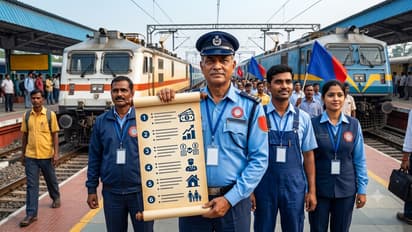
8th Pay Commission AIRF Demands: Railway employees union AIRF has presented 6 demands to the 8th Pay Commission. These include salary hikes, better promotion scopes, and increased annual increments
8th Pay Commission works under Justice Ranjana Prakash Desai
The 8th Pay Commission was set up on November 3, 2025. Justice Ranjana Prakash Desai heads it as the chairperson. Over a year has passed since its formation. During this time, the commission is holding talks with various employee unions and listening to their proposals and grievances. Now, everyone is watching closely how much importance the commission gives to the submitted demands.
210
Commission has 18 months to submit its report
According to the Terms of Reference (ToR), the commission must submit its final report to the central government within 18 months from its formation date. Within this timeframe, the commission has to listen to the ideas, proposals, and grievances of eligible employee unions. That is why unions are submitting memorandums and demand letters one after another.
310
AIRF places 6 demands for railway employees
The All India Railwaymen's Federation (AIRF) has placed 6 major demands before the commission. These mainly aim for better pay, more promotion chances, and extra allowances. The federation states that fulfilling these demands will bring positive changes for both serving railway employees and retired pensioners.
Consultative meeting held with the commission on October 30
AIRF sat down for a consultative meeting with the commission's panel on October 30, 2026. They raised issues faced by employees across various railway departments. After the meeting, General Secretary Shiv Gopal Mishra informed the affiliated units about the recommendations through a letter.
510
Issues of track maintainers, women loco pilots, and train managers
The meeting specifically highlighted the problems of staff like track maintainers, women loco pilots, and train managers. The federation believes that the working conditions and challenges for these staff are different. So, the commission needs to consider these differences separately while fixing salaries and other benefits.
610
Tough duties and risks justify better pay
AIRF argued that railway employees have very tough duties. Their jobs involve various occupational risks, challenges, and possible dangers. Also, Indian Railways is modernizing rapidly. Considering all this, the federation feels the staff deserve better salaries and service-related benefits.
710
Special skills needed for modern railway demands
The federation proposed that the salary structure for railway employees should reflect the growing technical demands of running modern railways. Specifically, those working with rolling stock, signaling systems, and track maintenance require special training and advanced skills. Keeping up with the latest technology is also part of their job.
810
Demands hold weight as opportunity comes once in 10 years
Employee unions usually get a chance to present their grievances to the central government through a new pay commission once in 10 years. So, the demands made during this time have a significant long-term impact. The future salary structure and benefits of railway employees depend heavily on the commission's recommendations.
910
Other unions also submitted proposals alongside AIRF
Besides the railway employee union, the Staff Side of NC-JCM (National Council-Joint Consultative Machinery), BMS (Bharatiya Mazdoor Sangh), BPMS (Bharatiya Pratiraksha Mazdoor Sangh), and several other organizations have submitted their proposals and views to the commission in the last few months. Everyone shares one goal: bringing constructive changes to the lives of serving staff and pensioners.
1010
These are just proposals; final report expected by May-June 2027
The commission will examine every proposal and analyze data before submitting its recommendations to the central government. For now, we expect the final report around May-June 2027. Until then, these demands remain just proposals, not approved salary hikes or allowances. Whether these demands become reality depends entirely on the commission's final recommendations and the central government's subsequent decision. You can find the commission's latest updates on their official website: 8cpc.gov.in.