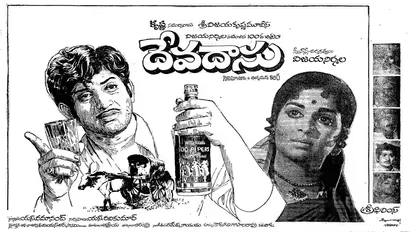
The Devadasu story holds a very special place in the Telugu film industry. Sarat Chandra Chattopadhyay wrote this epic love story, and legends like K.L. Saigal and Akkineni Nageswara Rao (ANR) already turned it into all-time classics. Superstar Krishna knew people would compare his work with the ANR film. Yet, he took a bold step and brought this story to the audience as a colour remake under the Padmalaya Pictures banner. Vijaya Nirmala directed this 1974 colour version, and it scored a massive hit, creating a unique record in Krishna's acting career.
The Devadasu Storyline
Childhood friends Devadasu (Krishna) and Parvathi (Vijaya Nirmala) love each other deeply. They grow up in a village, and their bond turns into strong romance. However, status differences and zamindari ego stand like a wall between them. Devadasu's father (S.V. Ranga Rao) strictly rejects their marriage.
Devadasu cannot cross his father's word. He moves to the city with severe mental agony and meets a courtesan named Chandramukhi (Jayanthi). She sees his pure love and develops deep affection for him. Meanwhile, Parvathi marries an old zamindar. Devadasu cannot handle the pain of losing Parvathi and becomes a heavy alcoholic. This tragic love story finally ends when he breathes his last right at Parvathi's doorstep.
The 1953 ANR film Devadasu set a massive benchmark for tragedy and acting. Superstar Krishna needed a lot of guts to remake the exact same story in 1974. Padmalaya Pictures spent heavily and shot this film grandly in a colour version.
The first half runs very smoothly with village romance, fun moments, and childhood memories. The story shifts towards separation, alcohol, and deep pain in the second half. Krishna carefully avoided his usual mass hero body language and showed pure agony through his dialogue delivery. However, audiences who compare it with the ANR version will definitely feel a different vibe.
How did the actors perform?
Krishna usually entertains fans in mass, action, cowboy, and James Bond roles. He surprised everyone by sinking perfectly into a tragic lover's role that demands intense emotions. He completely erased the Akkineni benchmark from his mind and showed Devadasu's pain and alcoholic depression in his own unique style. His acting in the climax scenes simply breaks your heart.
Vijaya Nirmala brilliantly showcased innocence, pure love, loyalty, and helplessness as Parvathi. She proved her talent by expressing deep emotions just with her eyes. Jayanthi delivered a top-notch performance as Chandramukhi. She stands out as a major highlight, playing the dancer who showers pure love on Devadasu. S.V. Ranga Rao gave a majestic performance as the zamindar, while Gummadi, Suryakantham, and Sridhar did complete justice to their respective roles.
The 1953 ANR Devadasu stands as an all-time classic love story. It remains an evergreen blockbuster even today. Superstar Krishna made his Devadasu movie years later, and this is exactly where the massive rivalry began. The producers of the old ANR film re-released their classic right when Krishna's Devadasu hit the theatres. They wanted to cash in on the current movie's buzz.
This move heavily impacted the box office run of Krishna's Devadasu. Navayuga Pictures then stepped in and supplied funds for Krishna's film. Krishna, Sarathi Studios, and the Navayuga team joined hands. This incident sparked a major cold war between ANR and Krishna.
Akkineni Nageswara Rao was in the USA at that time. He returned to India and wanted to shoot a new movie, but the rival camp blocked his access to local studios. ANR faced severe shooting troubles. He took this as a challenge and immediately built his own Annapurna Studios, ensuring nobody could ever stop his work again.
This intense rivalry between Krishna and ANR continued for almost five years. Later, Krishna faced a separate issue with actor Shoban Babu. Krishna then approached ANR directly and proposed a multi-starrer project. ANR happily agreed, and the two legends teamed up to deliver the blockbuster hit movie Hema Hemeelu.
A female director taking up an already famous black-and-white classic and remaking it in colour was a very daring move. Vijaya Nirmala handled every single scene with extreme care and kept the core emotions intact. She succeeded as a director by presenting rich visuals that perfectly matched that era. Music director Ramesh Naidu breathed life into this movie. The songs continue to entertain music lovers even today.
Every song blends perfectly with the mood of the scenes. The background music (BGM) heavily elevated the emotional intensity. The Eastman colour framing is a massive plus point for this movie. Cinematographer V.S.R. Swamy used brilliant lighting to showcase the village atmosphere and zamindari palaces in a very colourful way.
Plus Points
Superstar Krishna's versatile acting: He kept his mass image aside and impressed everyone in a tragic role.
Ramesh Naidu's music: The melody songs and background score are top-notch.
Colour visuals: Padmalaya Pictures maintained rich production values, and V.S.R. Swamy showed great camera work.
Vijaya Nirmala's direction: She handled the heavy emotional drama very effectively.
Jayanthi and S.V. Ranga Rao delivered masterclass performances.
Minus Points
People who constantly compare it with the 1953 classic might find this version a bit hard to accept.
A few scenes in the second half drag a little and feel slow.
The 1974 Krishna starrer Devadasu remains a very special experiment in Telugu cinema history. The film successfully introduced a classic story to a brand-new generation through a colourful screen, melodious music, and brilliant acting. However, hardcore fans who grew up watching the ANR version might not connect with this movie. If you want to watch this 1974 classic today, the full movie is officially available on YouTube.