Preity Zinta Moves Bombay HC Against AI Deepfakes, Court Seeks Google, Meta's Takedown Plan
Synopsis
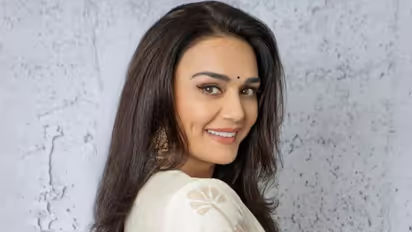
Preity Zinta has moved the Bombay High Court over AI-generated deepfakes and morphed content, which has led the court to direct Google and Meta Platforms to derive a mechanism for removing such alleged infringing material. The court will pass further orders on July 6, 2026, amid growing concerns over AI misuse against public figures.
Preity Zinta, in a very strict approach, has approached the Bombay High Court regarding the circulation of AI deepfakes, morphed images, and chatbot personas that allegedly use her likeness without consent. In a significant development, the court has directed technology giants Google and Meta Platforms to collaboratively establish a mechanism for the removal of such infringing content.
Zinta's move to the Bombay High Court comes amid increasing concerns over the misuse of artificial intelligence to create misleading digital content and impersonate public figures. The court had previously granted permission for her to file the suit on June 16, 2026, by Justice Abhay Ahuja. The actor's petition highlights the potential for damage to reputation and unauthorised commercial exploitation of her identity through these AI-generated materials, which were circulated across platforms operated by Google and Meta.
Allegations of Rights Infringement
Preity's lawsuit alleges that multiple defendants have created, uploaded, and disseminated AI-generated content using her face and voice without her authorisation. The plea explicitly states that these AI-generated deepfake videos, morphed images, and chatbot-style conversations falsely represent the actress and have the potential to harm her public image and professional persona, particularly in Mumbai, where she primarily works. The suit claims infringement of her personality rights, copyright, and moral rights under Section 62 of India's Copyright Act, 1957. Senior advocate Venkatesh Dhond, representing Zinta, emphasised that the increasing sophistication of AI deepfakes makes it challenging for viewers to discern fake from real content, thereby necessitating urgent judicial intervention.
Court Directs Takedown Protocol Development
During a hearing on July 3, 2026, Justice Madhav Jamdar of the Bombay High Court instructed all parties involved, including Google and Meta, to jointly devise a practical protocol for removing genuinely infringing AI-generated deepfake content while ensuring that lawful material remains unaffected. Representatives for Google and Meta informed the court of their willingness to remove specific links identified by the actress as containing objectionable content. However, they opposed a broad, blanket order that would compel them to constantly monitor or proactively remove content, arguing that some flagged URLs might not violate any rights. The court observed that Zinta has made a case for protective relief.
What Will Be The Future Steps
Zinta's case is a remarkable addition to the growing number of instances in India where celebrities are seeking legal protection against the misuse of AI for impersonation. Indian courts have previously granted similar relief to several prominent figures, including Anil Kapoor, Amitabh Bachchan, Jackie Shroff, Shilpa Shetty, Kartik Aaryan, Akshay Kumar, and Suniel Shetty, highlighting a broader debate surrounding digital consent, personality rights, and the adequacy of existing legal frameworks to address rapidly evolving AI technologies. The matter has been scheduled for further hearing on July 6, 2026, when the court is expected to pass additional orders regarding the proposed takedown mechanism.