India Faces Steep Rise in Energy Demand to Reach Developed Nation Status
Synopsis
India's primary energy consumption is projected to rise 2.5 times by 2047. NITI Aayog emphasizes balancing energy security, affordability, and building a self-reliant manufacturing base to reduce dependency on global supply chains for clean energy.
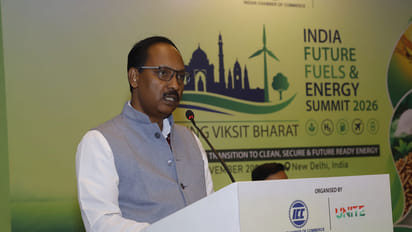
New Delhi [India], November 29 (ANI): India's primary energy consumption is expected to rise 2 to 2.5 times and its electricity demand around 4 to 5 times as the country works towards developed nation status by 2047, said Rajnath Ram, Adviser (Energy), NITI Aayog, at the India Future Fuels & Energy Summit 2026.
Addressing the summit organised by the Indian Chamber of Commerce (ICC), Ram noted that the real challenge is to enhance energy security while keeping power affordable and sustainable. He observed that energy security now carries more weight than climate goals in view of the changing geopolitical situation. "Energy security is no longer only about price and availability. It is also about choke points, shipping routes and supplier concentration, and every country is now treating energy as a strategic asset," Ram said.
Pointing to the 2026 West Asia crisis that disrupted shipping and hit oil supplies, he noted that Brent crude rose from about USD 71 a barrel to USD 117 in April and hovered around USD 96. India managed the crisis through an inter-ministerial committee and daily monitoring, keeping domestic price hikes to nearly 8 to 10 per cent against around 50 per cent globally. The government is now considering building at least 40 million tonnes of strategic crude oil storage.
Ram cautioned that the clean energy transition created new supply chain dependencies. Despite having almost 170 GW of solar capacity, India has very little ingot and wafer manufacturing, importing about 95 per cent of its magnets and 90 per cent of its battery cells. With China restricting exports of certain solar technologies, he stressed that India has to build its own manufacturing base. "The challenge is not only about securing barrels and cargoes. It is equally about securing wafers, cells, magnets, minerals and the materials that support the grid," he said.
Speaking on thermal power economics, Ravi Prakash Agrawal, Mission Director, NTPC Ltd., stated that domestic coal remains available for the next 100 to 150 years at a much lower cost than oil and gas. He noted that around 12 power plants in the NCR were co-firing biomass, reaching almost 4.67 per cent last year and heading past the mandatory 5 per cent mark this year. "Business always comes down to economics. Using green fuel to replace oil and gas is much better than burning it in coal plants, because co-firing raises the cost of power, and that affects every individual in the country," Agrawal said.
Anil Razdan, Chairman, ICC National Expert Committee on Energy, urged Indian industry to invest across the full technology chain, noting that carbon footprints created trade barriers and investors needed assured returns. "We have to be world leaders, not buyers of technology but owners and inventors of technology. Expenditure on research and development, by the government, the country and industry alike, must rise from under 1% to over 5% if we really want to be there on the global scene," Razdan said.
Debmalya Banerjee, Regional Director, ICC North, pointed out that electric vehicles still drew charging power from thermal plants and announced that ICC would hold its green energy summit in February. "Nuclear energy, used in the appropriate manner, can solve our energy problems to a great extent. Hydrogen has not picked up well in the country, and European countries are far ahead of us in this technology," Banerjee said. (ANI)
Stay updated with all the latest Business NewsShare Market NewsIPOsGold PriceDA Hike8th Pay CommissionAsianet News Official App