Energy security redefined, now hinges on manufacturing resilience: Minister
Synopsis
Union Minister H D Kumaraswamy stated that India's energy security has evolved from resource access to manufacturing resilience and tech supply chains. He outlined the country's strategy to become a leading producer of clean energy technologies.
Union Minister for Steel and Heavy Industries H D Kumaraswamy on Thursday asserted that the definition of energy security has undergone a fundamental transformation, stating that national strength in today's evolving global landscape depends on manufacturing resilience and tech supply chains rather than simple resource access.
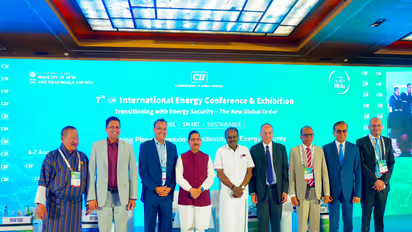
Delivering a keynote speech at the Special Plenary Session on "Energy Security & Supply Chains" at the 7th CII International Energy Conference & Exhibition in New Delhi, the Minister outlined India's strategy to emerge as a global hub for clean technologies. He emphasized that industrial capability and energy security are now fundamentally linked. "Today, under the visionary leadership of Hon'ble Prime Minister Narendra Modi, India's energy security is no longer defined solely by access to energy resources. It is increasingly determined by our ability to manufacture, innovate and build resilient supply chains for the technologies that will power the future," the Minister said.
A Strategic Shift Towards Self-Reliance
Kumaraswamy noted that recent geopolitical disruptions and competition over critical minerals have shifted industrial priorities worldwide. He explained that India is responding through the vision of Aatmanirbhar Bharat by establishing competitive domestic capabilities while staying connected to global value chains.
"India should not merely become one of the world's largest consumers of clean energy technologies. India must become one of the world's leading producers of the equipment, materials and technologies that will drive the global energy transition," he said.
Steel: The Backbone of the Clean Energy Transition
Highlighting the crucial role of Heavy Industries and Steel, Kumaraswamy described steel as the central pillar of the clean energy transition, pointing out that renewable infrastructure, battery factories, and hydrogen projects rely directly on steel. He noted that as the world's second-largest producer, India is well positioned to meet its expanding domestic needs while addressing global demand for sustainable steel. He reaffirmed the national target of reaching 300 million tonnes of steelmaking capacity by 2030 through eco-friendly practices.
"Steel has become the backbone of the global energy transition. The future of the steel sector will not be defined only by production capacity but by sustainability, competitiveness and technological advancement," he remarked.
Key Initiatives for a Resilient Supply Chain
The Minister detailed key central initiatives driving this industrial shift, including the PM E-DRIVE Scheme with an outlay of Rs 10,900 crore to build complete electric mobility ecosystems, and the Production Linked Incentive (PLI) Scheme for Advanced Chemistry Cell Batteries, committing Rs 18,100 crore for 50 GWh of battery capacity. He also pointed to the Rs 7,280 crore scheme for manufacturing Sintered Rare Earth Permanent Magnets to secure critical mineral supply chains.
"Our objective is to build complete domestic manufacturing ecosystems that create value and generate employment. This is the essence of resilient supply chains in the twenty-first century," he said.
A Call for Collaborative Action
The Union Minister urged industry, academia, and financial institutions to join hands with the government to advance national self-reliance and support long-term economic development goals.
"I invite industry and all stakeholders to come forward and work with the Government to make India Aatmanirbhar and realise the vision of Viksit Bharat by 2047," the Minister said. (ANI)
(Except for the headline, this story has not been edited by Asianet Newsable English staff and is published from a syndicated feed.)Stay updated with all the latest Business NewsShare Market NewsIPOsGold PriceDA Hike8th Pay CommissionAsianet News Official App