China urges open AI development, cautions on US national security risks
Synopsis
China's Foreign Ministry called for an open and inclusive approach to AI development, warning against turning it into a geopolitical, zero-sum contest. Beijing criticised calls for a slowdown and pushed for global cooperation and governance.
China Advocates for Open, Inclusive AI
China on Monday called for greater openness and inclusivity in artificial intelligence development, warning that “fear-mongering, confrontation and vicious competition” could undermine efforts to establish sound global governance for the technology.
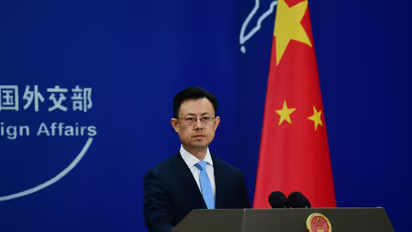
Responding on "Chinese AI advantage would pose US national security risks", China’s Foreign Ministry spokesperson said AI was a “consequential technology for the future of humanity” and called for the development of “open & inclusive AI for good and for all”.
The comments come amid growing debate over the pace of AI development and the potential risks posed by increasingly capable models, including concerns over whether advances could outpace humans’ ability to understand and control the technology.
Geopolitical Tensions and Development Debate
The issue has also acquired a geopolitical dimension, with China and the US competing for leadership in AI, including in areas such as advanced models, computing power and semiconductor technology.
China’s state-run Global Times has criticised Anthropic CEO Dario Amodei after he called for a slowdown in AI development, arguing that rapid advances could eventually outpace humanity’s ability to control such systems.
Amodei has warned that AI development is accelerating rapidly, partly because AI systems are increasingly capable of contributing to the development of the next generation of AI models. He has described this process as “recursive self-improvement” and said it could eventually outpace efforts to understand and control advanced systems.
Global Times quoted Chinese technology experts as saying that framing AI development as a US-China national security competition risks turning AI safety into a geopolitical issue rather than a global challenge requiring cooperation.
Push for Global Cooperation
The debate comes as China pushes for greater international cooperation on AI governance. At the BRICS Summit in New Delhi, Chinese President Xi Jinping called for a people-centred approach to AI and a global governance framework based on consensus.
China has also proposed establishing a BRICS AI open-source community as part of wider cooperation on emerging technologies, alongside initiatives covering digital industries, intelligent manufacturing and science and technology talent.
Against this backdrop, Beijing’s latest comments signal its preference for international cooperation and open development of AI, while opposing approaches that it believes could turn technological progress into a zero-sum contest between major powers. (ANI)
(Except for the headline, this story has not been edited by Asianetnews Editorial staff and is published from a syndicated feed.)Stay updated with all the latest Business NewsShare Market NewsIPOsGold PriceDA Hike8th Pay CommissionAsianet News Official App