BYD Sets New Electric Car Speed Record, Surpassing Rimac
Synopsis
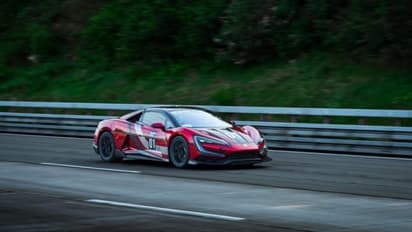
BYD's Yangwang U9 reportedly reached 472.41 km/h on a German track, surpassing the Rimac Nevera R's record. This track-focused version boasts quad electric motors with a combined output exceeding 3,000 PS, advanced torque vectoring, and more.
Chinese electric vehicle giant BYD claims to have developed the fastest electric car technology. The company says its track version of the Yangwang U9 achieved a top speed of 472.41 km/h. This track run took place at the Automotive Testing Papenburg (ATP) plant in Germany. This is the same track where the Rimac Nevera R hypercar previously set several records in July.
Reports indicate that the track-focused version of the BYD Yangwang U9 has become the world's fastest electric car. Compared to the Yangwang U9's 472.41 km/h, the Rimac Nevera R achieved a top speed of 431.45 km/h. This record was set in July 2025. The track-focused version of the Yangwang U9 has a clear lead in top speed. The track-focused Yangwang U9 is approximately 80 km/h faster than the standard Yangwang U9. During a track run in November 2024, the Yangwang U9 achieved a top speed of 391.94 km/h.
German racing driver Marc Basseng drove the track-focused BYD Yangwang U9. This electric hypercar is equipped with quad electric motors. Each of these produces 555 kW or 755 PS. This produces a combined output of over 2,207 kW or 3,000 PS. The power-to-weight ratio is 1,200 PS per ton. In comparison, the Rimac Nevera R, with its four electric motors combined, produces a combined power output of 1,571 kW or 2,017 PS.
To achieve and maintain such high speeds, the track-focused Yangwang U9 utilizes advanced equipment. To harness its immense power, this hypercar features advanced torque vectoring technology. For optimal traction, this electric car uses the DiSus-X intelligent body control system on the BYD e4 platform. It works by making real-time adjustments to the suspension. For example, it adjusts damping force and ride height to keep the vehicle stable during extreme cornering and acceleration.
The track-focused Yangwang U9 uses a special thermal management system to ensure optimal cooling in extreme conditions. The hypercar claims to be the first car to use a mass-produced 1200V ultra-high-voltage vehicle platform. It also has some unique aspects, such as being able to use duct tape to cover gaps in the body paneling. This will improve aerodynamics.