Zelenskyy Says US Floated Donbas For NATO Trade Deal In Recent Talks
Synopsis
Volodymyr Zelenskyy revealed US negotiators proposed ceding Donbas for NATO membership. While rejecting territorial cessions, he is open to public consultation if offered a comprehensive security package amidst ongoing international peace talks.
Zelenskyy Says US Floated Donbas For NATO Trade Deal In Recent Talks
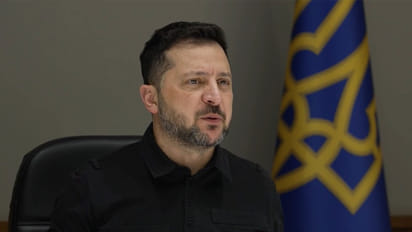
Ukrainian President Volodymyr Zelenskyy has said that Washington recently floated the possibility of Kyiv surrendering its eastern Donbas region to Russia in exchange for joining NATO. According to CNN, speaking to reporters, Zelensky noted that it was the "first time" US negotiators had put forward such an idea.
Russian President Vladimir Putin has long sought control over the Donbas, while pointing to Ukraine’s potential accession to the Western military alliance as a key justification for launching his full-scale invasion in 2022. Although Russian forces hold a large portion of the Donbas, Moscow's protracted ground campaign in the area has largely ground to a halt.
"The Americans raised a question: ‘What if Ukraine joins NATO? Would Ukraine withdraw from Donbas?’ This was the first time this had been raised," CNN quotes Zelensky as saying.
While emphasising that Kyiv would not cede its territory, the Ukrainian leader stated he would submit a proposal to a public vote if offered a "comprehensive security package" featuring a well-equipped Ukrainian military and formal NATO guarantees. "If the American side confirms precisely this to us, together with other NATO partners, then I will ask our Ukrainian society what it thinks: do we accept it or not? I have no right to make that decision on my own. But we need specifics, and we don’t have them yet," he added, according to CNN.
The Donbas region assumes significance militarily, as it houses Ukraine’s heavily fortified "fortress belt," which serves as a critical defensive buffer preventing Russian forces from advancing into central Ukraine. Economically and politically, the region is Ukraine’s industrial heartland, rich in coal, shale gas, and critical minerals, while also forming a vital land corridor to Crimea and the Sea of Azov. The region is often described as a central and defining fault line in diplomatic negotiations.
Russian President Vladimir Putin has consistently demanded full Ukrainian withdrawal from the entire Donbas as a core condition for any settlement, while Zelensky has framed holding the region as a matter of Ukraine's national survival.
This comes amid renewed diplomatic engagement between the two sides facilitated by the United States, with Ukrainian President Volodymyr Zelenskyy recently holding discussions with US President Donald Trump's Special Envoy Steve Witkoff and Jared Kushner in Ireland. The meeting followed their discussions with Russian President Vladimir Putin in Moscow and focused on humanitarian issues, greater European participation in peace negotiations and further diplomatic engagements.
Zelenskyy said the discussions had produced three key outcomes, including preparations for what could become the largest prisoner exchange since the beginning of the conflict. "First, a humanitarian outcome – prisoners will be released, and we are counting on the largest prisoner exchange since the start of this war," he said in a post on X.
He also stressed the importance of European involvement in the diplomatic process, saying Kyiv wanted European representatives to have an equal position at the negotiating table. "The second outcome – we are involving European representatives even more actively in diplomacy so that they can have an equal seat at the negotiating table. Ukraine always defends the interests of all of Europe," Zelenskyy said.
The Ireland meeting followed talks between Witkoff, Kushner and Putin at the Kremlin in Moscow. The discussions came after two days of trilateral negotiations involving Russia, Ukraine and the United States in Abu Dhabi, which concluded without a breakthrough but reportedly made progress on several issues, including preparations for a prisoner exchange. However, significant differences remain over territorial arrangements and future security guarantees.
During the Kremlin discussions, Putin reiterated Moscow's opposition to the deployment of foreign troops on Ukrainian territory following a potential peace agreement. "The presence of any foreign troops on Ukrainian territory is absolutely unacceptable to us," Putin said.
Meanwhile, five European countries — France, Germany, Italy, Poland and the United Kingdom — along with European Union institutions will represent Europe in negotiations aimed at ending the Ukraine conflict, European Council President António Costa announced on Friday (local time), amid renewed diplomatic efforts involving the United States, Ukraine and Russia. The inclusion of the E5 countries and EU institutions in Europe's negotiating team marks a coordinated effort by European leaders to ensure the continent has a unified voice in ongoing diplomatic efforts to end the Ukraine conflict.