World Press Freedom Day: UN warns of escalating dangers for journalists
Synopsis
UN chief Antonio Guterres warns of escalating dangers for journalists, linking free press to peace. An RSF report shows global press freedom has hit a 25-year low, with over half of nations facing 'difficult' or 'very serious' conditions.
Guterres' Stark Warning on Press Freedom
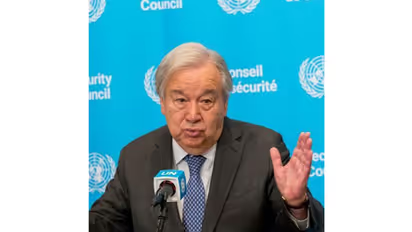
UN Secretary-General Antonio Guterres has issued a stark warning on World Press Freedom Day, highlighting the escalating dangers faced by media professionals globally and asserting that without a free press, there can be no peace or human rights. The UN chief noted that while it is often said that in war, "truth is the first casualty," the reality is frequently more grim.
"But far too frequently, the first casualties are the journalists, who risk everything to report that truth, not only in war, but wherever those in power fear scrutiny," he said.
Antonio Guterres pointed out that across the globe, media workers continue to face a barrage of threats, including "censorship, surveillance, legal harassment and even death." He expressed deep concern over the sharp rise in the number of journalists killed in recent years, particularly those who are "often deliberately targeted, in war zones."
Highlighting a systemic failure to protect media workers, the UN Secretary-General revealed that "85% of the crimes committed against journalists go uninvestigated and then punished," describing this as "an unacceptable level of impunity." He further cautioned that press freedom is under "unprecedented strain" due to a combination of economic pressures, new technologies, and active manipulation.
Guterres warned of the societal consequences that follow when the media is silenced or intimidated. "When access to reliable information erodes, mistrust takes root. When public debate is distorted, social cohesion weakens. And when journalism is undermined, crises become far more difficult to prevent and resolve," he stated.
Emphasising the foundational role of a free media, the UN Secretary-General remarked that "all freedom depends on press freedom." He maintained that without such liberties, "there can be no human rights, no sustainable development and no peace." In his appeal to the international community on World Press Freedom Day, Antonio Guterres called for a global commitment to "protect the rights of journalists and build a world where the truth and truth-tellers are safe."
Global Press Freedom Hits 25-Year Low
These warnings from the UN chief coincide with findings that global press freedom has plummeted to its lowest level in a quarter-century, with a new report by Reporters Without Borders (RSF) revealing a catastrophic decline in media independence worldwide. The World Press Freedom Index 2026 indicates that more than half of the 180 nations surveyed are now categorised under "difficult" or "very serious" conditions.
According to the RSF, the worldwide average score has fallen to 54.3 points, marking the weakest performance since the Index was established in 2002. The organisation observed that "52.2%" of countries now occupy the most troubled categories, representing a massive increase from the "13.7%" recorded two decades ago. Most alarmingly, less than 1 per cent of the global population resides in nations where the environment for journalism is deemed "good," a sharp contrast to the 20 per cent documented in the early 2000s.
The RSF attributed this decline to a toxic mix of aggressive political rhetoric, the financial instability of media outlets, and the increasing implementation of legislation designed to obstruct journalistic activities. The report highlighted that the legal framework for the press has seen the most significant decay over the past year, with over 60 per cent of countries witnessing a downturn. The authorities are reportedly employing national security and anti-terror laws as "key tools" to stifle reporting.
Country Rankings and Regional Impact
War-torn regions remain the most perilous for media workers. The RSF noted that Iraq, Sudan, and Yemen are among those severely impacted, while the conflict in Gaza has resulted in the killing of over 220 journalists since October 2023.
In terms of rankings, Norway has secured the first position for the tenth year running, while Eritrea continues to be placed at the bottom for the third consecutive year. Conversely, Syria saw a notable rise, jumping 36 spots following the political transition after the collapse of the Bashar al-Assad administration in December 2024.
The United States has slipped seven places to 64th position, a drop the RSF linked to heightened political animosity towards the media and institutional choices affecting international news agencies. "US President Donald Trump's frequent attacks on the press and journalists are now systematic, relegating the country to 64th place," the RSF stated. (ANI)
(Except for the headline, this story has not been edited by Asianet Newsable English staff and is published from a syndicated feed.)