West Asia conflict slows IMEC, but India, Europe still keen: Jaishankar
Synopsis
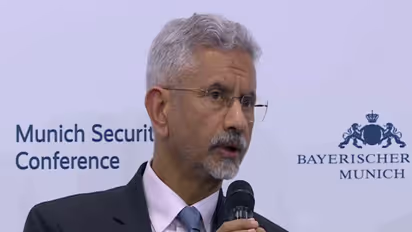
EAM S Jaishankar said the IMEC project is progressing, but slower than anticipated due to the West Asia conflict. Speaking at the Munich Security Conference, he affirmed strong continued interest from India and Europe in the economic corridor.
External Affairs Minister S Jaishankar on Saturday said that the India Europe Middle East Corridor (IMEC) was progressing but not at the pace that was initially expected due to the conflict in West Asia.
Speaking at the Munich Security Conference 2026, Jaishankar in response to a question on the progress of the project, which noted that US President Donald Trump had expressed enthusiasm for the initiative, said that the answer was "kind of yes," though at a slower pace than initially anticipated. He attributed the delay to the ongoing conflict in West Asia, which shifted regional and international attention toward immediate security concerns. "It's understandable because there was a big conflict going on in the Middle East and everybody's attention was on that conflict," Jaishankar said.
Sustained European and Indian Interest
The External Affairs minister underscored sustained interest in the corridor from both India and Europe. He pointed to conversations with governments, leaders, and businesses from Mediterranean countries as well as Germany and France, describing "a big European interest" matched by "a big Indian interest."
Further he framed the project as a revival of historic trade linkages between India and Europe. "There's a big European interest in the IMEC, there's a big Indian interest in the IMEC. We are the two ends of it. remember this is the historical trade route of hundreds if not thousands of years so we are trying..."Jaishankar said.
He alluded to German Chancellor Freidrich Merz remarks at the Munich Security Conference "coming back from a vacation from history" to explain the importance of IMEC at a time when global politics becomes more competitive, countries are rediscovering the importance of old trade geographies -- and reinventing them for the 21st century.
"You know yesterday I think Chancellor Merz used this 'coming back from a vacation from history' I think when you come back from the vacation you'll discover IMEC is also part of history which you need to reinvent," Jaishankar said Suggesting that Europe is now re-entering a phase of strategic competition and geopolitical realism - shaped by war in Ukraine and intensifying global rivalries, Jaishankar argued that IMEC too is "part of history which you need to reinvent."
The phrase "vacation from history" is often used to describe Europe's post-Cold War period -- a time when many European states assumed major geopolitical conflict and power competition were largely over. Jaishankar was in conversation with his German counterpart Foreign Minister Johann Wadephul in a discussion on the topic: "Navigating Uncertainty: India and Germany in a World in Disarray."
Corridor's Purpose is Economic, Not Political
Responding to a question by a audience member who asked how the IMEC would contribute to regional stability in a manner consistent with international law and the two-state solution, Jaishankar clarified that the proposed corridor is primarily an economic and connectivity project and should not be viewed as a mechanism to resolve the Israel-Palestinian issue.
The External Affairs Minister reiterated that India maintains a longstanding and well-known position on Palestine and cautioned against conflating political disputes with economic initiatives. "When we embarked with a set of partners on the IMEC, the purpose is really to address connectivity and logistics issues and improve the economy," he said. "I would be careful mixing up the two issues. The purpose of IMEC is not to solve the Palestinian issue."
He stressed that while both regional stability and Palestinian rights are important matters, the economic corridor was not designed as a substitute for political negotiations. "Each of those issues is important, but I would not take one as the solution for the other," he added.
IMEC's Framework and Path Forward
The India-Middle East-Europe Economic Corridor (IMEC), unveiled in 2013, comprises of an Eastern Corridor connecting India to the Gulf region and a Northern Corridor connecting the Gulf region to Europe. It will include a railway and ship-rail transit network and road transport routes.
Foreign Secretary Vikram Misri while addressing a special Briefing on the State visit to India of the President of EU Council Antonio Costa and the President of EU Commission to Ursula von der Leyen in January touched up on the consensus in the Inida-EU FTA on the fact that the IMEC initiative is one that should be taken forward.
Stating that "Connectivity is a very important thread in the agenda between India and the EU," Misri said that IMEC "was on the agenda, and there was consensus on the fact that the IMEC initiative is one that should be taken forward."
"And we should now graduate from the working-level meetings that have taken place to higher-level meetings, culminating in a summit of the IMEC member countries. So between Europe and India, we are united on this, and we will take this forward with the other collaborators within IMEC," Misri had said in the special briefing.
The IMEC was proposed during the 2023 G20 Summit in New Delhi. Along with India and the United States, Saudi Arabia, the European Union, the United Arab Emirates, France, Germany, and Italy signed a Memorandum of Understanding for the project. (ANI)
(Except for the headline, this story has not been edited by Asianet Newsable English staff and is published from a syndicated feed.)