War in the Gulf and the Fragility of the Global Energy System
Synopsis
Experts say rising tensions in Gulf have exposed how vulnerable the global economy remains to energy disruptions. With nearly 20% of world’s oil passing via Strait of Hormuz, even small disturbances can shake markets. Prolonged conflict involving the US, Iran and Israel could push oil prices higher, disrupt shipping, and trigger inflation.
By Dr Aparaajita Pandey
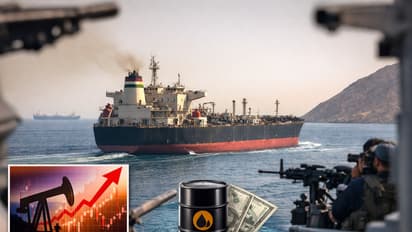
It has been seen that when a conflict erupts in the Persian Gulf, economies around the world get worried. The same is the case at the moment, as the conflict between US, Iran, and Israel escalated, to no one’s surprise the Strait of Hormuz has become the most valuable cog in global wheel of the crude oil supply chain. The Strait of Hormuz is easily one of the most contested choke points in the global supply of crude oil and natural gas. The fact that almost one – fifth or 20 percent of all of the world’s supply passes through the strait has made it a battlefield.
The narrow passage separates Iran from the Arabian Peninsula and even slight disruptions often start a chain reaction that has the tendency to snowball into inflation that becomes hard to contain which has an impact on almost every sector of the economy. As this particular conflict seems to be one that can not be easily quelled and has a chance of becoming a prolonged dispute, the panic that has begun to set in; would eventually lead to even greater problems.
The deeper significance of the crisis lies beyond the daily fluctuations of energy markets. The conflict and the immediate fall out around the world is indicative of the fact that the global economy remains structurally vulnerable to geopolitical shocks in the Gulf; and that is a reality that has not changed and one that has shaped international politics for more than half a century.
Echoes of 1973
The modern history of energy geopolitics begins with the oil shock of 1973.As a spillover of the Arab-Israeli War, Arab members of OPEC enacted an oil embargo against the United States and several of its European allies. The result was an almost immediate and spectacular quadrupling of oil prices and one of the most historic and severe economic consequences of the cold war era.
The embargo uncovered an elementary fact about the global economy which was that control over energy supply had the potential to provide a country with virtually infinite geopolitical leverage. Western economies nosedived into recession, inflation surged, and governments of the west were forced to recalibrate their foundations of energy security.
The crisis redesigned global operating procedures. Strategic petroleum reserves were established, energy diversification became a policy priority, and crude oil began to be treated as a national security imperative and not merely an economic priority.
The leverage that controlling crude oil supplies holds in the international market has not changed even today. This is a textbook example of energy statecraft, and will possibly be quoted every time there’s a conflict in the gulf in the future.
The Tanker War Revisited
The current crisis is also reminiscent of a later incidence of Gulf conflict as well; the Tanker War of the 1980s. During the Iran-Iraq War, both sides targeted oil tankers and energy infrastructure to destroy the other’s economy and consequently upset global energy flows.
Between 1984 and 1988 a multitude of vessels were attacked in the Persian Gulf. Oil terminals, shipping lanes, and tankers became instruments of strategic warfare. Much like today, insurance rates mounted, global shipping was interrupted, and external powers including the United States were pulled into escorting oil tankers through the Gulf. The Tanker War exhibited a crucial link. It was one between the global energy system and its reliance on the extremely fragile maritime infrastructure.
That logic is the same, only the weapons and technology has become more sophisticated. This advancement in technology has led to more precision in the disruption of energy infrastructure and supply.
The Geography of Energy Power
The tyranny of geography continues to play out even today especially in the current conflict. Despite decades of diversification, massive volumes of oil and liquefied natural gas still have to pass through a limited number of maritime chokepoints. The Strait of Hormuz tends to be the most important of these, followed by the Suez Canal and the Strait of Malacca.
The markets tend to react immediately if even one of these is blocked for any reason. The current crisis tanker traffic through Hormuz has slow down dramatically as shipowners re-evaluate the risks of operating in an active conflict zone. War-risk insurance premiums have escalated, and shipping companies have momentarily suspended transit through the region. It is important to note that volatility in the markets has been triggered even without complete closer of the Strait of Hormuz.
Geoeconomic Warfare and Asia’s Strategic Exposure
For Iran, the leverage created by this geography is pivotal to its strategy. Tehran doesn’t need to defeat its adversaries in a conventional military confrontation. Threatening the free flow of energy through the Gulf, imposes economic costs on the entire global system including its opponents. The war shifts from the battlefield to supply chains and global infrastructure which consequently makes the target area to large that those not directly involved also get affected. The political economy of the conflict becomes so large that energy insecurity and mounting financial costs, build a pressure so strong that diplomatic avenues have to be explored.
Such conflicts expose energy vulnerabilities around the world, and they have been more pronounced in Asia than other regions. Roughly three-quarters of the crude passing through the Strait of Hormuz is for Asian economies, including China, India, Japan, and South Korea. For these countries, stability in the Gulf is not a distant geopolitical concern but a central economic interest.
India demonstrates the dilemma particularly clearly. India relies greatly on imported energy to sustain industrial growth and transportation networks. A continued rise in oil prices, an interruption in shipping quickly translates into inflationary pressures, fiscal strain, and currency volatility. This reality also exposes a deeper strategic contradiction. India tends to frame its foreign policy around the Indo-Pacific, yet its economic lifelines remain intrinsically tied to a stable West Asia.
A Fragile Global System
The current conflict underscores the fact that the global economy is inextricably tied to geopolitical risk, energy security, and diplomatic manoeuvring.
Energy markets sit at the centre of that intersection. The infrastructure that is responsible for the smooth running of global economies is also the most vulnerable part of the global supply chain and can be used as leverage for coercion. It is clear that while strides have been made in technology and infrastructure and the nature of warfare has changed; the fundamentals of strategic leverage have not. The core characteristics of a conflict have remained the same and countries are bound by their geography; either blessed by their natural lotteries or destroyed by them. It has also reiterated that resource nationalism or complete control over one’s own natural resources is of utmost importance.
It seems that the trend of this kind of strategic leverage will continue, and the same lessons of diversification and alternative resource bases, passages, and markets will be discussed once the conflict reaches its eventual end. It will be interesting to see, if anything changes.
The author is an energy strategist and a Professor at Amity Institute of Defence and Strategic Studies, Amity University.