US Teacher Quits Job, Turns Side Hustle Into Full-Time Career, Earns Over Rs 4 Lakh A Month By Walking Dogs
Synopsis
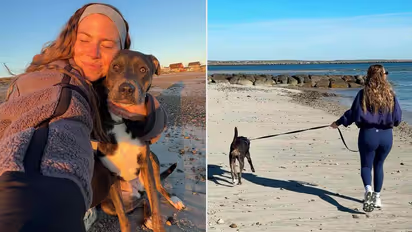
A woman in the United States left her teaching job after five years to pursue the side hustle of dog walking and pet sitting full time, People magazine reported.
For five years, Kaitlyn Ballard worked as a fifth-grade reading and writing teacher, following a routine that began long before sunrise. The 27-year-old would wake up at 4:30 am to hit the gym, return home for breakfast and get ready for work. By 7:30 am, she was in her classroom, where she would remain until 3:30 pm.
“Teaching was always the plan, and I honestly never thought about doing anything else,” Ballard, 27, tells PEOPLE exclusively. “I never had an ultimate passion for teaching where that is what I could only see myself doing, I just was never presented with any other option.”
After five years in the classroom, however, Ballard, who was living in Texas with her husband at the time, began wondering if teaching was really where she wanted to spend the next phase of her career.
She felt there was limited room to grow in the direction she wanted her life to take. Ballard wanted more control over her schedule, greater flexibility and an opportunity to challenge herself outside the classroom.
“I wanted my everyday to be something that I found so much joy in,” she says. “Leaving was scary because teaching had been such a huge part of my identity, but I also knew that staying somewhere simply because it was familiar wasn’t going to get me where I wanted to go.”
But there was one major obstacle standing between Ballard and a career change: financial security.
Rather than immediately walking away from her teaching job, she began searching for a way to generate additional income while keeping her regular paycheck. That search led her to dog walking and pet sitting through Rover.
Ballard initially charged $20 per walk and $60 per night for house sittings and boarding. While continuing to teach full time, she says the side hustle brought in an additional $35,807.25.
At that stage, Ballard had no intention of turning dog walking into a full-time profession. She was simply fitting clients around her demanding teaching schedule.
“I never imagined becoming a full time dog walker/pet sitter, but I feel like anyone that is, never initially planned for it,” she says. “It kind of just happens over time.”
For Ballard, that transition happened little by little.
As the number of clients grew and she recognized the business potential, she began investing in her work. She completed pet first aid training, obtained insurance for her pet-sitting business and more than doubled her rates.
She also started approaching her Rover profile like a business rather than simply a listing. Ballard researched competing sitters in her area, studied local pricing and worked on creating a profile and bio that would attract potential clients.
In 2025, Ballard and her husband learned they would be moving from Texas to Cape Cod, Massachusetts, because of his military service. The relocation gave her the chance to make the career change she had already been considering.
More importantly, the income she had built through Rover gave her enough financial breathing room to pursue pet sitting full time.
After moving to Massachusetts, Ballard continued growing her client base through Rover and word of mouth. Since arriving on the Cape, she says she has worked with 29 different clients, including eight recurring weekly clients and four larger clients who regularly book house sittings and extended stays requiring multiple visits each day.
“One day, I want to open my own LLC, but as I am in the building stages, Rover plays an imperative part of it because that credibility travels with me and I am able to reach so many people without having to market myself outside of the app,” she says.
Her earnings have also climbed dramatically.
While she was still teaching, Ballard says her monthly dog-walking income ranged from roughly $300 to $500 during slower periods and $1,000 to $1,500 during her busiest months.
Since turning pet sitting into her full-time work, she says she now averages between $4,000 and $4,500 a month while working approximately 15 to 20 hours a week.
Her biggest month so far came in April, when she says she earned $6,763.
“I didn’t even have to work 40 hours a week to see that income and that is when I knew this business could be scaled way further than what I am even doing now,” she says.
The change has transformed more than Ballard's income. It has completely reshaped her daily routine.
Her average workday now begins around 9:45 am, when she heads out for her first client, and typically ends around 1 pm, depending on her schedule.
Before work, she has time to wake up at sunrise, walk along the beach, exercise and eat breakfast. She can even return home for lunch before finishing her working day in the early afternoon.
The contrast with her teaching routine is striking.
“Life is SO different now and only for the better,” she says. “I have more time to myself, to my husband, to our two dogs, and the opportunity to pursue the things that bring me the most joy.”
But Ballard says the flexibility of the profession can sometimes obscure just how demanding the work really is.
“The biggest surprise had to be how much work can actually go into building a dog walking business,” she says. “Dog walking can be viewed as a low income, side hustle, do it while you are in high school kind of job. However, that is so far from the truth.”
The job requires much more than simply taking a dog outside, according to Ballard. Pet sitters need to understand different breeds, sizes and temperaments, read canine body language and recognize signs that something may be wrong.
She has encountered situations involving off-leash or reactive dogs and says the work can also involve breaking up fights at dog parks or responding to emergencies such as choking or overheating.
“You can be put in high stake situations where you are the sole person responsible for the safety of that dog in your care and the safety of the people around you,” she says.
The experience also changed Ballard's perception of the phrase “professional pet sitter.”
“You see people referring to themselves as ‘professional pet sitters’ and from the outside, I used to laugh at that,” she says. “However, after being on this side of the business, I now recognize the importance of that label because when you do this full time, put in the work to obtain all the knowledge and experience, gain the necessary credentials and become fully insured, this is no less than a professional job.”
As her business gained momentum, Ballard discovered another way to turn her experience into an income opportunity: social media.
She began documenting her journey online and creating content for people interested in using Rover to build their own pet-sitting businesses. Her goal was to highlight the financial potential of pet sitting while eventually creating another source of income.
“I decided to document my journey for two reasons: to share with others the opportunities that jobs like dog walking can provide for you financially, even beyond a side hustle, and to eventually monetize what I am teaching others,” she says.
Ballard now offers Rover profile audits, a pet-sitting business tracker, a Rover Blueprint Master Course and one-on-one coaching.
Her digital products have opened another revenue stream while allowing her to connect with aspiring pet sitters across the U.S., Canada and the Netherlands. Some are building their own businesses, while others are considering leaving traditional jobs, including teaching.
Her online content focuses on maximizing the Rover platform while also discussing the realities of self-employment, from earnings and expenses to taxes.
For Ballard, the career change has also had a profound personal impact.
“Leaving teaching and building my pet sitting business has increased my mental health by 110%,” she says, adding that while she was teaching, she experienced panic attacks at night related to the environment she faced each day. “The pressure, the standards, the expectations, were insane and my body eventually stopped trying to keep up.”
Ballard says she now sees dog walking as a long-term career but does not plan to stop there.
“I do see dog walking as a long term career; however, I also see myself doing more than that,” she adds. “I see myself continuing to teach others how to successfully build their pet sitting business while continuing to build mine and working with brands who align with my values and my work.”
“What I am building is so much bigger than just walking dogs,” she continues. “I’m building a life that I actually want to wake up to. A life where I have freedom, flexibility, creativity, and the ability to decide what comes next.”