US museum to return stolen Shiva Nataraja, other Indian antiquities
Synopsis
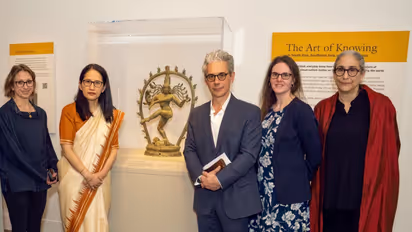
Three invaluable antiquities, including a 9th-century Shiva Nataraja, will be returned to India from the Smithsonian's National Museum of Asian Art after research confirmed they were illegally removed from Tamil Nadu temples.
Three invaluable antiquities are set to return to India from the Smithsonian's National Museum of Asian Art (NMAA) following extensive provenance research confirming that they were illegally removed from the country. The objects include a 9th-century Shiva Nataraja bronze, a 12th-century Somaskanda sculpture of Shiva and Uma, and a 16th-century depiction of Saint Sundarar with Paravi.
An agreement formalising the return was signed by the Deputy Chief of the Indian Mission in US, Ambassador Namgya Khampa, and NMAA Director Dr Chase Robinson. According to the Embassy of India in the United States, the Shiva Nataraja bronze will remain on long-term loan to the Smithsonian, allowing the public to view it and appreciate India's rich artistic and spiritual heritage.
Investigation Confirms Illegal Removal
Earlier in January, the National Museum of Asian Art announced that after a thorough provenance review, it had confirmed that the sculptures had been removed illegally from temple settings in Tamil Nadu. The museum's investigation involved detailed scrutiny of the objects' transaction histories, with photographic evidence from the Photo Archives of the French Institute of Pondicherry showing the sculptures in temples between 1956 and 1959. The findings were corroborated by the Archaeological Survey of India, which confirmed that the bronzes had been taken in violation of Indian laws.
The Priceless Sculptures
The three sculptures -- Shiva Nataraja (Chola period, ca. 990), Somaskanda (Chola period, 12th century), and Saint Sundarar with Paravai (Vijayanagar period, 16th century) -- exemplify the high artistry of South Indian bronze casting. They were originally sacred objects, carried in temple processions, reflecting the religious and cultural heritage of the region.
Provenance Details Emerge
The Shiva Nataraja bronze, which belonged to the Sri Bhava Aushadesvara Temple in Tirutturaippundi Taluk, Tanjavur District, was photographed in 1957 and later acquired by the museum from the Doris Wiener Gallery in New York in 2002. Research revealed that falsified documentation had been used to facilitate its sale.
The Somaskanda and Saint Sundarar with Paravi sculptures entered the museum's collection as part of a gift from Arthur M. Sackler in 1987. Provenance research confirmed their presence in temples in Alattur village and Veerasolapuram village, Tamil Nadu, in 1959 and 1956, respectively.
A Collaborative Effort
The return of these objects was made possible through the dedicated efforts of the NMAA's provenance team, South and Southeast Asian Art curators, and support from institutions such as the French Institute of Pondicherry, alongside cooperation from various individuals and organisations worldwide. (ANI)