US lawmakers sound 'alarm bell' over China's infiltration campaign
Synopsis
US lawmakers issue a stark warning about the CCP's 'epic campaign' to infiltrate local US governments. The conviction of a former California mayor is cited as an 'alarm bell,' highlighting China's strategy of targeting 'soft targets.'
CCP's 'Epic Campaign' to Infiltrate US at Local Level
United States lawmakers have issued a stark warning regarding the Chinese Communist Party's (CCP) "epic campaign" to infiltrate American local governments, citing the recent conviction of a former California mayor as a critical "alarm bell" for national security.
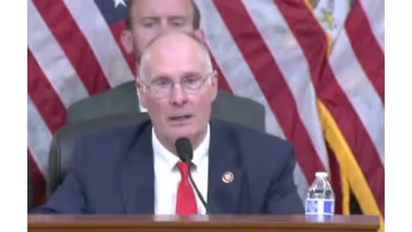
The Select Committee on China Chairman, John Moolenaar, in his opening statement on Thursday at the hearing titled 'China's Economic Espionage and Subnational Influence in the United States', accused the Chinese government of undertaking "an epic campaign" to undermine the United States at home. The campaign, he said, spanned economic and traditional espionage, state-directed cyber intrusions, talent recruitment programs, information warfare, covert influence networks, legal and illegal lobbying, blackmail, infiltrating critical infrastructure, and transnational repression aimed at the Chinese diaspora.
The hearing followed last month's arrest and guilty plea of Eileen Wang, the former mayor of Arcadia, California, who was revealed to be an illegal agent acting at the direction of People's Republic of China government officials. It highlighted how Beijing is increasingly targeting "soft targets" such as municipal governments, school boards, and local businesses to bypass federal oversight.
Moolenaar detailed how Eileen Wang acted as an illegal agent for the Chinese government. Wang, who recently pleaded guilty and is now in prison, was found to be carrying out a Chinese Communist Party (CCP)-directed agenda before her tenure as mayor. "This Chinese government agent - acting at the direction of PRC government officials - took advantage of our free and open society to carry out an agenda on behalf of the CCP. This is an alarm bell for all of us that the CCP's malign influence must be confronted," Moolenaar stated.
United Front Work: A Tool for Political Warfare
He identified the CCP's "United Front Work" as a primary instrument of political warfare, operating through a sophisticated strategy of access, coercion, and incentives. "What makes it uniquely concerning is that it is not simply a foreign intelligence activity conducted from afar; it is a comprehensive influence operation that reaches deep into communities, businesses, and institutions across the United States, often through seemingly benign cultural, academic, or commercial engagement," Moolenar said in his introductory remarks at the hearing.
The CCP utilises trade delegations and "sister-city" relationships to identify and co-opt local influencers. It pressures the Chinese diaspora by exploiting family ties in China to silence criticism or gather intelligence. Further, it offers commercial benefits and political access to local officials in exchange for supporting Beijing's narratives.
The hearing further described the CCP as the "largest oppressor of Chinese people in the world," noting that the regime specifically targets Chinese-Americans who courageously speak out against its activities. "A strategic investment pitch to a mayor, a partnership with a local university, or outreach to diaspora civic groups can yield long-term advantages for the CCP's objectives. Because these engagements often occur far from Washington, they can unfold with limited oversight, inconsistent safeguards, and uneven awareness of the risks involved," Moolenar said.
Call for 'Whole-of-Society' Response to Counter CCP
The Republican lawmaker warned that a significant "vulnerability gap" exists between federal intelligence and local exposure. Because local engagements often occur far from Washington, they frequently unfold with "limited oversight and inconsistent safeguards."
In a call for a "whole-of-society" response, he said that federal agencies must share actionable intelligence with state and local partners. The goal, the lawmaker stated, is to transition toward cultural and economic exchanges that are "transparent, secure, and mutually beneficial" while safeguarding US sovereignty from CCP manipulation.
The bipartisan House Select Committee was established in 2023 to investigate and analyse economic and security threats posed by the Chinese Communist Party. Democratic Members Representative Kathy Castor, Representative Andre Carson, Representative Jill Tokuda and Representative Greg Stanton questioned witnesses at the Select Committee hearing
Bipartisan Concerns and Warnings Against Xenophobia
Ranking Member Ro Khanna, in his remarks, echoed concerns regarding economic espionage, stating it is "undisputed" that China has stolen intellectual property and forced coercive joint venture agreements. "We don't steal China's technology. They shouldn't be stealing ours... We need to stop the offshoring of our jobs to China," Khanna said, calling for bipartisan work on economic self-reliance.
However, Khanna, speaking as an Asian-American and the son of immigrants, issued a sharp warning against conflating the CCP's actions with the Chinese-American community. He invoked the "troubled history" of US discrimination, specifically mentioning the 1882 Chinese Exclusion Act and the now-discontinued "China Initiative," which he said harassed and profiled Chinese-American scientists.
"We would not have Silicon Valley if we did not have the Chinese-origin top AI researchers in this country," Khanna argued, noting that 38 per cent of the top AI researchers in the US are of Chinese origin. He specifically pointed to Jensen Huang, the head of Nvidia, as a symbol of the "incredible value" the diaspora provides to American innovation.
Khanna emphasised the need to maintain a clear distinction between the "legitimate threats" posed by the Chinese government and the treatment of Chinese immigrants and students. "I am very, very passionate... that we do not in any way conflate [threats] with the harassment of Chinese immigrants, of Chinese-Americans, of Chinese students," he added.
Witnesses Testify on Espionage and Risks of Profiling
David Shedd, former acting director of the Defence Intelligence Agency, stated that China has orchestrated its state resources to launch a highly strategic campaign - relying on traditional forms of espionage and novel forms largely alien to Western security services - to steal the commercial and technological secrets. He added that China's epic campaign of industrial espionage is a key variable explaining China's rapid economic ascent and military buildup. And that campaign has not stopped.
In his testimony at the hearing, John C Yang, President and Executive Director of the non-profit Asian Americans Advancing Justice (AAJC), said that "broad, ethnicity-based suspicion of Chinese and other Asian Americans has too often substituted for evidence-based enforcement." For more than a decade, the Government has prosecuted people of Chinese and Asian descent at a disproportionate rate under the Economic Espionage Act of 1996 ("EEA").
He cited the examples of Taiwanese American scientist Wen Ho Lee, Chinese American hydrologist Sherry Chen, to emphasise that any broad-brush approach targeting students, property owners and researchers of Chinese descent, as well as private Chinese companies, ultimately undermines US security. "I think there are two important things: one is just rhetoric. I'm very concerned when I hear categorisations of an entire group of people as foreign adversaries," said Yang. "Yes, the Chinese government is a foreign adversary, no question about that. But when we say that the people are foreign adversaries, or that is how it is defined in legislation, that becomes a problem even with respect to Chinese companies."
Yang added, "The second thing is making sure that we have a policy that is narrowly tailored. We should use a scalpel, not a sledgehammer, and not engage in broad categorisations, but engage in that type of nuance that is necessary." He advocated for a targeted approach that focuses resources on genuine state-directed threats, rather than casting a wide net over students, scientists, and small business owners. Yang stated that this approach is a more effective one, and it is the only approach consistent with treating Asian Americans as fellow Americans rather than as a constituency to be screened.
CCP Exploiting US Tax Code, Witness Warns
At the House hearing, the Ways and Means Committee Chairman Jason Smith warned that the CCP is exploiting the US tax code to fund "chaos and violence." Smith revealed an ongoing investigation into a "dark web of funding" involving US-based tax-exempt organisations tied to Neville Roy Singham, a Shanghai-based tech mogul with close ties to the Chinese Communist Party.
"Foreign money from CCP-aligned sources has flowed into US non-profits protesting data centres in what we can only assume is an attempt to undermine America's position as the global technology leader," Smith testified. "We cannot allow the US tax code to be weaponised against our national security interests."
'Pre-Positioning' Near Critical Infrastructure a 'Crisis'
Witness Michael Lucci, chief executive of State Armour, a security company, warned of a systematic "pre-positioning" of CCP-affiliated entities near critical American infrastructure and military bases, describing the trend as a primary security crisis. He detailed several alarming instances where Chinese nationals or state-linked companies purchased land near sensitive sites, including Laughlin Air Force Base in Texas, the Grand Forks Air Force Base in North Dakota, and the B-2 stealth bomber fleet at Whiteman Air Force Base in Missouri.
Lucci argued that the CCP intentionally exploits "governance seams" between federal and state authorities to conduct surveillance and prepare for potential sabotage, positioning state governments as a vital, yet underutilised, first line of national defence.
The testimony also labelled the CCP's infiltration of American higher education and research institutions as a "crisis," alleging that current security efforts are insufficient to prevent the transfer of intellectual property to the Chinese military. Lucci cited reports showing that Pentagon and Department of Energy grants have inadvertently funded research partnerships with Chinese entities linked to the "Seven Sons of National Defence," effectively modernising China's military with US taxpayer dollars.
He further identified Chinese Student and Scholar Associations (CSSAs) as tools used by Beijing to suppress campus dissent and facilitate technology theft, urging state leaders to enact stricter research safeguards and treat these student groups as foreign missions. Lucci highlighted the proactive responses of states like Nebraska and Texas, which have enacted comprehensive laws to ban CCP-linked technology, protect farmland, and divest pension funds.
Ranking Member Khanna pressed Lucci about past social media posts calling for the denaturalisation of Chinese Americans who obtained US citizenship through birthright. "Do you believe these people should be denaturalised? It's US law that anyone born in a US territory is an American citizen. Do you believe that 1.5 million [people] should be denaturalised?" Khanna asked. "I think that if they have practically zero nexus to the United States of America, other than they were born in a territory, I think it's worth considering that, yes," Lucci replied. (ANI)
(Except for the headline, this story has not been edited by Asianet Newsable English staff and is published from a syndicated feed.)