US-China relations: 'Constructive stability' sought in Trump-Xi meet
Synopsis
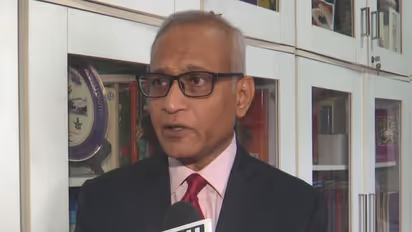
The upcoming Trump-Xi meeting will focus on critical minerals, semiconductors, and trade imbalances, says Prof. Srikanth Kondapalli, noting a US policy shift towards 'constructive strategic stability' to reduce competition with Beijing.
Shift Towards 'Constructive Strategic Stability'
Speaking to ANI, Kondapalli said the meeting came amid a shift in US-China policy, with the Trump administration seeking “constructive strategic stability” in ties with Beijing. “So, number one, in the previous period, they considered China as a strategic competitor. But the Trump administration initiated a policy of 'constructive strategic stability'--basically, which means that they want to reduce competition; they want to also have stability in bilateral relations,” he said.
Kondapalli said this approach was partly linked to the Trump administration's focus on the Russia-Ukraine conflict, Gaza and Iran. “From a Chinese perspective as well, the Chinese are focusing on their 'China Rejuvenation' concept by 2049, and they also have the 'Community of Shared Destiny' which they want to expand further with other countries,” he said.
He said the two sides decided during their May meeting to pursue “constructive, cooperative, strategic stability”, which essentially meant a predictable relationship with greater scope for cooperation.
Economic and Trade Agenda
Critical Minerals and Semiconductors
On the areas of cooperation, Kondapalli said critical minerals would be a key issue, particularly ensuring uninterrupted supplies. “Number one is on critical minerals supplies--uninterrupted supplies--because the globe is dependent on 90 per cent of critical minerals that China had acquired over a long period of time,” he said.
He said semiconductors would be another major area of discussion, with the possibility of some relaxation in restrictions imposed during the Biden administration. “The second is that the Americans would relax the semiconductor ban which was imposed during the Biden administration,” Kondapalli said.
AI, Trade Imbalances, and Investment
He also identified artificial intelligence as another major issue, along with trade imbalances and investments. “There is a lot of trade imbalance. So there is a suggestion that China should invest in the United States, import more from the United States, and also conduct other business activities--so that, for example, buying soybeans from the United States,” he said.
Kondapalli said the discussions were likely to focus heavily on critical minerals, semiconductor-related chips, trade deficits and Chinese investment in the US. “Because the Trump administration feels that the USD 8.9 trillion trade deficit between the two countries in favour of China is not a viable option; the Chinese need to import from the United States and also export capital to the United States,” he said.
Geopolitical Flashpoints
He also flagged the ongoing conflict in West Asia as a potentially contentious issue, saying the Trump administration would want China not to supply equipment and intelligence-related support to Iran. “So the suggestion is that China should be a part of the solution for the Iran conflict rather than increasing the conflict,” he said.
Kondapalli said a five-point proposal initiated by Pakistan and China was being repackaged as part of a possible solution to the West Asian conflict and could also come up during the Trump-Xi meeting. “While the Biden administration asked China not to support the Russia-Ukraine conflict-related matters, we see now Trump shifting to the Iran conflict, and it is likely to be a major sticking point as well as a major discussion between the two,” he said.
Broader Regional and Global Concerns
Beyond bilateral issues, he said regional stability, energy security, North Korea, Taiwan, the South China Sea and space-related matters could also figure in the discussions. “Broadly, it is also about the 'G2' that Trump had announced between China and the United States,” he said.
Kondapalli said energy security would also be important given China's dependence on imported energy resources and the potential impact of US sanctions related to Russian oil imports. “So energy security will also be discussed during the meeting between Trump and Xi Jinping,” he said.
“There are many other issues, especially space-related, especially the Taiwan Straits, the South China Sea, and others. But mostly, they would start with bilateral [issues] in terms of the agreements signed last October in Busan and also some consensus they reached during the May meeting between the two leaders,” Kondapalli added. (ANI)
(Except for the headline, this story has not been edited by Asianetnews Editorial staff and is published from a syndicated feed.)