After OPEC: The UAE Exit and Washington’s Quiet Rewriting of the Oil Order
Synopsis
UAE’s exit from OPEC could reshape global oil power and weaken cartel control. Is this the start of OPEC’s decline and a long-term US strategy? Here’s what it means for prices, geopolitics, and India’s energy security.
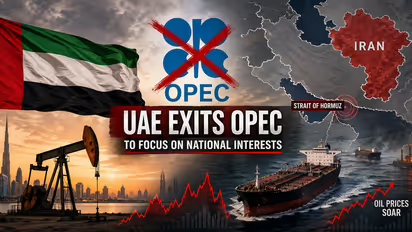
In energy geopolitics, the most significant changes rarely broadcast themselves as paradigm shifts. They usually appear disguised as technical disagreements over quotas, compliance, or market share. The United Arab Emirates’ decision to leave OPEC would be classified as such a moment. On quieter refection, these apparent production ceilings reveal themselves to be something else. Such changes are indicative of the gradual undoing of collective power of the OPEC and the culmination of a long U.S. effort to safeguard that oil and its trade can never be weaponised against the US and most of the western world as it was in 1973.
Why 1973 Still Shapes Oil Politics
It is important to understand the 1973 oil shock as a foundational moment of global energy statecraft. The 1973 oil crisis was not simply an economic interruption; it was a geopolitical reckoning. Arab producers, acting in consensus, established that control over supply especially through chokepoints like the Strait of Hormuz could transform into global leverage. The surge in prices and consequent inflationary pressures led to Western economies faltering due to foreign pressure, and they were not used to such dictates. As a result, Washington learned a lesson more enduring than the economic damage; it was that they the US never wanted to be held hostage or respond to pressures in such a manner. The U.S. reaction over the following decades was developing strategic reserves, promoting the International Energy Agency, and ultimately unleashing shale production which was devised to dilute that vulnerability. However, a reality that persisted was the untarnished cohesiveness of the OPEC and the leverage they held in global markets.
UAE’s Economic Logic Behind the Exit
The UAE’s formal justification behind leaving the OPEC is quite straightforward. OPEC’s quota system restricted its ambitions, and with billions invested in developing capacity, Abu Dhabi seeks the independence to produce and monetise at will. The logic is economically sound, particularly in a world where the energy transition is rapidly taking place and the opportunities for maximising hydrocarbon revenues are limited. Yet, it is hard to ignore the time at which this decision has been taken. The decision comes at a time when tensions instability in the region is at its peak and tensions involving Iran refuse to die. The volatility of the global energy markets can’t be ignored as UAE decides to pull out of OPEC. With this background, it seems that UAE has taken a step in its national interest, however the US’ influence behind it should not be ignored.
Is the US Behind OPEC’s Fragmentation?
This withdrawal is indicative of the UAE – US alignment. Washington has constantly opposed OPECs behaviour that controls oil supply and inflates prices. A major producer like the UAE moving away from OPEC achieves specifically what U.S. policy has sought for decades; greater supply flexibility and weakened coordinated control. With this backdrop it is easy to see that for the US, the erosion of OPEC starts with fragmentation and not direct confrontation.
OPEC’s strength comes majorly not only from owning a majority of the world’s most highly demanded resource but also the unity among its members to use the supply of crude oil as leverage. The UAE’s exit upsets this equilibrium. It is tempting to draw a parallel between UAE’s exit from OPEC to that of the famed BREXIT from the EU. Both worked on the same assumption; a domino effect of one member leaving, forcing the others to leave. While it did not happen in the case of EU, one will have to wait and watch for OPEC. It would not be incorrect to state that the stakes for OPEC countries are higher when it comes to fiscal gain and the pressure from the US was decidedly absent in the case of EU. UAE leaving the OPEC has introduced a precedent in a previously highly unified organisation. Even if other members do not follow immediately, the signal is unmistakable. OPEC risks losing the control it has over world politics that comes from its fundamentally collective nature of it transforms into a looser consultative forum, still relevant but no longer decisive. For Washington, this signifies strategic success achieved not through demolishing the institution, but by rendering it less unified and less adept of acting in unison.
The Strait of Hormuz Factor
At the centre of this revolution lies a persistent American objective of counterbalancing chokepoint risk. The Strait of Hormuz continues to be one of the most critical arteries of global energy flows, and its vulnerability has shaped decades of strategic thinking. The U.S. response has been multi-faceted, merging domestic production expansion with efforts to expand global supply and reduce dependence on any single route or bloc.
This shift is an evolution from collective power to energy nationalism. The competitive environment that is predicted after UAE’s departure would provide grounds for all member countries to put their national interests before the interests of OPEC. This could possibly lead to a competition among oil producing nations. This competition stands to intensify as newer energy markets are opening up and a transition when it comes to the choice of energy resources is also on the horizon.
India’s Opportunity — and Risk
For countries like India, this progressing landscape presents both opportunity and risk. A more competitive supply conditions could apply downward pressure on prices, offering relief to a major importers. It also increases diplomatic flexibility, allowing India to deepen bilateral energy ties and diversify sourcing strategies. The predicament however is, that the erosion of coordinated supply management establishes greater uncertainty. Markets will potentially become more sensitive to geopolitical shocks, and vulnerabilities. India’s long-standing emphasis on diversification and strategic autonomy thus becomes even more critical in navigating this emerging order.
The UAE’s exit from OPEC is not an isolated rupture. It is part of a longer historical arc that began in 1973, when oil was first deployed as a geopolitical weapon against the West. If 1973 revealed vulnerability, 2026 may point towards its strategic correction. OPEC might endure, but its era as a united force in global energy politics maybe at risk. In its place emerges a more fragmented and competitive order, one in which oil continues to matter, but collective leverage might be at risk.
Disclaimer: The opinions expressed are solely those of the author and do not reflect the views or stance of the organization. The organization assumes no responsibility for the content shared.