Recovered From the Wreckage: Rare Titanic Relics Fetch Over Rs 12 Crore at Historic UK Auction
Synopsis
Over 100 items linked to Titanic were sold at an auction in the UK for over Rs 12.66 crore. A golden pocket watch belonging to passenger Mary Mangan fetched Rs 3.17 crore, while a diamond ring worn by survivor Lady Duff Gordon sold for Rs 1.9 crore.
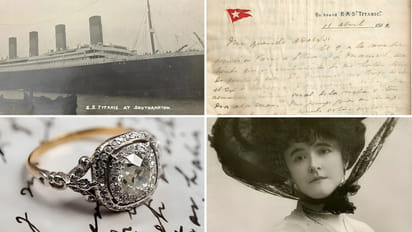
Rare items linked to the Titanic, the passenger ship that sank in 1912, have fetched record prices at a recent auction in the UK. More than 100 items connected to the ship and its passengers were sold, with the total sale value crossing £1 million (over ₹12.66 crore). The most expensive item was a golden pocket watch belonging to Mary Mangan, a third-class passenger. It sold for £250,000 (around ₹3.17 crore). A diamond ring worn by another passenger, Lady Duff Gordon, also attracted a high bid, according to a report by BBC.
The sale included personal belongings, letters, a postcard and travel documents that offer a glimpse into the lives of people who were aboard the Titanic during its final journey.
Mary Mangan's pocket watch sells for ₹3.17 crore
The golden watch belonged to 32-year-old Irish passenger Mary Mangan, who was travelling in third class. It was found on her body after the Titanic sank and was later returned to her family along with her other belongings.
Mangan had moved to the US but returned to Ireland in early 1912 to visit her family. Her watch was recently displayed at Titanic Belfast in Northern Ireland, along with other items from the Mangan family collection.
The watch also set a record as the most expensive item sold at auction from a third-class Titanic passenger.
Lady Duff Gordon's diamond ring fetches ₹1.9 crore
Another major item at the auction was a diamond ring worn by Lucy, Lady Duff Gordon. It sold for £150,000 (around ₹1.9 crore).
Lady Duff Gordon was a first-class passenger who survived the disaster. She escaped with her husband, Sir Cosmo Duff Gordon, in Lifeboat No. 1.
英国一场拍卖会上,一枚属于泰坦尼克号贵族幸存者达夫・戈登夫人的钻戒,最终以 15 万英镑成交。
同场拍卖中,一张当年在南安普顿码头观看巨轮启航的观光门票,也拍出 4 万英镑高价。这枚订婚钻戒伴随女主人在海难中幸存,而这张船票属于一名遇难二等舱乘客的母亲,她当时目送儿子登船。
两件承载悲剧记忆的遗物引来众多藏家竞价,泰坦尼克相关文物持续受到市场追捧,每一件藏品背后都连着一段百年往事。
#英国新闻
— Reven|China Through the Dynasties (@yi_jing94918) November 23, 2026
The ring was believed to be her engagement ring. Her family kept it for generations, and it was known as the 'Titanic Ring'. It was the only significant piece of jewellery she owned that survived the sinking.
The ring was sold through one of her descendants. Its final price was almost double its expected value of £80,000.
Letter recovered from passenger's body sells for ₹1 crore
A handwritten letter by first-class passenger Ramon Artagaveytia Gomez sold for £80,000 (around ₹1.01 crore).
The water-stained letter was recovered from Gomez's body after the disaster. Written in Spanish on official Titanic letter-headed paper, it gives details about the ship.
It describes things such as the ship's paint colours, temperature and the number of people dining on board. The letter is also rare because it was written in Spanish rather than English.
Jack Phillips' postcard sells for ₹40 lakh
A postcard written by Jack Phillips, the Titanic's senior wireless operator, also attracted strong interest.
Phillips wrote the postcard to his sister, Elsie, on April 6, 1912, four days before the ship began its first journey. The Titanic was docked in Southampton at the time.
The postcard sold for nearly £32,000 (around ₹40.5 lakh).
Phillips became one of the key figures in the rescue effort. After the Titanic hit the iceberg, he stayed at his post and sent wireless distress messages to other ships, asking for help. He died in the disaster.
Other Titanic items sold at the auction
Several other items linked to the ship and its passengers also found buyers.
Insurance document: A Titanic-related insurance document sold for £27,000 (around ₹34.2 lakh).
Rare ticket: Another rare ticket linked to the ship fetched £45,500 (around ₹57.6 lakh).
Departure viewing ticket: A special ticket that allowed a passenger's mother to watch the Titanic leave Southampton sold for £40,000. It belonged to Eliza Dibden, whose 18-year-old son William died in the disaster.
Auctioneer says Titanic's story still interests people worldwide
The auction was held by Henry Aldridge and Son Ltd in Devizes, Wiltshire, UK. Auctioneer Andrew Aldridge said the total sale value was more than £1 million, with Titanic-related items making up a large part of the amount.
He said the auction showed that people around the world continue to take an interest in the Titanic's story.
Aldridge also said that selling these personal belongings helps keep the memories of the people who travelled on the ship alive.
The Titanic began its first journey from Southampton on April 10, 1912. It hit an iceberg in the North Atlantic on the night of April 14 and sank in the early hours of April 15. Around 1,500 people lost their lives.
The ship's tragic story continues to attract interest more than 114 years later. Its personal belongings remain important reminders of the people who were on board.