Ink Still Wet: How China's Seventeen-Point Agreement Changed Tibet After The 1950 PLA Entry
Synopsis
China has long described the 1951 Seventeen-Point Agreement as a peaceful agreement that brought Tibet into the People’s Republic of China while protecting Tibetan autonomy and religion. Critics argue the agreement came after PLA had already entered Tibet by force in 1950. They say political control and restrictions on monasteries quickly followed.
New Delhi: Communist China has long presented the 1951 Seventeen-Point Agreement as proof that Tibet's annexation was peaceful. Beijing’s official account holds that the agreement guaranteed Tibetan political autonomy, religious freedom, and a gradual, measured transition into the People’s Republic. The story China tells is one of liberation, not occupation.
The history of what actually happened tells a very different story.
Even before the agreement’s provisions could take root, the CCP and the PLA were already reshaping Tibetan society – through military pressure, political manipulation, and the slow dismantling of institutions that had defined Tibetan life for centuries. The promises were made. The violations followed almost immediately. The bad faith started before the ink was even dry.
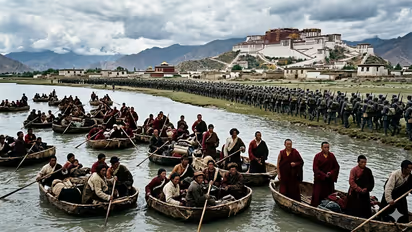
To understand why, you have to look at the sequence of events that produced the agreement in the first place. The PLA had already conquered eastern Tibet by force in October 1950, months before anything was signed in Beijing in May 1951. The agreement did not come before the occupation. It came after and gave it a diplomatic face. When a PLA vanguard of around 3,000 troops marched into Lhasa in September 1951, they were entering a capital whose government had been coerced into signing under threat of further military force, with no real structures of shared governance anywhere in sight.
Instead of building institutions that gave Tibetan leaders a meaningful role, the PLA set about cementing its own dominance. Tibetan officials and military personnel were steadily pushed into ceremonial positions. The real decisions – the ones that mattered – were made by Chinese military commanders and Communist Party cadres. Tibetan leaders were consulted in name. In practice, they were sidelined.
A genuine transfer of authority conducted in good faith would have looked completely different. It would have meant negotiation between equals, with legal and administrative arrangements settled before any large military presence arrived.
In Tibet, the army came first. Political accommodation was supposed to follow. It never came.
From the very beginning, Tibetans had almost no leverage in their own affairs. What happened next made the hollowness of the agreement impossible to ignore.
In the Tibetan areas of Kham and Amdo, land reform and collectivisation campaigns were underway by late 1955 and 1956. Traditional landholding systems – the economic and social fabric of those communities – were dismantled. Monasteries lost their economic standing. Ordinary people faced escalating political pressure with no recourse and no protection.
These were not development programmes. They were ideological campaigns, enforced by a military power that had no intention of waiting for Tibetan consent. This was precisely what the agreement had promised would not happen.
Seventeen-Point Agreement gave an explicit assurance
Tibet's existing political and social systems would remain in place unless Tibetans themselves chose to change them. That assurance was broken within a few years.
People resisted. Armed uprisings broke out across Kham and Amdo from 1956, as communities fought back against the destruction of their way of life. The 1959 Lhasa uprising was not a sudden explosion. It was the result of years of broken promises, mounting grievances, and a people who had been told they were partners slowly realising they were subjects.
Religious and cultural life came under pressure too and earlier than Beijing has ever acknowledged. Monasteries, which sat at the centre of Tibetan spiritual and communal life, were placed under political surveillance not long after the troops settled in.
Senior monks were leaned on to demonstrate loyalty to the CCP. Religious authority was recast as feudal backwardness, an obstacle to the socialist future being built around and over Tibetan society. Culture was not protected. It was slowly subordinated.
None of this was accidental. The CCP never treated the Seventeen-Point Agreement as a genuine commitment. It was a tool, a way to dress up in diplomatic language a control that had already been seized by force.
The occupation came first. The paperwork followed. And the promises written into that paperwork were abandoned almost as soon as they were made.
The Seventeen-Point Agreement was not a negotiated peace. It was a cover for a conquest that had already happened and a society already being taken apart, piece by piece.