Silence at Any Cost: What a Tiananmen Protest Reveals About Beijing’s Power
Synopsis
A Tiananmen self-immolation exposes how Beijing suppresses dissent: rapid containment, media framing as mental illness, physical erasure, and digital censorship. The goal is not control of protest, but prevention of memory, meaning, and spread.
New Delhi: A lone act, Liu Chunling of the Falun Gong, self-immolated himself in Tiananmen Square, but it was extinguished before it could become a movement. It did not disrupt public order for long. It disrupted something far more sensitive. The incident introduced unpredictability into a space designed to absorb none.
Beijing’s response was immediate and familiar, not because the act was unprecedented, but because the method of suppression was already rehearsed.
The objective was not merely to stop a protester. It was to prevent meaning from forming. In the Chinese governance model, dissent is not dangerous because it challenges authority. It is dangerous because it spreads. What matters is not the scale of the act, but its potential to become referential. A single body in flames is not a threat. A remembered flame is. This is why the response focused less on investigation and more on containment, less on explanation and more on disappearance.
The state acted not as a government confronted by protest, but as a system closing a breach. The human cost was secondary. The primary goal was speed. Suppression before narrative. Control before comprehension.
Within hours, the state media moved to classify the incident as a matter of personal pathology. Political intent was instantly ruled out. The language was clinical and dismissive, framing the act as a mental illness instead of an expression. This framing was not incidental--it is a recurring tactic in the management of dissent. By medicalising protest, the state removes it from the realm of grievance and relocates it into individual malfunction.
The implication is subtle but effective. There is nothing to debate if there is nothing to address. State outlets did not ask why the act occurred. They asserted that it was not worthy of inquiry. This approach mirrors earlier responses to disruptive acts, where psychological instability becomes a convenient terminus for public discussion. The blackout that followed was total. No sustained coverage. No follow-up reporting. No contextualisation. The absence itself became the message. Silence was not the failure of communication. It was the strategy. When the state speaks only once and then withdraws, it signals finality. The event is closed not by resolution, but by classification.
Physical control followed informational suppression with equal precision. Security forces moved in numbers that far exceeded the practical requirement of crowd management. Over five hundred riot police were deployed to seal the square, clear witnesses, and remove all visible traces. High-pressure hoses washed away debris, markings, and blood, collapsing the physical timeline of the event. What remained was a sanitised space indistinguishable from the hours before. This is not crowd control in the conventional sense. It is scene erasure. The goal is to deny continuity. A protest that leaves no residue cannot be revisited. A space that bears no marks cannot accumulate meaning. The choreography of the response was as important as its scale. Rapid sealing, visual cleansing, and dispersal ensured that no secondary gathering could occur. The square returned to normal operation before shock could crystallise into solidarity. The act was isolated not only in time, but in memory. Suppression here was not violent spectacle. It was administrative efficiency.
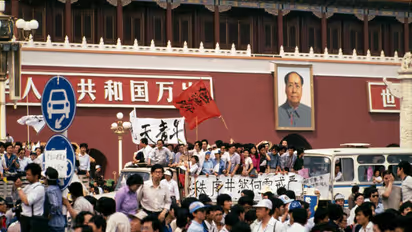
This method draws directly from precedent. Tiananmen Square has long functioned as both a symbol and a warning. In 1989, peaceful assembly was met with overwhelming force because the leadership concluded that delay itself was dangerous. Tanks were not deployed because the protest was violent. They were deployed because it persisted. The lesson internalised since then is clear. Dissent must be addressed before it becomes collective. The contemporary response reflects this inheritance. While the tools have changed, the logic remains intact. The state no longer relies on visible mass violence. It relies on speed, denial, and fragmentation. The memory of 1989 is not suppressed because it is irrelevant. It is suppressed because it remains instructive. Every modern response to dissent carries its imprint. The objective is to ensure that no moment achieves the symbolic density that Tiananmen once did. The square is not merely a location. It is a threshold the state will not allow to be crossed again.
Digital control completed what physical force began. Online censorship intensified sharply in the hours following the incident. Keywords disappeared. Search results collapsed. Video fragments were removed across platforms with unusual speed. Monitoring groups recorded a significant spike in content suppression in relation with the event, extending beyond domestic platforms to global social media accessed through virtual private networks. This escalation was not defensive. It was pre-emptive. The state did not wait to see whether the incident would trend. It acted as if virality was inevitable. By scrubbing references early, authorities prevented the formation of a shared digital record. Without repetition, there is no amplification. Without amplification, there is no movement. This is how dissent is neutralised in the contemporary Chinese information environment. Not by rebuttal, but by disappearance. Control is exercised not through persuasion, but through absence. The square was cleared. The feeds were cleaned. The event was reduced to a ghost that could not circulate.
What remains, then, is not a demand for outrage, but for scrutiny. The suppression tactics employed here are not novel. They are systematic, repeatable and refined. They merit examination not as isolated excesses--but as components of an established governance method. An international probe would not seek spectacle. It would seek a pattern. It would examine how classification replaces inquiry, how force replaces dialogue, and how erasure replaces accountability. Without such scrutiny, the method will persist, perfected through repetition. The act may be over. The system that extinguished it is not.