Taiwan no pushover, China invasion would be catastrophic: Expert
Synopsis
JNU expert Srikanth Kondapalli warns a Chinese invasion of Taiwan would be 'catastrophic' for Beijing. He also notes Trump's China visit was empty-handed, and a US-China G2 could be 'problematic for India'.
Taiwan 'No Pushover', China Warned of 'Catastrophic' Invasion
Highlighting Taipei's advanced defensive capabilities against aggressive state actors, Chinese Studies expert at Jawaharlal Nehru University, Professor Srikanth Kondapalli, has asserted that Taiwan is no pushover when compared to other major global flashpoints like Ukraine and warned that any military incursion by Beijing would result in catastrophic casualties for Chinese forces.
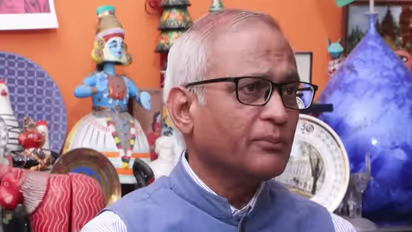
In an interview with ANI, Chinese Studies expert at Jawaharlal Nehru University, Professor Srikanth Kondapalli, broke down the long-term regional stability implications of US President Donald Trump's state visit to Beijing on May 13-15, emphasising that Taipei maintains high-tech operational military hardware capable of striking deep inside the mainland. He explicitly noted, "Taiwan is no pushover when you compare Taiwan and Ukraine."
Trump's Beijing Summit: 'Empty-Handed' Visit
Evaluating the outcome of the summit between President Trump and Chinese President Xi Jinping, Professor Kondapalli noted that a potential invasion would prove incredibly detrimental to China's global rise, as "a minimum one lakh Chinese soldiers will be killed if there is an invasion by China on Taiwan." He explained that with nearly USD 4 trillion of China's trade passing through the Taiwan Strait, any armed conflict would completely derail Beijing's long-term economic security.
While the summit generated massive international headlines, displaying substantial corporate and political camaraderie, Professor Kondapalli stated that the US leader effectively left empty-handed with no major breakthrough policy deliverables. "The visit by the United States President Donald Trump to Beijing on May 13-15, I think it is quite significant, but it appears that he left empty-handed," the JNU professor observed, pointing out that even though Trump carried a powerful business delegation of nearly 30 tech tycoons and CEOs, including Elon Musk, Tim Cook, and Jensen Huang, no major investment agreements were finalised. He added that the summit turned out to be a big disappointment for Nvidia chief Jensen Huang, as no announcements materialised regarding the sales of H200 AI chips to China. While noting that "the optics are substantial", featuring formal walks through the Rose Garden and grand banquets, Professor Kondapalli maintained that the structural economic impasse remains stark, reiterating that "there is nothing concrete out of the visit" and "there is no joint statement issued by the two sides."
US-China Talks on Middle East Tensions
Detailing the shifting security understandings emerging out of the high-stakes deliberations regarding Middle Eastern hostilities, Professor Kondapalli highlighted significant takeaways negotiated by the superpowers, stating that "the Chinese, according to Trump, have promised that they will not support Iran on the nuclear issue. And second is the militarisation of Straits of Hormuz, as Xi Jinping mentioned in his speech." He revealed that complex back-channel negotiations are currently taking place between global powers regarding enriched stockpiles, specifically focusing on "taking away the 440 kilogrammes of enriched uranium and storing this in safe havens in Russia or in China." This comes amid escalating anxieties over the Strait of Hormuz, where mounting hostile manoeuvres threaten not only international crude shipping but also critical "submarine cable links that are being threatened by Iran now, which has a lot of implications for data security."
Implications for India: A 'Potential Problem'
When asked about the far-reaching regional implications for New Delhi, especially concerning a potential US-China-Pakistan strategic nexus, Professor Kondapalli explicitly warned that a developing G2 arrangement would create "a potential problem between China-US and China-India", stating that "this is going to be problematic for India." He noted that while the overt coordination seen during historical friction points has not been formally declared this time, the structural risks remain identical to past crises, referencing previous regional deployments. "The same reiteration has not happened during Trump-Xi meetings, but the impact would almost be the same as we saw the coordination between US-Pakistan on Operation Sindoor and also China and Pakistan in Operation Sindoor-related matters," he observed.
Furthermore, Professor Kondapalli strongly dismissed suggestions that recent border management talks signal a total return to normal, stressing that a dangerous geopolitical undercurrent still persists. He drew attention to the diplomatic duplicity embedded in Beijing's language, pointing out that "it is interesting that Xi Jinping spoke about we are partners but not rivals when PM Modi visited Tianjin. The same words were repeated to Trump." "This phrase came up after we had Galwan and we lost 20 Indian soldiers," Professor Kondapalli cautioned, concluding that "there is a potential problem between China-US and China-India", meaning New Delhi needs to be "very cautious about this impact."