Strait of Hormuz 'militarily closed', says Iran despite Oman deal
Synopsis
Iran's Deputy FM says a temporary maritime route with Oman does not mean the Strait of Hormuz is reopening. He stressed that militarily, the strait is closed and will not open 'tomorrow', with only commercial vessels allowed on the new route.
Strait of Hormuz 'Militarily Closed'
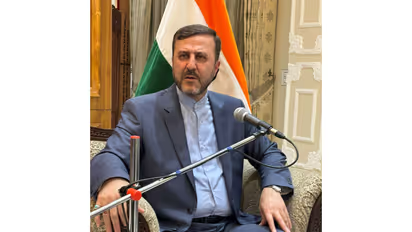
Iran's Deputy Foreign Minister for Legal and International Affairs Kazem Gharibabadi said the temporary maritime route agreed with Oman does not mean the reopening of the Strait of Hormuz, stressing that "militarily, the Strait of Hormuz is closed," as reported by ISNA.
Speaking in a television programme on Tuesday night, Gharibabadi said the understanding reached with Oman should not be interpreted as the reopening of the strait. "The understanding between Iran and Oman does not mean the opening of the Strait of Hormuz," he said.
On the timing of any reopening, Gharibabadi stated that "the Strait of Hormuz will not open tomorrow."
New Temporary Route Explained
Explaining the reasons behind the new route, he said, "For the past 58 years, ships have been passing through Omani waters, and Iran has suffered severe damage. The Strait of Hormuz is now a matter of Iran's national security, and fundamental changes must be made in the entry and exit routes."
Describing the route agreed with Oman, Gharibabadi said, "Based on this understanding, the entry route to the Persian Gulf will be through Iranian waters and the exit route through Omani territorial waters, and in both routes, ships will pass through Iranian waters. This route is like a round-trip highway with a total width of about 7 miles."
On the temporary nature of the arrangement, he said, "This route is temporary, and Iran and Oman must negotiate a new permanent route within 30 to 60 days to replace the previous maritime traffic plan."
Gharibabadi also reiterated Iran's military position on the strait, saying, "Militarily, the Strait of Hormuz is closed." On which vessels would be permitted to use the route, he said, "According to the memorandum of understanding, no military vessels will be allowed to pass through, and only commercial vessels will be allowed to pass through the Strait of Hormuz."
Armed Forces' Role in Negotiations
Addressing the possibility of future negotiations with the United States, Gharibabadi said, "The circumstances have changed, and if negotiations take place, they will not be like before."
Asked about the involvement of Iran's armed forces in negotiations with Oman over the shipping routes, Gharibabadi said the talks were being conducted through a joint working group. "The negotiations we are having are actually being held in the form of a joint working group in which the Ministry of Foreign Affairs, the Ports and Maritime Organization [PMO], the Islamic Revolutionary Guard Corps [IRGC], including the Navy and its deputy headquarters, as well as the General Staff of the Armed Forces are present," he said.
On the role of the armed forces in determining the routes, he said, "The main guidance regarding the routes actually lies with military friends and the armed forces complex, and the General Staff of the Armed Forces and the Islamic Revolutionary Guard Corps Navy are at the forefront of it."
Gharibabadi said the proposals discussed with Oman had originated from Iran's armed forces and had the backing of all relevant agencies. "The plans that we have discussed with Oman and have an understanding on are plans that have been presented by friends of the armed forces, and we all have a consensus on them. Therefore, these are negotiations in which all relevant agencies are present, and the discussions that have been held are supported and agreed upon by all parties," he said.
Emphasising the technical nature of decisions concerning maritime routes, Gharibabadi said the Ministry of Foreign Affairs was not responsible for determining the specific routes for ships. "The issues related to routes are technical issues. It is not within the competence of government agencies such as the Ministry of Foreign Affairs to determine where ships should go and where they should come from regarding routes; this issue is not really within our technical competence and naturally it is the duty of the armed forces to do their job in this regard, which they have done very well and with great care, and I must thank them," he said, according to ISNA.
US Responds with Warning
His remarks come as US President Donald Trump on Tuesday (local time) said that he had been informed by the US Navy that all mines had been removed or detonated from international waters in the Strait of Hormuz, while warning Iran that any attempt to lay new mines in the international waters would trigger an immediate US military response.
In a post on Truth Social, Trump said that Iran had been notified that any vessel involved in placing new mines in the strategic waterway would be "immediately and systematically destroyed."
Trump's latest statement comes amid escalating pressure on Iran, with his administration pursuing both economic and military measures against Tehran.
(Except for the headline, this story has not been edited by Asianet Newsable English staff and is published from a syndicated feed.)