Startling discovery: Strawberry-like underwater species with 20 arms found in Antarctic Ocean
Synopsis
Scientists uncover a new underwater species resembling a strawberry during Antarctic research expeditions, adding to the diversity of the Antarctic Ocean.
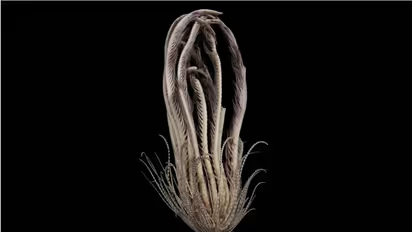
In a remarkable revelation, a team of scientists hailing from Australia and the United States have stumbled upon a "creepy-looking underwater species" during a series of research expeditions conducted near Antarctica. As reported by CTV News, this newfound species has been playfully dubbed the "Antarctic strawberry feather" due to its uncanny resemblance to the shape of a strawberry. Possessing approximately 20 arms, this creature exhibits a color spectrum spanning from "purplish" to "dark reddish."
The findings of this discovery have been documented in the journal Invertebrate Systematics. Over the course of several expeditions between 2008 and 2017, the researchers delved into the depths of the Antarctic Ocean in pursuit of a collection of enigmatic marine organisms identified as Promachocrinus species, or more commonly known as Antarctic feather stars. The researchers characterized these organisms as possessing movements that are almost "otherworldly" in nature.
The team meticulously collected samples from diverse regions across the globe, including the Siple Coast, Diego Ramirez, and Prince Edward Island. This exhaustive effort culminated in the identification of seven novel species collectively grouped under the designation of Promachocrinus, thereby elevating the tally of recognized Antarctic feather species from one to eight.
The species has been scientifically named 'Promachocrinus fragarius', with the term 'Fragarius' derived from the Latin word "fragum," signifying "strawberry."
These colossal creatures inhabit the depths of the ocean, thriving at varying depths ranging from approximately 65 to 1,170 meters. On initial observation, the Antarctic strawberry feather star evokes an alien-like impression. Upon closer examination of captured photographs, the distinct strawberry-like contours and texture of the aquatic entity become discernible.
The researchers highlight that the process of uncovering and identifying dark taxa, or previously undiscovered species, from the Antarctic ecosystem can be notably protracted due to inherent constraints related to the scale of essential sampling. They underscore the importance of distinguishing genuinely cryptic taxa requiring molecular data for identification, from those pseudocryptic entities that can be recognized once their attributes are reevaluated within a molecular framework. As biodiversity monitoring necessitates precise taxon identification, these distinctions hold paramount significance, especially when dealing with truly cryptic taxa.