South China Sea: China uses water cannons on PH vessels post-Quad meet
Synopsis
Days after a Quad meeting, Chinese Coast Guard ships used water cannons and risky manoeuvres against Philippine vessels near Bajo de Masinloc. The Philippine Coast Guard condemned the acts as 'illegal' but confirmed its mission to aid fishermen continues.
Days after the Quad Foreign Ministers reaffirmed their commitment to a free, open and rules-based Indo-Pacific during their meeting in Manila, tensions in the South China sea intensified after the Chinese Coast Guard deployed water cannons and undertook dangerous manoeuvres against Philippine vessels near Bajo de Masinloc (BDM).
China Coast Guard's Aggressive Actions
According to a statement posted on X by Philippine Coast Guard spokesperson for the West Philippine Sea, Rear Admiral Jay Tarriela, tensions escalated on Friday after the China Coast Guard (CCG) carried out multiple water cannon attacks and dangerous manoeuvres against Philippine Coast Guard (PCG) and Bureau of Fisheries and Aquatic Resources (BFAR) vessels conducting maritime operations near BDM.
The incidents occurred while the PCG and the BFAR were implementing the Kadiwa ng Bagong Bayaning Mangingisda (KBBM) programme, a government initiative aimed at delivering fuel subsidies and essential provisions to Filipino fishing boats and ensuring the safety of Filipino fisherfolk operating in their traditional fishing grounds.
Details of the Water Cannon Incidents
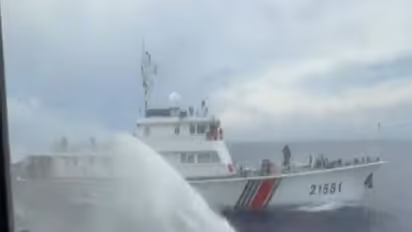
The PCG said that at around 6:26 am (local time), a CCG vessel fired a water cannon at BRP Cape San Agustin from a distance of about 400 metres while the Philippine vessel was conducting a maritime patrol approximately 15 nautical miles northeast of BDM. The vessel was reportedly being shadowed by at least six China Coast Guard ships and several Chinese maritime militia vessels, the spokesperson said.
The situation intensified at around 7:35 am (local time), when another CCG vessel directed water cannon fire at the BFAR vessel BRP Datu Paduhinog as it proceeded with a routine maritime control and surveillance mission. According to the PCG, the Chinese vessel closed to within seven metres of the Philippine ship's port bow, creating a serious risk of collision.
The Philippine Coast Guard further stated that the CCG vessel had switched off its Automatic Identification System (AIS), concealing its identity in violation of international maritime safety regulations.
The PCG said BRP Datu Paduhinog was struck directly by water cannon fire at around 7:53 am (local time), followed by two additional direct hits at approximately 8:00 am (local time). Shortly afterwards, the vessel temporarily lost satellite internet connectivity before communications were restored at 8:36 am (local time).
In another incident, at around 8:09 am (local time), a Chinese maritime militia vessel was observed dragging a rope roughly 100 metres behind BRP Datu Sumakwel, an action the PCG said endangered the safe navigation of the Philippine vessel.
At approximately 8:55 am (local time), another CCG vessel also fired its water cannon at BRP Datu Cabaylo from about 300 metres behind the vessel.
Philippines Condemns 'Illegal' Maneuvers
Despite what it described as "illegal, coercive, aggressive and deceptive" actions by Chinese vessels, the Philippine Coast Guard said all personnel remained safe and the mission continued in support of Filipino fishermen exercising what Manila says are their lawful rights in the area.
As of 9:30 am (local time), the PCG reported monitoring 26 vessels near Bajo de Masinloc, comprising three Philippine Coast Guard vessels, seven DA-BFAR vessels, 12 China Coast Guard vessels and three Chinese maritime militia vessels.
The Philippine Coast Guard strongly condemned the actions of the CCG, describing them as dangerous and unprofessional. It reiterated that Bajo de Masinloc forms an integral part of Philippine territory and that its surrounding waters lie within the country's territorial sea and exclusive economic zone.
"The PCG strongly condemns the dangerous and unprofessional actions of the China Coast Guard. Bajo de Masinloc is an integral part of the Philippine territory, and its surrounding waters form part of the country's territorial sea and exclusive economic zone. The 2016 Arbitral Award has affirmed that BDM is a traditional fishing ground of Filipino fisherfolk, whose rights cannot be lawfully impeded by any foreign power," the spokesperson said.
Reaffirming Manila's position, the PCG said it would continue protecting Filipino fisherfolk and upholding the country's sovereignty, sovereign rights and jurisdiction in the West Philippine Sea in accordance with international law, including the United Nations Convention on the Law of the Sea (UNCLOS), while avoiding unnecessary escalation of tensions.
Confrontation Follows Quad Meeting
The latest confrontation came just two days after the Quad FMM that took place in the Philippines' Manila on the sidelines of ASEAN-related ministerial engagements. The Philippines currently holds the ASEAN Chair for 2026.
The meeting was attended by External Affairs Minister S Jaishankar, Australian Foreign Minister Penny Wong, Japanese Foreign Minister Toshimitsu Motegi and US Secretary of State Marco Rubio, during which the groups reaffirmed Quad's commitment to strengthening a free and open Indo-Pacific and reiterated its "unwavering support" for ASEAN unity and centrality, as the four countries discussed regional challenges and cooperation priorities.
In a joint press release, the Quad ministers said, "As ASEAN Comprehensive Strategic Partners, we, the Secretary of State of the United States and the Foreign Ministers of Australia, India, and Japan, met today in Manila to reaffirm our commitment to strengthening a free and open Indo-Pacific and our unwavering support for ASEAN unity and centrality."
The ministers underlined their commitment to working closely with ASEAN and its member states, stating that they remain "deeply invested" in the region's success. The Quad leaders also discussed ways to strengthen support for the practical implementation of the ASEAN Outlook on the Indo-Pacific (AOIP) through cooperation in key areas, including maritime and transnational security, economic prosperity and security, critical and emerging technologies, and humanitarian assistance and emergency response. (ANI)
(Except for the headline, this story has not been edited by Asianet Newsable English staff and is published from a syndicated feed.)