PM Albanese Defends Quad Security Expansion Before Upcoming China Trip
Synopsis
Australian PM Albanese defends the Quad's expanding security and maritime surveillance role, emphasizing national interest and regional cooperation just before departing for critical bilateral talks with China in the wake of the Manila summit.
PM Albanese Defends Quad Security Expansion Before Upcoming China Trip
Manila [Philippines], November 17 (ANI): Australian Prime Minister Anthony Albanese declared on Tuesday that Australia works strictly "in Australia's national interest" as he defended the Quad’s expanding security footprint, including upcoming joint maritime surveillance exercises, just hours before departing for bilateral talks with China, according to the Prime Minister’s Office of Australia.
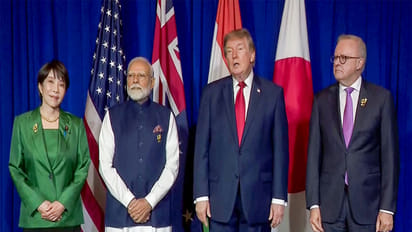
Speaking in Manila following the Quad Leaders’ Summit alongside US President Donald Trump, Japanese Prime Minister Takaichi Sanae, and Prime Minister Narendra Modi, Albanese emphasised that the four-nation grouping represents a combined GDP of nearly $35 trillion and almost one-fifth of global trade, acting as "more than the sum of our parts."
Addressing reporters regarding potential pushback from Beijing over the bloc's new military exercises, Albanese maintained a balanced stance on Australia's diplomatic ties. "We work in Australia's national interest. We do so in a transparent way. I've said that the relationship with China is strong. I look forward to visiting there tomorrow," Albanese said, adding that he defines Canberra's relationship with Beijing as one to "cooperate where we can, disagree where must, but engage in our national interests."
When pressed on how he would explain the necessity of Quad military exercises to Chinese President Xi Jinping, the Prime Minister noted that routine drills serve broader regional security and policing functions beyond defence. "People have, defence forces have military exercises, and that occurs. Australia regularly engages," Albanese said. "This is as well, these exercises are about maritime surveillance as well. One of the things that we can help with when it comes to surveillance, the issues aren't just about military issues. One of the big issues in this region is fishing and illegal fishing, and what occurs there... It's not about any one country. It's about our own sovereignty, but also about peace and security in the region."
During the doorstop, the PMO highlighted several major outcomes and expansions agreed upon at the Manila summit. Among them, Australia announced the extension of its Cable Connectivity and Resilience Centre to expand its current focus from data cables to include electricity cables, aiming to boost regional energy security and Southeast Asian connectivity. The Quad leaders also endorsed the first joint exercise under the Indo-Pacific Maritime Surveillance Collaboration, scheduled for early 2027, which will deploy respective Australian, US, Japanese, and Indian P-8 and P-3C maritime surveillance aircraft together to strengthen domain awareness.
Furthermore, the leaders committed to holding the inaugural Quad Business Leaders Forum in 2027 to drive private sector activity and agreed to enhance Quad Cybersecurity Cooperation to build resilient critical infrastructure and deter regional cyber attacks.
Addressing questions regarding global supply chains and critical minerals, particularly given China's dominance in mineral refining, Albanese pointed to Australia's strategic economic advantage. Noting that critical minerals and rare earths are vital for emerging technologies like trusted AI supply chains, he said, "Australia has a critical role to play, and that's why the agreement that I reached with President Trump on critical minerals was a major step forward. And since then, we're seeing that investment begin to flow into Australia." He added that the focus on resilience aligns with Canberra's budget theme of reform and resilience to protect against global economic shocks.
Albanese also confirmed that he raised the broader economic fallout of the conflict in Iran during the Quad discussions, emphasising its impact on inflation, oil prices, and regional stability. "My message was what I have said publicly on many occasions, which is that we are not protagonists in the war, but it is having an impact, and we want to see de-escalation because of the economic impact that it's having," he stated.
Earlier in the day, the Quad leaders on Tuesday announced five key outcomes at the 7th Quad Leaders’ Summit in Manila, focusing on economic cooperation, counterterrorism, maritime surveillance, cable connectivity and cybersecurity, while announcing that India will host the inaugural Quad Business Leaders’ Forum in Mumbai in 2027. The summit was attended by PM Modi, US President Donald Trump, Australian Prime Minister Anthony Albanese and Japanese Prime Minister Takaichi Sanae, who reaffirmed their commitment to a free, open, peaceful and prosperous Indo-Pacific.
According to the joint press release and the MEA post on X issued after the summit, the five outcomes include the Quad Business Leaders’ Forum, counterterrorism cooperation, Indo-Pacific Maritime Surveillance Collaboration, Quad Partnership for Cable Connectivity and Resilience, and enhanced Quad Cyber Cooperation. The Quad joint press release said the summit marked nearly a decade since the Quad was revived and the tenth anniversary of the vision of a Free and Open Indo-Pacific, first articulated by former Japanese Prime Minister Shinzo Abe in 2016.
The leaders said they strongly opposed destabilising or unilateral actions seeking to change the status quo, including through force or coercion, which could escalate tensions and undermine regional peace and stability. They also expressed grave concerns about economic coercion, including through arbitrary export restrictions, and committed to securing critical supply chains, protecting freedom of navigation and overflight, driving growth through emerging technologies, including trusted Artificial Intelligence (AI), and responding to disasters with life-saving assistance.
The leaders reaffirmed their unwavering support for ASEAN centrality and unity, reiterating their commitment to working with regional partners to address shared challenges and deliver tangible benefits across the Indo-Pacific. (ANI)