Steel Tracks, Strategic Chains: Why Pakistan’s Rail Projects Serve China and the Gulf More Than Itself
Synopsis
Pakistan’s railway “modernisation” masks a risky shift: debt-heavy transit corridors like ML-1 and Gwadar rail serve foreign supply chains, leaving Pakistan exposed, indebted, and sidelined from real growth.
New Delhi: Pakistan’s railways are being sold to the public as tools of regional integration and national revival. On the ground, they are taking the country in the opposite direction.
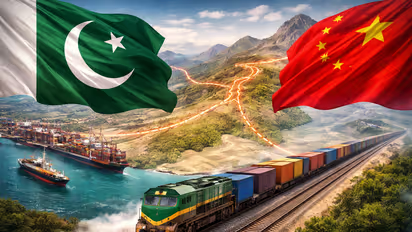
Projects like the ML-1 upgrade, proposed freight corridors, and the idea of linking Gwadar by rail to Gulf destinations such as Saudi Arabia are not about strengthening Pakistan’s economy. They are about turning Pakistan into a long, exposed transit strip for other people’s supply chains, while Pakistan pays the price.
ML-1: Modernisation or Transit First?
At the centre of this shift is ML-1, the Karachi–Peshawar line that forms the spine of the railway network. The upgrade is marketed as modernisation which includes faster trains, better signalling and improved efficiency. But the real priority is not Pakistani passengers or domestic industry. It is the movement of containers.
ML-1 is being shaped to push foreign cargo quickly from ports to borders and back again, with Pakistan reduced to little more than a passageway linking China, the Gulf and distant markets.
Gwadar: Port of Promise or Foreign Outpost?
Gwadar sits at the heart of this strategy and it is where the imbalance becomes most obvious. Gwadar is routinely described as Pakistan’s future economic engine. In reality, it functions more like a foreign logistics outpost on Pakistani soil.
The proposed Gwadar–KSA rail and logistics links are designed to serve external interests first. China gains a controlled route to warm waters. Gulf states gain an overland corridor that reduces reliance on vulnerable sea lanes. For them, the logic is clear and strategic.
For Pakistan, the gains are vague and largely theoretical. Beyond transit fees, there is little clarity on how lasting value is created. Manufacturing remains in China. Refining, storage and logistics hubs remain in the Gulf.
Gwadar itself has failed to generate the kind of local industry, employment, or urban development that was promised. The port moves slowly, the city struggles, and the surrounding region sees few tangible benefits. Yet Pakistan is expected to extend rail lines, secure vast stretches of territory and absorb the financial risks.
Who Really Benefits From These Rail Corridors?
Rail corridors do not create prosperity by default. They only work when they are tied to local production, processing, and domestic supply chains. In Pakistan’s case, those links are weak or missing. The country transports the goods, guards the tracks, and services the loans. Others capture the profits further up the value chain.
The financial burden is heavy. ML-1 alone runs into several billion dollars, financed through long-term borrowing by a state already under severe economic strain. Pakistan Railways is loss-making, outdated, and poorly integrated with domestic industry. Pouring debt into transit-oriented capacity does not solve these problems. It deepens them. Repayment does not depend on success or failure. It falls on the public regardless.
Supporters claim transit revenues will compensate for these costs. That argument is fragile. Transit margins are thin. They fluctuate with politics, security conditions and alternative routes. If traffic shifts elsewhere to another port, another corridor, another country, Pakistan is left with fixed costs and stranded infrastructure.
Jobs Myth vs Ground Reality
Jobs are another illusion. Construction brings temporary employment, but modern freight railways are highly automated. Without factories, warehouses, and processing plants owned and operated inside Pakistan, long-term skilled jobs remain scarce. The country becomes a low-value service provider, not an industrial hub.
Security Risks Pakistan Must Carry Alone
Security risks are rarely discussed honestly. A rail line built mainly to serve foreign strategic supply chains is not neutral infrastructure. It is a strategic asset and a potential target. In any regional crisis involving China, the Gulf, or wider power competition, these corridors become sensitive points. Securing them requires permanent deployments, surveillance, and emergency readiness. These costs are real, ongoing, and paid by Pakistan.
Worse, strategic entanglement pulls Pakistan into disputes that are not of its making. When infrastructure is designed around external interests, internal stability becomes hostage to external rivalries. What is sold as connectivity slowly turns into dependency.
There is also a quiet but serious opportunity cost. Money spent on Gwadar-centric transit dreams is money not spent on fixing Pakistan’s internal transport failures. Rural branch lines decay. Passenger services remain unreliable. Local manufacturers struggle with logistics while flagship corridors are polished for foreign cargo that barely touches the domestic economy.
A development-first railway policy would start at home. It would focus on farmers, factories, and local markets. It would demand that economic zones along rail lines produce real output, not just glossy brochures. It would share risks fairly instead of loading them onto a fragile state.
Pakistan does not need to reject trade or geography. Transit will always matter. But control matters more. When railways are built mainly to serve others, national development becomes an afterthought.
Corridor or Country: A Choice Still Unmade
The Gwadar–KSA rail vision and the ML-1 upgrade, as they stand, reflect this failure of priorities. They promise growth but deliver exposure. They speak the language of development while locking Pakistan into the role of a corridor, not a beneficiary.
Infrastructure is not just steel and concrete. It is power, risk and reward. Right now, Pakistan is being asked to provide the route while others run the business. That is not development. It is surrender by design.