Pak PM's 'direct response' threat to India amid severe domestic crises
Synopsis
Pakistan PM Shehbaz Sharif threatens India with a 'direct response' over water issues. This rhetoric is seen as a distraction from Pakistan's mounting internal crises, including militancy, unrest in Balochistan and PoJK, and political turmoil.
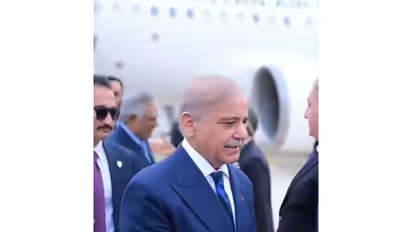
Pakistan has once again dipped into its familiar playbook of indulging in empty and hollow rhetoric against India, with Prime Minister Shehbaz Sharif threatening a "direct response" over water even as Islamabad grapples with a mounting share of crises at home -- from worsening militant violence in Khyber Pakhtunkhwa to unrest and human-rights abuses in Balochistan and Pakistan-occupied Jammu and Kashmir (PoJK), alongside the continued imprisonment of former Prime Minister Imran Khan. Yet, rather than confronting these failures, Sharif has once again chosen India as the target of his rhetoric.
Sharif, speaking at an event on the eve of Pakistan's Independence Day on Thursday, sought to portray India as an "enemy of peace" over New Delhi's decision to keep the Indus Waters Treaty in abeyance following the Pahalgam terror attack on April 22, which led to the death of 26 innocent individuals and ranting about the treaty as a national "red line". Following the April 22, 2025 terror attack in Jammu and Kashmir's Pahalgam, India kept the Indus Waters Treaty in abeyance after a Cabinet Committee on Security (CCS) meeting on April 23, 2025 and asserted that the conditions under which the treaty was negotiated have fundamentally changed. India has stated that the treaty can no longer function in its present form and will remain in abeyance until Pakistan "credibly and irrevocably" ends its support for cross-border terrorism.
"The Prime Minister said that India has proven itself an enemy of peace by unilaterally and illegally suspending the Indus Waters Treaty. He announced that every drop of Pakistan's water is our red line. There will be no compromise on the water issue. If India does not come to the right path, we will give it a direct response," the Pakistan Prime Minister's Office said in a statement on X. The irony is difficult to miss. A government presiding over deepening instability across multiple regions of the country is once again attempting to project toughness by threatening India, even as its own citizens continue to face violence, political repression and insecurity amid growing economic pressure and instability.
Unrest in Balochistan
Pakistan's carefully cultivated image of national unity is facing one of its sharpest challenges in Balochistan, where nationalist voices have called for August 14, Pakistan's Indepence Day to be observed as a "Black Day". Baloch leader and activist Mir Yar Baloch has urged Baloch people across the world to reject Pakistan's Independence Day celebrations, calling for black flags and armbands as a symbol of opposition to Islamabad's rule. His remarks came amid an alleged Pakistani military strikes in the Surab region that caused civilian casualties.
"The Pakistani military is attempting to celebrate 14 August under the shadow of guns, but it also knows that the people of Balochistan regard Pakistan as an occupying country and its military as the killers of the Baloch," he said in a post on X. Human rights activist Dr Mahrang Baloch, who is currently in confinement with Pakistani forces, has also slammed Islamabad for carrying out airstrikes in populated areas and causing civilian deaths. "Last night in Sorab, as a result of bombing by Pakistani warplanes, 27 people were killed and injured, including children," she said. She further argued that treating the deaths of civilians in populated areas as a routine military operation would amount to something far more serious.
According to Human Rights Defender and Baloch Activist Zara Baloch, more than 20 civilians, including innocent children, were killed in a strike by Pakistani forces. "Bombing civilian populations and taking the lives of innocent children is a blatant violation of international humanitarian laws. If the international community does not respond immediately, the humanitarian crisis in Balochistan will intensify further," she said in a post on X. The continuing reports have underlined the depth of distrust between Islamabad and large sections of Baloch society. For a country celebrating its independence, the spectacle of a region within its claimed territory calling the national day a "Black Day" exposes a profound crisis of legitimacy that threats against India cannot conceal.
Militancy in Khyber Pakhtunkhwa
While Sharif speaks of responding to India, Pakistan continues to struggle with violence from militant groups operating within its own borders. In Khyber Pakhtunkhwa, a suicide bombing near the Kabal Police Station in Swat killed 17 people, including seven policemen, while 27 others were injured, according to local authorities cited in reports. The attack occurred as people were protesting deteriorating law and order in the area. The episode serves as another reminder that Islamabad's claims of having brought militancy under control remain sharply at odds with the security reality faced by ordinary Pakistanis. Instead of explaining why its citizens continue to die in terrorist attacks, the Pakistani leadership repeatedly finds political mileage in escalating rhetoric against India.
Turmoil in PoJK
Pakistan's troubles do not end in Balochistan or Khyber Pakhtunkhwa. PoJK has witnessed prolonged protests, clashes, use of excessive force and serious questions surrounding the conduct of their "so-called" 2026 legislative elections. The Joint Awami Action Committee (JAAC) has led protests over political representation and other grievances, while allegations have emerged of manipulation, restrictions, internet shutdowns and the use of force against demonstrators. On Thursday, JAAC stated that in PoJK's Rawalakot, two people have been injured following firing by security forces in the region. In a post on X, JAAC said, "The use of force against civilians is deeply alarming. We call for an immediate end to violence and urge international human rights organisations and the media to closely monitor the situation on the ground."
India has called on the international community to hold Pakistan accountable for its human rights violations in the region. "We believe that the international community should hold Pakistan accountable for the deaths of so many people in the recent violence," MEA spokesperson Randhir Jaiswal said. He said public discontent had been met with "bullets and blackouts and repression and oppression" and stated that more than 90 people had been killed in recent months. Whatever Islamabad's preferred narrative may be, the persistence of unrest in PoJK demonstrates that Pakistan's governance problems are not confined to its western frontier.
Deepening Political Crisis
Pakistan's political crisis is equally stark. Former Prime Minister Imran Khan remains behind bars, while his sons, Sulaiman Khan and Kasim Khan, have raised concerns about their father's access to family, lawyers and doctors. "We have no updates because his family, doctors and lawyers haven't been allowed to see him for seven months," they told CNN earlier this month. Khan has remained imprisoned since 2023 following convictions in multiple cases. He and his supporters have repeatedly alleged that the cases against him are politically motivated and designed to prevent his political comeback. The continued imprisonment of Pakistan's most prominent opposition figure, coupled with the crackdown on his Pakistan Tehreek-e-Insaf (PTI) party, has further damaged Islamabad's claims to democratic credibility.
Sharif's latest warning over India's water is therefore less a demonstration of Pakistan's strength than another reminder of the country's tendency to look outward when confronted with uncomfortable realities at home. Islamabad wants to portray itself as a regional power capable of issuing warnings to India. But the picture inside Pakistan is far less reassuring: terrorist attacks continue, Balochistan remains deeply alienated, PoJK is witnessing political unrest, allegations of human rights abuses persist, and the country's principal opposition leader remains in prison. Against that backdrop, Sharif's declaration that "every drop" of water is a "red line" risks sounding like yet another piece of hollow sabre-rattling.
Pakistan's concerns over water might be genuine, but Islamabad's increasingly confrontational rhetoric cannot be viewed separately from the wider crisis confronting the country. From Balochistan and Khyber Pakhtunkhwa to PoJK, and from militant attacks to political repression, Pakistan faces a series of problems that cannot be resolved through rhetoric directed at New Delhi. For a government struggling with insecurity, political polarisation and allegations of rights violations at home, repeatedly turning to threats against India risks looking less like a coherent strategy and more like a familiar political distraction from Pakistan's deepening internal fault lines. (ANI)
(Except for the headline, this story has not been edited by Asianet Newsable English staff and is published from a syndicated feed.)