Susumu Kitagawa, Richard Robson and Omar M Yaghi Win Nobel Prize in Chemistry 2025 for MOF Innovation
Synopsis
Nobel Prize 2025 in Chemistry has been awarded to Kitagawa, Robson and Yaghi for developing metal-organic frameworks, porous crystalline structures that trap gases, purify water, and catalyze reactions.
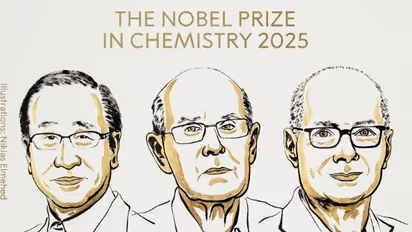
The 2025 Nobel Prize in Chemistry has been awarded jointly to Susumu Kitagawa (Kyoto University, Japan), Richard Robson (University of Melbourne, Australia), and Omar M. Yaghi (University of California, Berkeley, USA) for their pioneering development of metal-organic frameworks (MOFs), a revolutionary class of porous crystalline materials.
What are metal-organic frameworks (MOFs)?
MOFs are molecular structures made by linking metal ions with organic molecules to form highly porous frameworks. These nanoscopic 'rooms for chemistry' can trap, store, and manipulate gases and molecules, offering enormous potential in sustainability and industrial applications.
Origins and development of MOFs
In 1989, Richard Robson first experimented with assembling metal ions and organic molecules into spacious crystalline frameworks, laying the foundation for MOFs. In the 1990s, Susumu Kitagawa showed these structures could absorb and release gases, demonstrating their flexibility. Omar Yaghi later engineered stable MOFs with tunable properties, introducing rational design principles for practical applications.
Applications and significance
MOFs' high internal surface area allows gases such as carbon dioxide, methane, or water vapor to flow through their cavities. They can capture greenhouse gases, purify water, catalyze chemical reactions, and store hydrogen fuel. These materials are transforming materials science and offering sustainable solutions for energy and environmental challenges.
How MOFs could help solve global challenges
Following the discoveries made by the Nobel laureates, scientists have now created tens of thousands of unique metal-organic frameworks. Many of these materials could help address some of humanity’s most urgent problems. MOFs are being used to separate harmful PFAS chemicals from drinking water, break down pharmaceutical residues in the environment, capture carbon dioxide, and even harvest water from dry desert air. Their versatility makes them one of the most promising tools for a cleaner, more sustainable future.
Expert recognition
Heiner Linke, Chair of the Nobel Committee, stated, "Metal-organic frameworks have enormous potential, bringing previously unforeseen opportunities for custom-made materials with new functions." Tens of thousands of MOFs have been synthesized since, with applications ranging from carbon capture to desert water harvesting.
(With agency inputs)