New US-Iran MoU guarantees conflict, not peace: Expert Michael Rubin
Synopsis
Michael Rubin warns the new US-Iran MoU will guarantee conflict, arguing it empowers Iran without resolving security issues. He sharply criticises Trump's deal and the role of Pakistan as a mediator, calling it a betrayal of US interests.
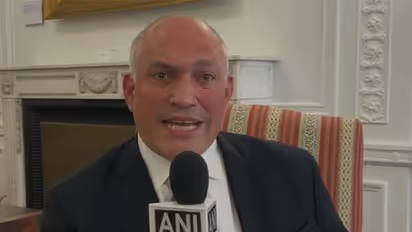
Director of Policy Analysis at the Middle East Forum (MEF), Michael Rubin, has warned that the newly announced US-Iran memorandum of understanding (MoU) could "guarantee another round of conflict" in West Asia, while questioning the credibility of Pakistan as a mediator in negotiations between Washington and Tehran.
Speaking to ANI, Rubin sharply criticised the framework of the agreement unveiled by US President Donald Trump, arguing that it risks empowering Iran without resolving the fundamental security concerns that have driven regional tensions for years. "Iran is buying time again. I never thought that Donald Trump could actually make Neville Chamberlain look like Winston Churchill. The fact of the matter is, what Donald Trump now presents is a deal which almost certainly guarantees another round of conflict in the Middle East," Rubin said.
His remarks come after senior US administration officials announced that President Trump and Vice President JD Vance had signed a memorandum of understanding with Iran, establishing a framework for future engagement. According to the officials, sanctions relief under the agreement will be linked to Tehran's cooperation on nuclear verification, commitments against supporting terrorism and regional destabilisation, and assurances that it is not pursuing a nuclear weapon.
Rubin, however, argued that the agreement does not adequately address concerns surrounding Iran's nuclear programme. "Legally, Iran is not entitled to a nuclear weapons program. It is still a signatory to the Nuclear Non-Proliferation Treaty, and its responsibilities under that agreement have never been waived," he said.
Criticism of Mediators
The MEF analyst also criticised the role played by Pakistan and Qatar in facilitating the diplomatic process. "US President Donald Trump has been blinded not only by Iran's ability to negotiate but also by his choice of mediators, Qatar and especially Pakistan," Rubin said.
Drawing a historical comparison, he added, "Relying on Pakistani mediation to solve the Iran problem would be the equivalent of Franklin Roosevelt during World War II relying on fascist Italy to solve the Nazi Germany problem. You never want to have a mediator who wants your side to lose."
Rubin further alleged that Pakistan had repeatedly acted against American interests. "Pakistan has repeatedly shown itself as unworthy of any sort of trust, and yet Donald Trump continues to turn back toward it. Pakistan betrayed the United States with regard to the Taliban. Pakistan betrayed the United States by hosting Osama bin Laden. Pakistan is betraying the United States again now," he said.
Regional and Economic Consequences
Commenting on Trump's statement that maritime traffic had resumed through the Strait of Hormuz following the announcement of the agreement, Rubin suggested that commercial shipping decisions would be driven by security concerns rather than political declarations. "When Donald Trump says that the Strait of Hormuz is open, 'let the oil flow,' he declared, Donald Trump doesn't have the power to make that declaration. The fact of the matter is, the owners of those ships will. As long as they fear that they face a grave risk, they're not going to listen to Donald Trump," he said.
Referring to India, Rubin said, "India is still going to have the same problems with regard to its energy that it had before Donald Trump's supposed peace." He also cautioned against viewing the agreement as the end of regional instability. "India's neutrality did pay off a bit during this war. But make no mistake, this isn't coming to an end," Rubin said.
According to Rubin, regional powers such as Israel, Saudi Arabia and the United Arab Emirates are unlikely to rely solely on the agreement for their security. "The Israelis, the Saudis, and the Emiratis all face an existential threat from Iran, and they're not going to gamble their existence on the fact that Donald Trump wants a Nobel Peace Prize," he said.
'An American Loss'
Rubin further warned that the United States could face the consequences if the agreement ultimately fails. "The United States is going to pay the price simply because the memorandum of understanding, which Donald Trump seems to have agreed to, sets the parameters of the negotiations in a way that almost guarantees an American loss," he said.
He also claimed that financial benefits flowing to Tehran could strengthen institutions such as the Islamic Revolutionary Guard Corps. "The fact of the matter is that, by giving the Iranians a minimum of USD 12 billion, we are going to fund their Islamic Revolutionary Guard Corps and their propaganda network for years to come," Rubin said.
His remarks come as the Trump administration maintains that the MoU is a performance-based framework, linking the economic sanctions with nuclear verification requirements and other commitments outlined in the agreement. A formal signing ceremony is expected to take place in Geneva later this week. (ANI)
(Except for the headline, this story has not been edited by Asianet Newsable English staff and is published from a syndicated feed.)