Nepal-India Gorkha Recruitment Dispute: Why Kathmandu Is Waiting for New Delhi to Make the First Move on Agnipath
Synopsis
Nepal has signalled its willingness to discuss the Gorkha recruitment deadlock with India but says New Delhi must initiate talks. The dispute stems from the Agnipath scheme, which prompted Kathmandu to suspend Gorkha recruitment in 2022.
New Delhi: Nepal’s Foreign Minister Shisir Khanal made a quiet but important statement during his recent trip to New Delhi that Kathmandu Nepal is ready to talk again about the Gorkha recruitment deadlock but only if India makes the first move.
Speaking to reporters here in New Delhi, Khanal said: “When the government of India feels it’s necessary, again like any other issue, we are happy to sit at the table and take up these issues as well.”
The statement was measured, but its meaning was clear: the ball was kept firmly in New Delhi’s court.
What Caused the Deadlock?
The dispute goes back to June 2022, when the Narendra Modi government implemented the Agnipath scheme, a new military recruitment model under which soldiers serve for just four years, after which 75% are discharged with a one-time cash payment and no pension. India applied this rule uniformly to everyone, including Gorkha soldiers from Nepal.
Nepal pushed back immediately and two months later, in August 2022, Kathmandu suspended all Gorkha recruitment into the Indian Army. Nepal’s argument rested on a foundational document: the 1947 Tripartite Agreement signed by India, Nepal, and the United Kingdom. That agreement guaranteed Nepalese Gorkhas service conditions broadly equal to those of regular Indian Army soldiers, including long-term service and full pension benefits.
According to Nepal, the Agnipath scheme violates that guarantee.
The Economic Stakes for Nepal
For many Nepali families, especially in the hill districts, a son in the Indian Army was not just a matter of national pride, it was a financial lifeline. Under the old system, Gorkha soldiers served at least 15 years and received a pension for life. That steady income supported entire communities across hilly regions like Gorkha, Lamjung, and Taplejung.
Remittances from Gorkha veterans have historically been a significant part of household income in Nepal’s rural belt. The World Bank has noted that remittances account for nearly 25–30% of Nepal’s GDP, and military pensions have long formed a stable pillar of that flow.
Nepal’s Security Concern: Trained Young Men with No Jobs
Beyond the economic argument, Nepal has raised a more uncomfortable concern: what happens when thousands of fully trained, weapons-familiar young men return home at 21 or 22, with no pension, no job guarantee, and limited civilian prospects?
Kathmandu has warned that such individuals could become easy targets for recruitment by private militias or mercenary networks. This concern is not hypothetical. Global research like International Crisis Group, 2021 on post-conflict disarmament has repeatedly shown that unemployed veterans with combat training are a high-risk group for radicalization. Nepal is understandably wary of creating that situation at home.
Impact on India’s Gorkha Regiments
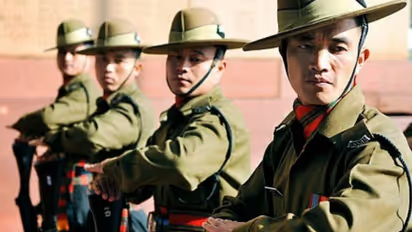
The standoff is not just Nepal’s problem. The Indian Army’s seven Gorkha Rifles regiments, the 1st, 3rd, 4th, 5th, 8th, 9th, and 10th, have received no fresh Nepalese recruits since 2022. These regiments, which field roughly 39 battalions with an estimated 32,000-40,000 soldiers in total, are among the most decorated units in the Indian Army’s history.
India’s Position: No Special Exceptions
New Delhi has not budged. The official stance is straightforward: Agnipath is a universal policy, applied equally to all recruits regardless of where they come from. India has not signalled any willingness to create a carve-out for Nepalese Gorkhas.
This position has left the two sides at an impasse for nearly three years. While India-Nepal relations remain generally warm on other fronts – trade, connectivity, cultural ties – the Gorkha issue has become a quiet but persistent irritant in what New Delhi often calls its “Neighbourhood First” policy.
The Road Ahead
For now, the Gorkha regiments remain short-staffed on the Nepalese side, villages in Nepal’s hills remain without the income that a generation of military service provided, and both governments appear content to let time pass. That may change but only if the two sides sit on table and decide to find solutions.